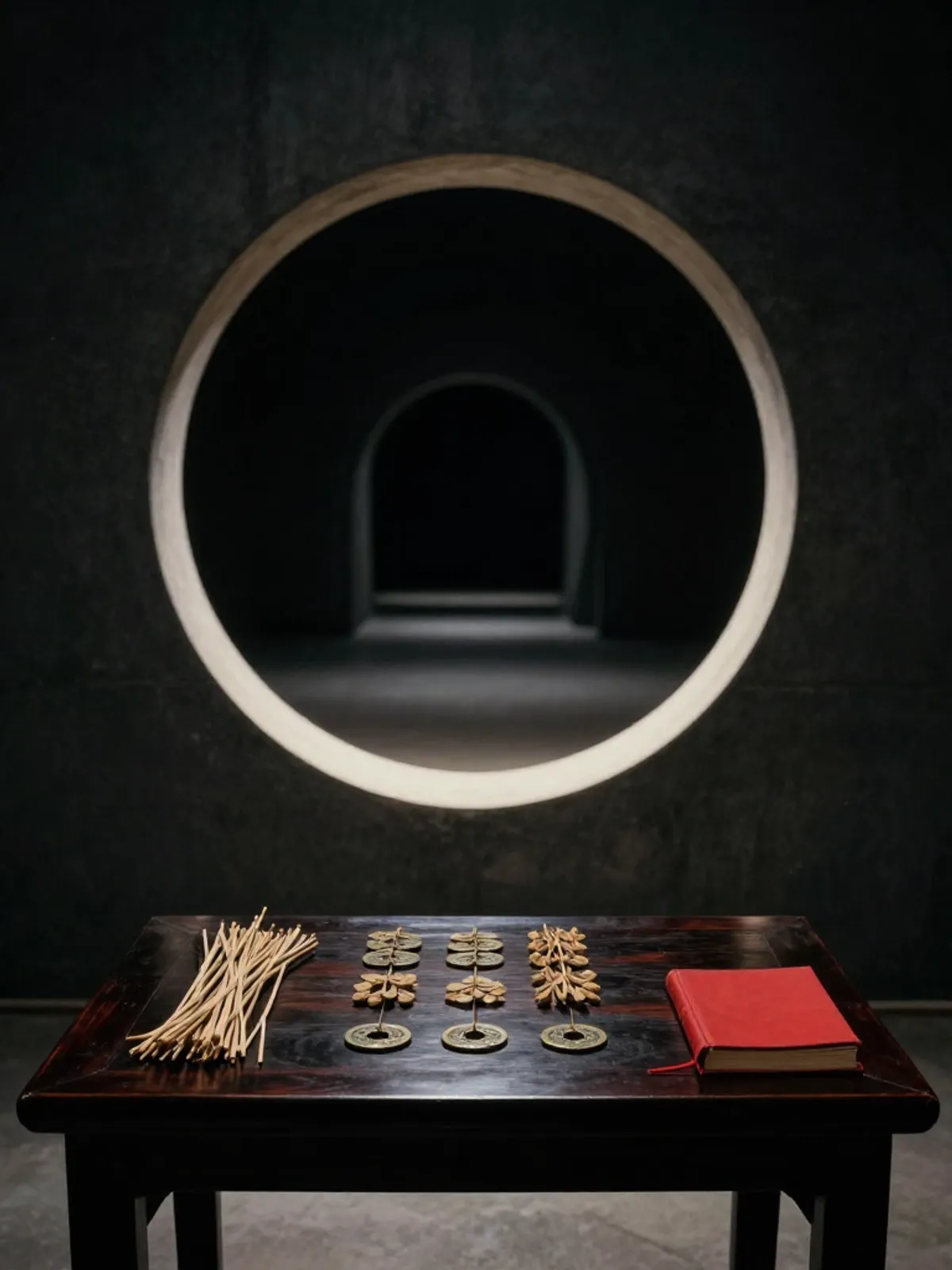
The Oldest Conversation
The I-Ching (易經) is not a fortune-telling manual. It is the oldest continuous conversation between humanity and the patterns of change.
Composed in layers over three thousand years - from the bone-oracle inscriptions of the Shang dynasty to the philosophical commentaries of the Warring States - the Book of Changes is less a book than a living system. It does not tell you what will happen. It shows you the shape of what is already happening.
To open the I-Ching is to enter a text that has never stopped being written. Every generation that consults it adds another layer of meaning, another ring of growth to an ancient trunk. Confucius reportedly said he wished for fifty more years of life so that he might study the Changes and avoid great faults. The Tang poet Bai Juyi kept a copy on his desk. Zhu Xi, the great Song dynasty philosopher, believed it held the key to the structure of reality itself. None of them thought they were reading a book of fortunes. They were reading the grammar of time.
A Text Built in Layers
Understanding the I-Ching requires understanding that it is not one text but many, composed across more than a millennium.
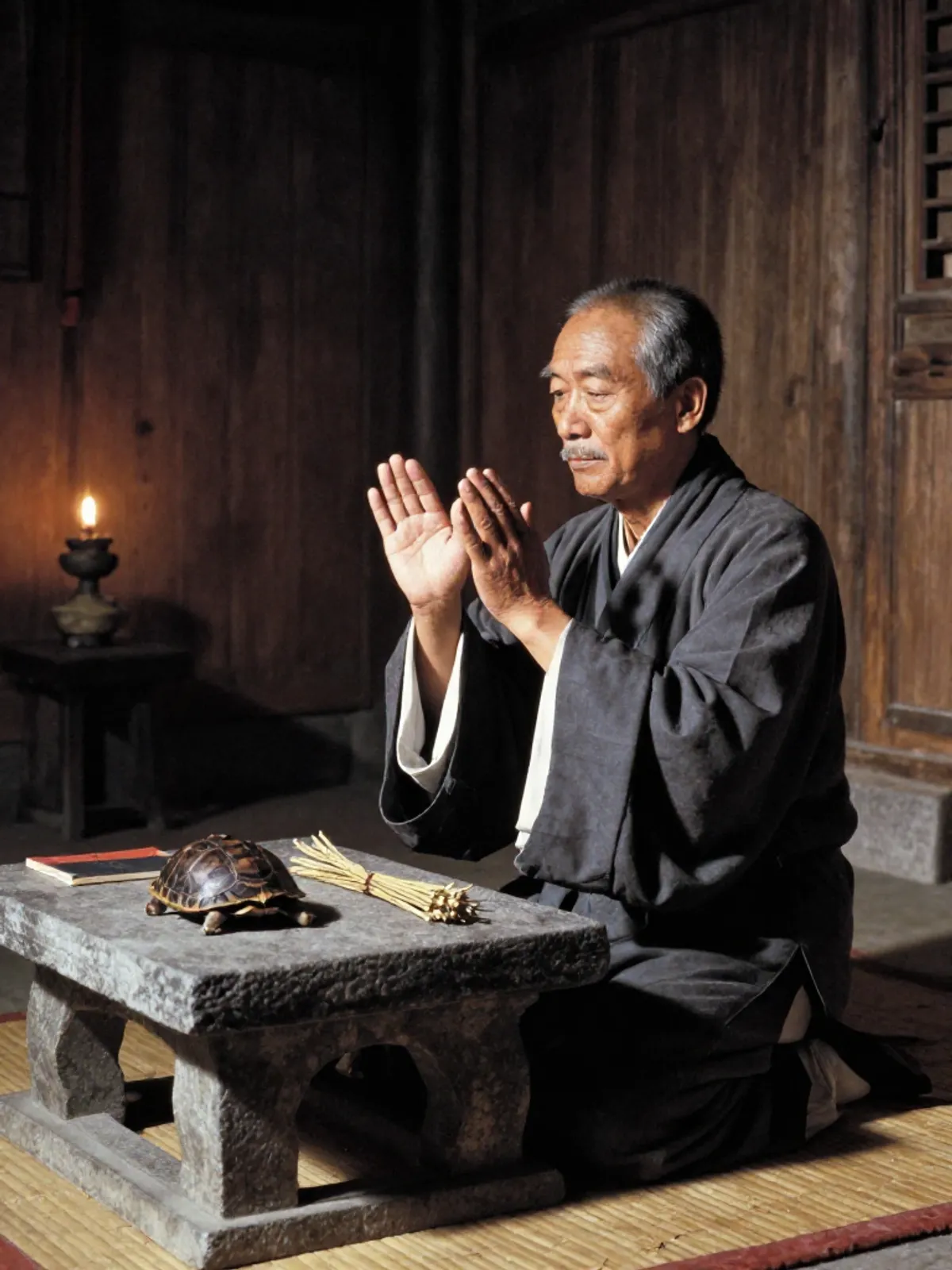
The earliest layer traces back to the Shang dynasty (c. 1600–1046 BCE), when diviners heated animal bones and turtle shells until they cracked, reading the patterns as messages from ancestral spirits. These oracle-bone inscriptions (jiaguwen, 甲骨文) represent the oldest known Chinese writing. They were not philosophy. They were operational questions posed to the dead: Should we attack? Will the harvest come? Is this illness dangerous?
When the Zhou dynasty (c. 1046–256 BCE) displaced the Shang, a new system emerged. The hexagram texts - the guaci (卦辭, hexagram judgments) and yaoci (爻辭, line statements) - are attributed to King Wen and the Duke of Zhou. These terse, often cryptic phrases replaced the cracked bones with a combinatorial system of six-line figures. The language shifted from direct command to image and metaphor: A dragon appears in the field. It is favorable to see a great person.
Centuries later, during the Warring States period (475–221 BCE) and into the early Han dynasty, a set of commentaries known as the Shiyi (十翼, Ten Wings) was appended to the core text. Traditionally attributed to Confucius himself - though modern scholarship considers this unlikely - these Wings include the Xici Zhuan (繫辭傳, Great Commentary), which transformed the I-Ching from an oracle into a cosmological treatise. It was the Xici that declared:
一陰一陽之謂道。
The alternation of yin and yang - this is called the Dao.
The final major layer arrived in the Song dynasty (960–1279 CE), when Neo-Confucian scholars like Zhu Xi (朱熹) and Shao Yong (邵雍) reinterpreted the I-Ching through the lens of li (理, principle) and number. Shao Yong's arrangement of the hexagrams into a binary-like sequence would later fascinate Leibniz in Europe. Zhu Xi's commentary became the standard examination text for centuries, shaping how millions of readers encountered the Changes.
Each layer speaks in a different register. The bone oracles are urgent and practical. The Zhou hexagram texts are poetic and compressed. The Ten Wings are philosophical and expansive. The Song readings are systematic and structural. To read the I-Ching well is to hear all these voices at once and to know which one is speaking.
The Eight Trigrams
Before the sixty-four hexagrams, there are the eight trigrams (bagua, 八卦) - the fundamental building blocks of the system. Each trigram consists of three lines, either broken or unbroken, and each embodies a primal image from nature.
The eight trigrams and their primary images:
- Qian (乾 ☰) - Heaven, the Creative. Three unbroken lines. Pure yang. Its energy is initiating, strong, unyielding.
- Kun (坤 ☷) - Earth, the Receptive. Three broken lines. Pure yin. Its energy is nurturing, yielding, vast.
- Zhen (震 ☳) - Thunder, the Arousing. Yang below two yin lines - movement erupting from stillness. The shock that awakens.
- Kan (坎 ☵) - Water, the Abysmal. Yang trapped between two yin lines - danger, depth, the hidden course. Water finds its way through the lowest places.
- Gen (艮 ☶) - Mountain, Keeping Still. Yang above two yin lines - stillness, meditation, the boundary that defines.
- Xun (巽 ☴) - Wind, the Gentle. Yin beneath two yang lines - penetration, gradual influence, the invisible force that bends trees.
- Li (離 ☲) - Fire, the Clinging. Yin between two yang lines - clarity, illumination, attachment. Fire depends on what it burns.
- Dui (兌 ☱) - Lake, the Joyous. Yin above two yang lines - openness, pleasure, exchange. The lake's surface reflects and communicates.
Every hexagram is a combination of two trigrams - one below (the inner, the foundation) and one above (the outer, the expression). To read a hexagram is to read the relationship between these two forces. Thunder over the mountain is different from mountain over thunder. Water over fire is different from fire over water. The interplay of inner and outer conditions is where meaning lives.
How the Oracle Speaks
The I-Ching works through 64 hexagrams (卦), each composed of six lines - broken (yin, ⚋) or unbroken (yang, ⚊). These are not random. They are maps of every possible configuration of change.
When you cast a reading - whether with yarrow stalks, coins, or the plum-blossom method (meihua, 梅花) - you are not predicting the future. You are asking: What is the quality of this moment? What pattern am I inside of?
The hexagram that arises is a mirror. It shows you what you already know but have not yet articulated.
But the I-Ching does not simply hand you a static picture. The system is dynamic. Certain lines in your hexagram may be changing lines (bianyao, 變爻) - lines that are in the process of transforming from yang to yin or yin to yang. A changing line is a line at its extreme, a condition so fully expressed that it is already becoming its opposite. When you have changing lines, your initial hexagram transforms into a second hexagram, and the reading becomes a narrative: this is where you are, and this is where the situation is moving.
The changing lines are where the most specific, personal guidance lives. The hexagram judgments speak to general conditions. The individual line texts - six per hexagram, 384 in total - speak to your particular position within that condition. Are you at the beginning of a process, still uncertain? The first line addresses that. Are you at the peak, fully committed? The fifth line speaks there. Each position in the hexagram corresponds to a stage of development, a quality of engagement.

The Yarrow Stalks and the Coins
There are two primary methods for generating a hexagram, and the difference between them is not merely procedural. It is philosophical.
The yarrow stalk method (shicao, 蓍草) is the ancient one. You begin with fifty stalks, set one aside, then divide, count, and sort the remaining forty-nine through a series of three manipulations per line. The entire process for a single hexagram takes fifteen to twenty minutes of focused, meditative attention. The probabilities are unequal: yang and yin lines arise in specific ratios, and changing lines are relatively rare.
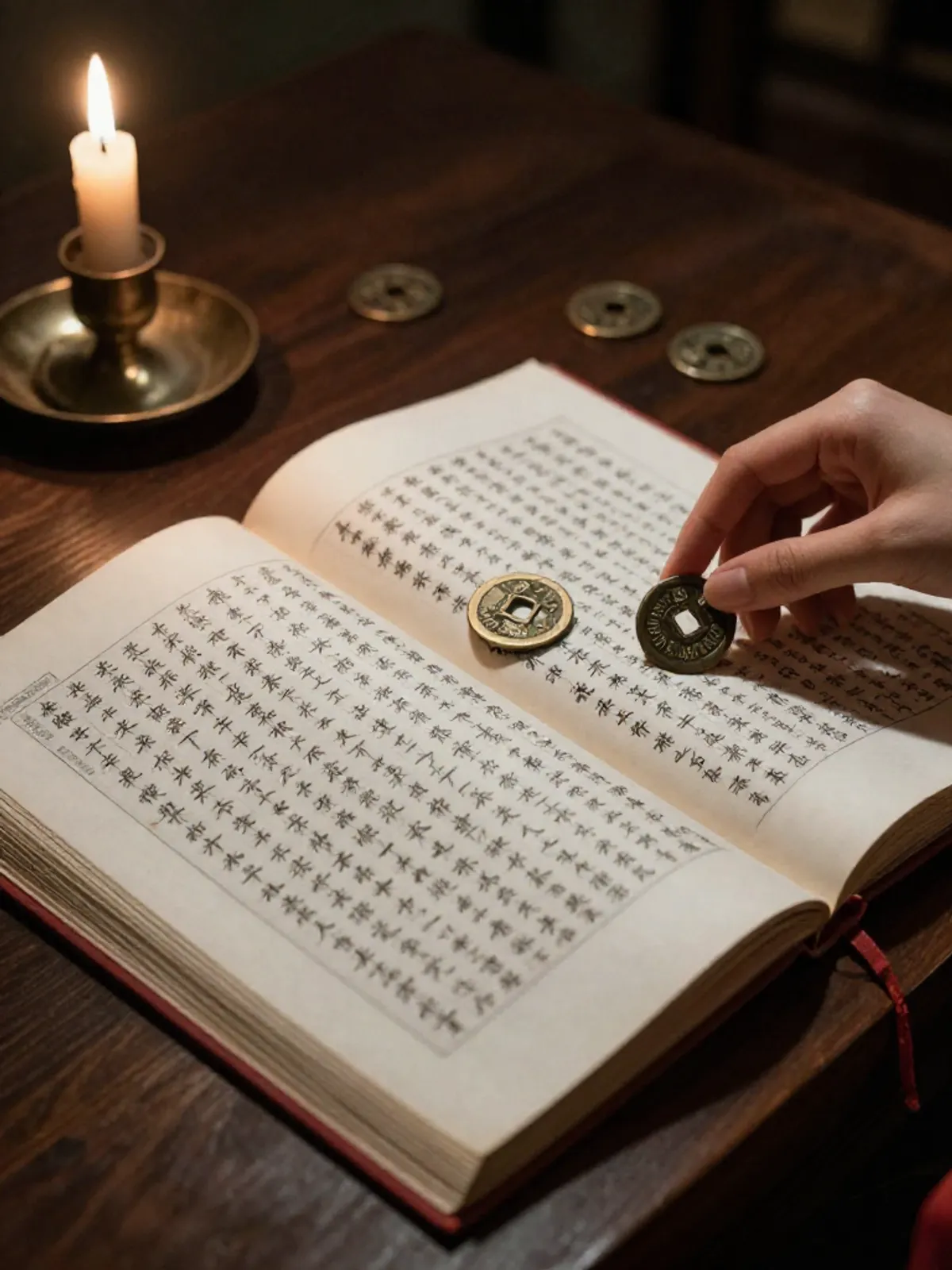
The three-coin method is a Song dynasty simplification. You toss three coins six times, assigning numerical values to heads and tails. It is fast - a full hexagram in under a minute. But the probability distribution differs significantly from the yarrow stalk method. Changing lines arise much more frequently with coins, and the ratio between yin and yang is altered.
Does it matter? Traditionalists argue that the yarrow stalk method's slower pace is the point - the extended manipulation stills the mind, builds concentration, and allows the question to deepen. The uneven probabilities mirror the natural bias of reality: change is rarer than stability, and when it comes, it matters more. The coin method, by contrast, generates noise. Too many changing lines, too little signal.
Others argue that sincerity is what matters, not method. The Xici Zhuan says:
易無思也,無為也,寂然不動,感而遂通天下之故。
The Changes has no thought, no action. It is still and unmoving. When stimulated, it penetrates all situations under heaven.
The oracle responds to the quality of attention you bring, not the tool you use. If coins help you ask with clarity, then coins are sufficient. If the ritual of the yarrow stalks deepens your sincerity, then the stalks serve you better.
A Reading: Hexagram 29, Kan (坎) - The Abysmal Water
To understand what a reading actually looks like in practice, consider Hexagram 29: Kan (坎), The Abysmal. It is water doubled - the trigram Kan above and Kan below. Water over water. Danger upon danger.
The hexagram judgment reads:
習坎,有孚,維心亨,行有尚。
Repeated danger. If you are sincere, your heart will find its way through. Action will be honored.
This is not a comfortable hexagram. Kan represents the pit, the ravine, the situation you cannot walk around - only through. The ancient character for kan (坎) contains the radical for earth with a hollow space: a hole in the ground. Water flows into it. You are in that water.
But the judgment does not say "retreat." It says: be sincere. The character fu (孚) - sincerity, trustworthiness - appears as the condition for passage. Not cleverness. Not force. Sincerity. The heart (xin, 心) that does not deceive itself is the heart that finds its way through repeated danger.
The Xiang Zhuan (象傳, Image Commentary) adds:
水洊至,習坎。君子以常德行,習教事。
Water flows on and reaches its goal. Thus the person of character walks in steady virtue and practices the art of teaching.
Water does not fight the terrain. It does not argue with the cliff. It flows, finds the lowest point, and continues. This is the instruction of Kan: do not resist the difficulty. Move through it with consistency and integrity. The doubling of the trigram means the danger is not a one-time event. It is a condition. You must learn to live with depth.
Now suppose you cast this hexagram with a changing line in the second position. The line text reads:
坎有險,求小得。
The abyss is dangerous. Seek small gains.
The second line sits in the center of the lower trigram - a position of balance within difficulty. The counsel is not to attempt a grand escape but to make incremental progress. Small gains. Not the whole solution, but the next step. This is often the most useful advice the I-Ching offers: not the sweeping answer, but the right scale of action.
The changing line transforms the hexagram. The second line shifts from yang to yin, and Hexagram 29 becomes Hexagram 8: Bi (比), Holding Together. The narrative arc is clear: you are in deep water, but if you maintain sincerity and seek modest progress, you will find your way to alliance and mutual support.
This is how the I-Ching speaks. Not in prophecy, but in movement.
The Feminine Lines
In the I-Ching's symbolic language, the broken line ⚋ is yin - receptive, dark, yielding, interior. The second hexagram, Kun (坤 ☷), is pure yin: The Receptive. Its image is the earth.
地勢坤,君子以厚德載物。
The earth's condition is receptive devotion. Thus the person of character carries the outer world with breadth of virtue.
Kun is not weakness. It is the capacity to hold everything. Without Kun, the creative force of Qian (乾 ☰) has nowhere to land, nothing to become. Creation without reception is noise.
The relationship between Qian and Kun - the first and second hexagrams - establishes the fundamental polarity of the entire system. But it is crucial to understand that this is not a hierarchy. The Xici Zhuan is explicit:
乾知大始,坤作成物。
Qian knows the great beginning. Kun completes all things.
Initiation without completion is empty. Completion without initiation is inert. The I-Ching places Qian first not because it is superior but because sequence requires a starting point. The text itself acknowledges that Kun's work - the patient, sustaining labor of bringing things to fruition - is equally essential and arguably more difficult.
Shao Yong and the Plum Blossom Method
In the Northern Song dynasty, the scholar Shao Yong (邵雍, 1011–1077) developed an approach to the I-Ching that dispensed with stalks and coins entirely. His method, known as meihua yishu (梅花易數, Plum Blossom Numerology), generates hexagrams from any observable phenomenon - the number of petals on a flower, the hour of an unexpected sound, the count of words in a question, the direction a bird flies.
The story goes that Shao Yong was sitting in his garden one winter evening when he saw two sparrows fighting over a plum branch. From the time of day, the number of birds, and the direction of the branch, he derived a hexagram that predicted a young woman would come to pick the blossoms the next day, fall, and injure her leg. The prediction proved accurate - or so the tradition claims.
Whether the anecdote is historical or pedagogical, its point is precise: the world is already structured by the same patterns the hexagrams describe. You do not need a ritual apparatus to access them. You need perception. The meihua method trains you to see hexagrams everywhere - in the arrangement of clouds, in the rhythm of a conversation, in the way a door opens or fails to open.
This is the I-Ching at its most radical: not a text you consult but a lens through which you perceive. The sixty-four hexagrams are not merely symbols in a book. They are the recurring shapes of change itself, and once you learn to recognize them, the entire world becomes readable.
The Problem of Translation
Most English readers encounter the I-Ching through the Wilhelm-Baynes translation, first published in German by Richard Wilhelm in 1924 and rendered into English by Cary Baynes in 1950. This translation is elegant, deeply felt, and in many places misleading. Wilhelm studied with Lao Naixuan, a Qing dynasty scholar, and his version reflects a particular Neo-Confucian reading of the text filtered through early twentieth-century German romanticism.
John Blofeld's I Ching (1965) introduced a more accessible, practically oriented version. Alfred Huang's The Complete I Ching (1998) attempted to recover the Chinese perspective. More recently, scholars like Edward Shaughnessy have produced academic translations based on the Mawangdui silk manuscripts, which preserve an older arrangement of the hexagrams and variant line texts.
The difficulty is that the I-Ching resists translation at a structural level. Its power depends on the polysemy of classical Chinese - single characters that carry five or six meanings simultaneously, all of which may be active in a given passage. The character yuan (元) in the first hexagram can mean "primal," "great," "originating," "head," or "first." Wilhelm renders the four-character phrase yuan heng li zhen (元亨利貞) as "sublime success, furthering through perseverance." But these four characters might equally be read as four separate oracular qualities: "primal, penetrating, favorable, steadfast." The compression of the original resists being unpacked into any single target language.
This is not a call to abandon translations. It is a reminder that every translation is an interpretation, and the I-Ching always exceeds its interpreters. If you read seriously, read more than one version. And if you can, learn enough classical Chinese to sit with the original characters. Even a few dozen key terms - yuan, heng, li, zhen, ji (吉, auspicious), xiong (凶, ominous), hui (悔, regret), lin (吝, difficulty) - will transform your relationship with the text.
The I-Ching Beyond China
The I-Ching's influence extends far beyond the Chinese cultural sphere, though these extensions are often misunderstood.
In the late seventeenth century, the German polymath Gottfried Wilhelm Leibniz received a copy of the Xiantian (先天, "Before Heaven") hexagram arrangement from the Jesuit missionary Joachim Bouvet. Leibniz was astonished: the sequence of hexagrams, when read as broken and unbroken lines, corresponded exactly to the binary number system he had independently developed. He took this as evidence of a universal mathematical language underlying all creation. Whether Leibniz was right to see deep structural correspondence or merely projecting his own framework onto an alien system remains debated.
In the twentieth century, Carl Jung wrote the foreword to the Wilhelm-Baynes translation and introduced the concept of synchronicity - meaningful coincidence - partly to explain how the I-Ching might work without violating causality. For Jung, the hexagram that arises in a reading is not caused by the question. It is connected to it through a deeper pattern of meaning that underlies both the inner psychological state and the outer physical event. The I-Ching does not predict. It resonates.
The physicist David Bohm, in his theory of the implicate order, proposed that the universe is structured like a hologram - every part containing information about the whole. He never explicitly connected this to the I-Ching, but the parallel is striking. The hexagram system operates on a similar principle: each hexagram contains all the others in potential, and any single reading enfolds the entire field of change.
These Western encounters with the I-Ching are valuable, but they must be handled with care. The text is not a precursor to binary computing, not a proof of Jungian psychology, not a Chinese version of quantum mechanics. It is its own thing - a tradition of inquiry with its own assumptions, its own epistemology, its own standards of evidence. The most respectful engagement begins by letting the text be foreign.
Beginning Your Practice
You do not need a teacher to begin working with the I-Ching. You need:
- A question - not "will I?" but "what is the nature of this situation?"
- A method - three coins is simplest. Toss them six times, build the hexagram from the bottom up.
- Patience - sit with the image before reaching for the commentary. Let the hexagram speak to you in its own language first.
There are a few additional practices that deepen the work over time:
Keep a journal. Record every reading - the date, the question, the hexagram, the changing lines, the transformed hexagram, and your initial impression. Then return to it weeks or months later. The I-Ching's answers frequently make more sense in retrospect than in the moment. Patterns emerge across readings. You begin to notice which hexagrams recur in your life, which lines speak to your habitual blind spots.
Study the trigrams before the hexagrams. Learn the eight trigrams and their qualities until they are second nature. When you can look at a hexagram and immediately feel the relationship between its upper and lower trigrams - thunder beneath the lake, wind over fire, mountain resting on earth - you are reading the way the text was designed to be read.
Do not ask the same question twice. The I-Ching tradition is consistent on this point. Meng (蒙, Hexagram 4, Youthful Folly) states it directly:
初筮告,再三瀆,瀆則不告。
At the first consultation, I instruct. If asked two or three times, that is frivolity. If treated frivolously, I give no instruction.
This is not superstition. It is a discipline of attention. If you ask a question and do not like the answer, the problem is not with the oracle. It is with your willingness to hear.
The I-Ching does not give you answers. It gives you a more precise question - and that is always more valuable.