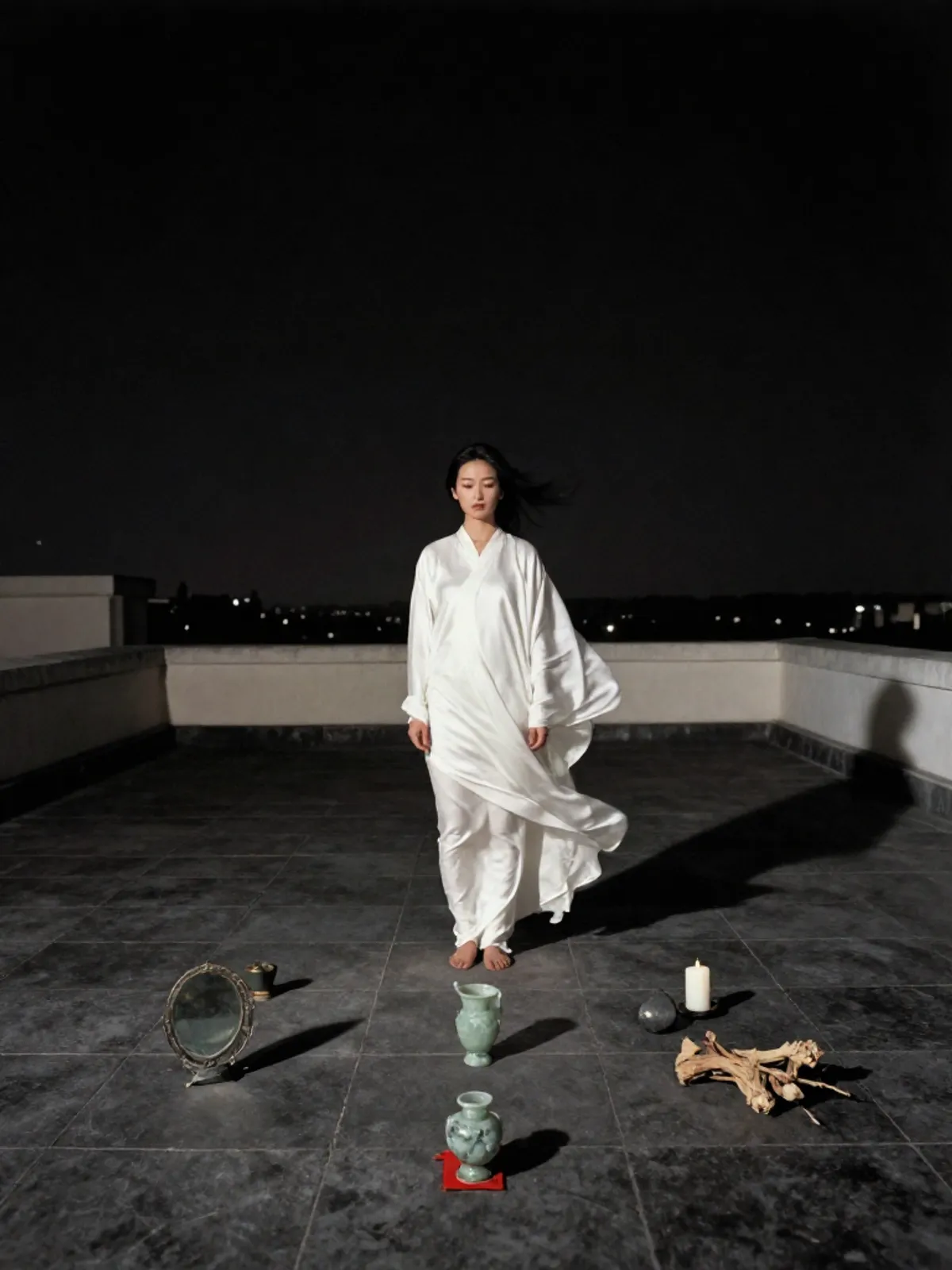
A Different Kind of Astrology
When most people hear "Chinese astrology," they think of the twelve animals of the zodiac - Rat, Ox, Tiger, and so on. This is the folk layer: charming, widely known, and barely scratching the surface.
Beneath it lies a precise and sophisticated system: the Heavenly Stems and Earthly Branches (天干地支), the Five Phases (五行), and the Four Pillars (四柱) - also known as bazi (八字), the "eight characters" of your birth chart.
This is not personality typing. It is a map of how the forces of wood, fire, earth, metal, and water are configured at the moment of your birth - and how they unfold through time.
Where Western astrology looks upward - to planetary positions against the backdrop of constellations - Chinese astrology looks inward, into the cyclic interplay of elemental forces. The sky is not irrelevant, but the fundamental unit of analysis is not the planet. It is the phase (行, xíng), a quality of energy in motion. The word xíng literally means "to walk, to move." The Five Phases are not static substances. They are verbs masquerading as nouns.
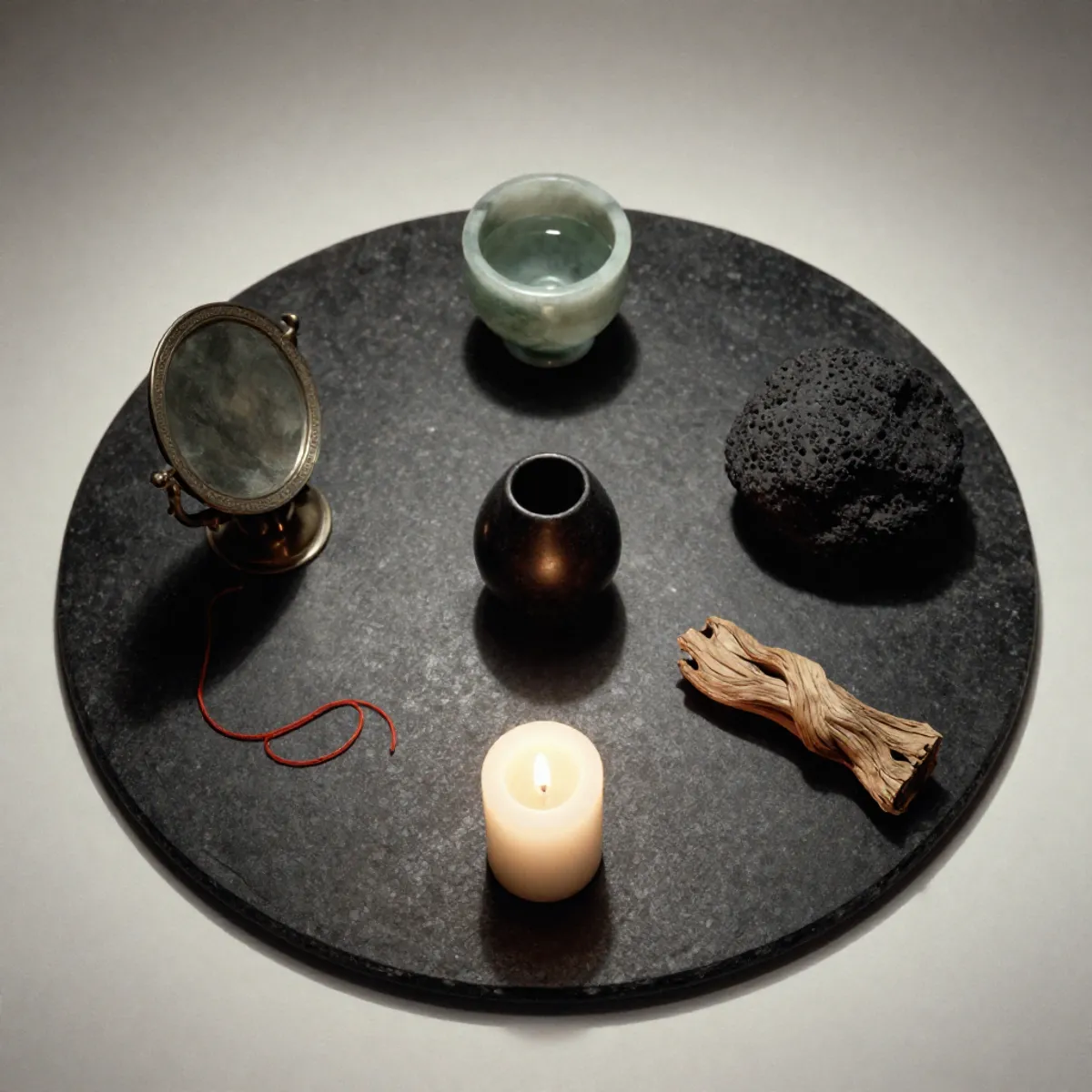
The Ten Heavenly Stems
The ten Heavenly Stems (天干, tiāngān) are among the oldest symbolic structures in Chinese civilization. They appear on Shang dynasty oracle bones from the second millennium BCE, where they were already being used to name days in a ten-day week. Their origins likely predate writing itself.
The ten stems are:
| Stem | Pinyin | Phase | Polarity | |------|--------|-------|----------| | 甲 | jiǎ | Wood | Yang | | 乙 | yǐ | Wood | Yin | | 丙 | bǐng | Fire | Yang | | 丁 | dīng | Fire | Yin | | 戊 | wù | Earth | Yang | | 己 | jǐ | Earth | Yin | | 庚 | gēng | Metal | Yang | | 辛 | xīn | Metal | Yin | | 壬 | rén | Water | Yang | | 癸 | guǐ | Water | Yin |
Each stem carries a quality. 甲 (jiǎ) is the great tree - upright, ambitious, visible. It is the force that pushes a seedling through concrete, the drive to grow vertically, to be seen. 乙 (yǐ) is the vine - flexible, adaptive, quietly tenacious. Where jiǎ breaks through obstacles, yǐ grows around them, finding light by indirection.
丙 (bǐng) is the sun itself - expansive, generous, impossible to hide. 丁 (dīng) is candlelight or a hearth fire - warm, intimate, illuminating what is near rather than what is far. 戊 (wù) is the mountain or great wall - massive, immovable, dependable. 己 (jǐ) is garden soil - nurturing, absorptive, fertile, quietly sustaining life.
庚 (gēng) is the axe or the sword - decisive, reforming, cutting away what is no longer needed. 辛 (xīn) is the jewel or fine needle - refined, precise, sensitive to impurity. 壬 (rén) is the ocean or great river - vast, deep, powerful in its movement. 癸 (guǐ) is rain, dew, underground springs - quiet, nourishing, penetrating where force cannot reach.
The yang and yin expressions of each phase are not better or worse. They are different strategies for the same element. The tradition sometimes speaks of this as the difference between qì in its outward-moving form and qì in its inward-gathering form - the breath going out and the breath coming in.
The Twelve Earthly Branches
If the ten Stems are heaven, the twelve Branches are earth. The Earthly Branches (地支, dìzhī) form the other half of the stem-branch system. They are older than the animal zodiac - the animals were attached later, probably during the Han dynasty, as a popular mnemonic.
| Branch | Pinyin | Animal | Phase | Month | |--------|--------|--------|-------|-------| | 子 | zǐ | Rat | Water | Nov | | 丑 | chǒu | Ox | Earth | Dec | | 寅 | yín | Tiger | Wood | Jan | | 卯 | mǎo | Rabbit | Wood | Feb | | 辰 | chén | Dragon | Earth | Mar | | 巳 | sì | Snake | Fire | Apr | | 午 | wǔ | Horse | Fire | May | | 未 | wèi | Goat | Earth | Jun | | 申 | shēn | Monkey | Metal | Jul | | 酉 | yǒu | Rooster | Metal | Aug | | 戌 | xū | Dog | Earth | Sep | | 亥 | hài | Pig | Water | Oct |
The Branches map time at every scale: hours of the day, months of the year, years in the twelve-year cycle. Each Branch has its own elemental nature, but - and this is crucial - each Branch also contains Hidden Stems (藏干, cánggān), concealed elemental forces nested inside.
子 (zǐ), the Rat branch, contains only 癸 (guǐ water) - a pure and undivided force. But 丑 (chǒu), the Ox, contains 己 (jǐ earth), 癸 (guǐ water), and 辛 (xīn metal) - three stems working within a single branch. The Hidden Stems are where much of the subtlety of chart reading lies. The surface element of a Branch tells you the weather. The Hidden Stems tell you what is happening underground.
When a Stem pairs with a Branch, you get a Stem-Branch pair (干支, gānzhī) - for example, 甲子 (jiǎzǐ), yang wood over the Rat. There are sixty such pairs in the full cycle, known as the sexagenary cycle (六十甲子, liùshí jiǎzǐ). This sixty-unit cycle has been the backbone of Chinese timekeeping for over three thousand years, running without interruption. Every hour, day, month, and year has its place in the cycle.
The Five Phases in Depth
The Five Phases (五行, wǔxíng) are not the Western classical elements. They are not substances sitting in a row. They are a theory of relationship - how different qualities of energy interact, support, and constrain one another.
Two cycles govern these relationships:
The Generation Cycle (相生, xiāngshēng) - literally "mutual birth" - describes how each phase nurtures the next:
Wood feeds Fire. Fire creates Earth (ash). Earth bears Metal (ore). Metal collects Water (condensation on metal). Water nourishes Wood.
This is the cycle of support, of mothering. In a bazi chart, the phase that generates your Day Master is called your Resource (印, yìn) - the energy that feeds you, restores you, gives you ground to stand on.
The Control Cycle (相剋, xiāngkè) - "mutual conquest" - describes how each phase restrains another:
Wood parts Earth (roots break soil). Earth dams Water. Water extinguishes Fire. Fire melts Metal. Metal cuts Wood.
Control is not destruction. It is governance, limitation, necessary shaping. A chart with no control is like a life with no discipline - everything grows wild. A chart with too much control is constriction. The art of reading lies in assessing the balance.
These two cycles - generation and control - produce a dynamic equilibrium. The Huangdi Neijing (黃帝內經), the foundational text of Chinese medicine, applies the same logic to the body:
木曰曲直,火曰炎上,土曰稼穡,金曰從革,水曰潤下。
Wood is called bending and straightening. Fire is called blazing upward. Earth is called sowing and reaping. Metal is called conforming and transforming. Water is called moistening and descending.
Each phase has a direction in space, a season in time, a color, a taste, a sound, an emotion, and - critically - a pair of organs in the body. Wood governs the liver and gallbladder. Fire governs the heart and small intestine. Earth governs the spleen and stomach. Metal governs the lungs and large intestine. Water governs the kidneys and bladder.
This is not metaphor. In Chinese medicine, a person with excessive wood in their chart may be constitutionally prone to liver qi stagnation - frustration, tension in the sides of the body, a tendency toward anger that cannot find expression. A person weak in water may struggle with kidney vitality - fear, exhaustion, lower back weakness. The chart and the body speak the same language.

The Four Pillars
A bazi chart consists of four Pillars (四柱, sìzhù), each composed of one Heavenly Stem sitting atop one Earthly Branch. Four pillars, each with two characters - eight characters total. Hence bazi, "eight characters."
The four pillars represent:
Year Pillar (年柱, niánzhù) - your ancestral inheritance, your relationship to society, the outer world's first impression of you. It reflects the energy of the year you were born and, by extension, your generation.
Month Pillar (月柱, yuèzhù) - your parents, your upbringing, your career environment. The Month Branch determines the season of your birth and is considered the most powerful single influence on the chart's elemental balance. Classical texts call it the ling (令), the "command" - the reigning energy of the season.
Day Pillar (日柱, rìzhù) - yourself. The Heavenly Stem of the Day Pillar is the Day Master, the center of the entire chart. The Earthly Branch beneath it represents your spouse or most intimate partner. Everything in the chart is read in relation to this pillar.
Hour Pillar (時柱, shízhù) - your inner world, your children, your aspirations, what you produce and send into the future. The Hour Pillar is the most private column, the one least visible to others.
To see how this works, consider a person born on February 4, 1962, at the hour of the Snake (9-11 AM). Their four pillars would be:
| | Year | Month | Day | Hour | |------|------|-------|-----|------| | Stem | 壬 (Water+) | 壬 (Water+) | 庚 (Metal+) | 辛 (Metal-) | | Branch | 寅 (Tiger) | 寅 (Tiger) | 午 (Horse) | 巳 (Snake) |
This person's Day Master is 庚 (gēng) - yang metal. The axe, the sword, the force of reform. They meet the world with directness, decisiveness, a certain blunt clarity. But the chart is saturated with water (two 壬 stems) and wood (two 寅 branches, whose main Hidden Stem is 甲, yang wood). Water is the output of metal - metal generates water - which means this person pours tremendous energy outward. The wood in the branches represents wealth for a metal Day Master (metal controls wood), suggesting a life shaped by the pursuit or management of resources. Whether this is a blessing or a burden depends on whether the metal at the center is strong enough to bear the load.
This is the logic of bazi: not "you are a metal person," but "what is metal's situation in this specific landscape of forces?"
Reading Your Day Master
In a bazi chart, the Day Master (日主, rìzhǔ) - the Heavenly Stem of the day you were born - is you. It represents your core nature, the element through which you experience and act upon the world.
A 丁 (dīng fire) Day Master is candlelight: warm, intimate, illuminating small spaces. A 丙 (bǐng fire) Day Master is the sun: radiant, impossible to ignore, but sometimes scorching.
A 壬 (rén water) Day Master is the ocean - vast ambitions, deep thinking, a tendency to overwhelm. A 癸 (guǐ water) Day Master is morning dew - perceptive, gentle, nourishing in quiet ways that others barely notice.
Understanding your Day Master is the beginning of self-knowledge in Chinese astrology. It does not confine you. It shows you the terrain you are working with.
To find your own Day Master, you need your birth date converted to the Chinese calendar's stem-branch system. The calculation involves the sexagenary cycle and is not trivial to do by hand - classical practitioners memorized a perpetual calendar called the wànniánlì (萬年曆), the "ten-thousand-year calendar." Today, reliable online bazi calculators can produce your four pillars in seconds. Enter your birth year, month, day, and hour. Look for the Heavenly Stem of the Day Pillar. That is your Day Master.
But do not stop there. The Day Master in isolation tells you less than the Day Master in context. A 甲 (jiǎ wood) Day Master born in spring, surrounded by water and wood, is a towering forest - almost too much growth. The same Day Master born in autumn, surrounded by metal, is a tree under the axe - challenged, pressured, but potentially refined by adversity into something more interesting than easy growth could produce.
Hidden Stems: The Interior Life of the Branches
Each Earthly Branch contains one to three Hidden Stems (藏干, cánggān) - internal elemental forces that are not immediately visible but profoundly shape the chart's dynamics.
The classical text Yuanhai Ziping (淵海子平) compares the Hidden Stems to the roots of a plant: you cannot see them, but they determine whether the plant stands or falls. The main Hidden Stem in each Branch is called the zhèngqì (正氣), the "correct qi" - the dominant force. Secondary and tertiary stems are the zhōngqì (中氣) and yúqì (餘氣), residual energies from adjacent seasonal phases.
For example, the Branch 寅 (yín, Tiger) contains:
- 甲 (jiǎ, yang wood) - the main qi, dominant
- 丙 (bǐng, yang fire) - the secondary qi
- 戊 (wù, yang earth) - the residual qi
This means that when you see 寅 in a chart, you are not simply looking at wood. You are looking at wood with fire beginning to kindle and earth providing a base. The Tiger carries within it the seed of spring's full unfolding - wood growing, fire stirring, earth stabilizing.
Hidden Stems matter because they reveal alliances and conflicts that are not apparent on the surface. Two Branches may appear unrelated by their surface elements, but their Hidden Stems may be locked in a control relationship - or may combine to produce an entirely new phase through one of the complex Branch combination rules (三合, sānhé, the three harmonies; 六合, liùhé, the six combinations).
This is where bazi ceases to be a simple lookup table and becomes an art of interpretation. The visible chart is the text. The Hidden Stems are the subtext.
Luck Pillars: The River of Time
A bazi chart is a snapshot of birth - but no one lives at the moment of their birth forever. The system accounts for time's passage through Luck Pillars (大運, dàyùn), ten-year periods that shift the elemental landscape of a life.
Luck Pillars are derived from the Month Pillar and progress forward or backward through the sexagenary cycle depending on the person's gender and the yin-yang polarity of the Year Stem. A yang-year male or yin-year female progresses forward; the reverse progresses backward. Each Luck Pillar brings a new Stem-Branch pair into play, introducing fresh elemental forces that interact with the natal chart.
A person whose chart is dry and fire-heavy may struggle during a Luck Pillar dominated by wood and fire - more fuel on an already blazing landscape. But when a water Luck Pillar arrives, it may bring relief, balance, and the conditions for flourishing. Classical practitioners would say: 運到則發 (yùn dào zé fā) - "when the right luck arrives, one blossoms."
Within each ten-year Luck Pillar, annual pillars (流年, liúnián) add another layer of temporal specificity. The year 2026, for instance, is 丙午 (bǐng wǔ) - yang fire over the Horse, a branch that also carries fire. It is an intensely fiery year. For a person whose chart needs warmth, this may be a year of breakthrough. For a person already burning, it demands caution.
The interplay between natal chart, Luck Pillars, and annual pillars is where bazi becomes genuinely predictive - not in the fortune-telling sense of "this will happen," but in the diagnostic sense of "these are the forces at work, and here is how they are likely to interact."
Bazi and Western Astrology
Readers familiar with Western astrology will notice both resonances and fundamental differences.
Western astrology is spatial. It maps the positions of planets along the ecliptic at the moment of birth. The zodiac is a circle divided into twelve signs and twelve houses. The language is one of angular relationships - conjunctions, squares, trines, oppositions - between celestial bodies.
Bazi is temporal. It maps the quality of time itself - not where the planets are, but what phase of the cosmic cycle is active at the moment of birth. There are no planets in a bazi chart. There is no zodiac wheel. There are only the Stems and Branches, encoding the Five Phases in their yin and yang polarities, arranged across four moments of time.
Western astrology tends toward narrative: the chart tells a story about your character, your relationships, your destiny. Bazi tends toward diagnosis: the chart reveals a pattern of elemental strengths and deficiencies, and the practitioner's task is to assess what is needed. The question is less "who are you?" and more "what does your system require to come into balance?"
There is also a difference in how the two traditions handle fate. Western astrology has long debated free will versus determinism - whether the stars incline or compel. Bazi sidesteps this debate with a more pragmatic framework. Your natal chart is your ming (命) - your endowment, what you are given. Your luck pillars and annual cycles are your yun (運) - the current you are swimming in. And your choices, your cultivation, your responses to circumstance - these are your de (德), your virtue. Ming cannot be changed. Yun arrives on its own schedule. But de is yours.
Bazi in History
The stem-branch system was already ancient when the bazi method was formalized during the Tang and Song dynasties. The scholar Li Xuzhong (李虛中, c. 761-813) is credited with developing the three-pillar method (using year, month, and day). It was Xu Ziping (徐子平) of the Song dynasty who added the Hour Pillar, completing the four-pillar system. The method has been called Ziping (子平) astrology in his honor ever since.
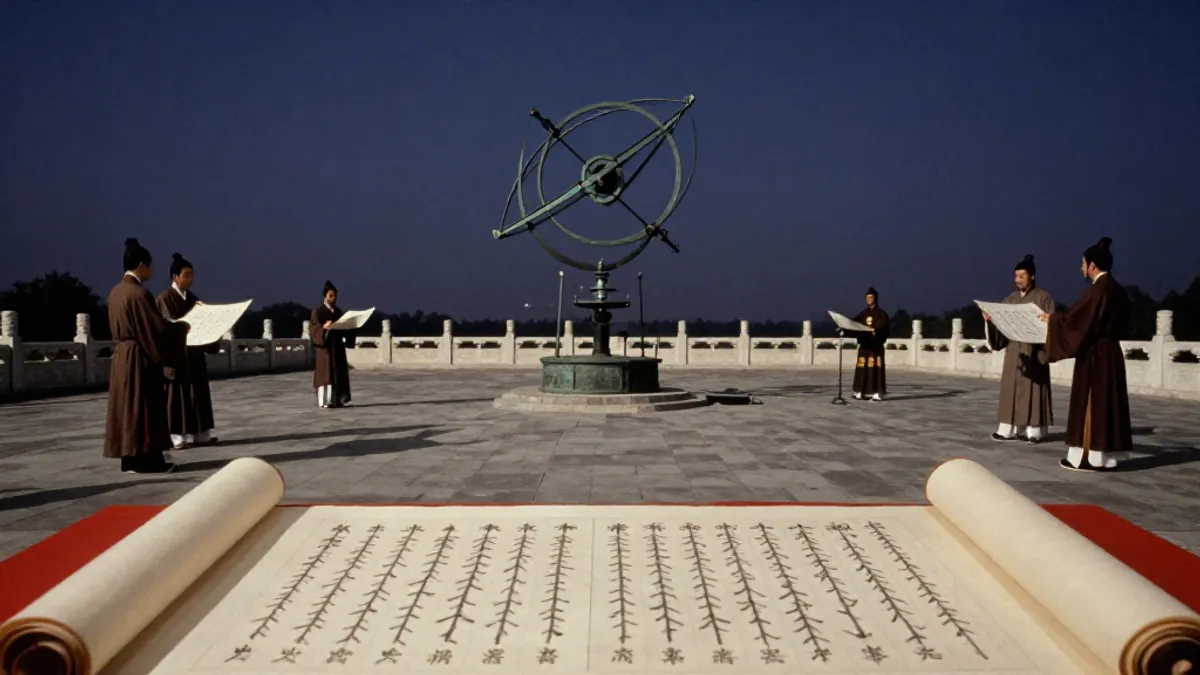
At the imperial court, bazi was serious business. The Qin Tianjian (欽天監), the Imperial Astronomical Bureau, employed specialists who calculated auspicious dates for state rituals, military campaigns, and the emperor's personal decisions. Marriage matching (合婚, héhūn) was among the most common applications - families would exchange the bazi of prospective bride and groom, and an astrologer would assess the compatibility of their elemental configurations. A mismatch in the Five Phases could derail a betrothal.
The practice was not confined to the elite. Village fortune-tellers, itinerant scholars, and family elders all used simplified forms of bazi reasoning. The tōngshū (通書), the traditional almanac found in nearly every Chinese household, is structured around stem-branch cycles and their implications for daily activity - which days favor travel, construction, marriage, burial.
Even today, in Hong Kong, Taiwan, and mainland Chinese communities worldwide, consulting a bazi practitioner before major life decisions - marriage, business launches, home purchases - remains common. The system has survived not because of superstition but because its diagnostic framework proves, again and again, to be a useful lens for understanding the rhythms of a life.
The Stems and the Body
The correspondence between the Heavenly Stems and the organs of the body is not an afterthought - it is foundational. The Huangdi Neijing establishes a direct mapping:
| Stem | Phase | Yin Organ | Yang Organ | |------|-------|-----------|------------| | 甲/乙 | Wood | Liver (肝) | Gallbladder (膽) | | 丙/丁 | Fire | Heart (心) | Small Intestine (小腸) | | 戊/己 | Earth | Spleen (脾) | Stomach (胃) | | 庚/辛 | Metal | Lungs (肺) | Large Intestine (大腸) | | 壬/癸 | Water | Kidneys (腎) | Bladder (膀胱) |
A skilled Chinese medicine practitioner reading a bazi chart is not doing something separate from diagnosis - they are doing diagnosis at the constitutional level. The chart reveals which organ systems are likely to be strong, which are vulnerable, and how the passage through different Luck Pillars may shift the body's landscape over time.
A person with a strong fire Day Master and little water in the chart may be constitutionally brilliant but prone to heart-fire rising - insomnia, anxiety, a tongue tip that reddens under stress. A person with excessive metal and deficient wood may have strong lungs but a constrained liver - respiratory resilience paired with emotional rigidity. These are not certainties. They are tendencies, written in the same elemental language that governs the seasons and the cycles of the natural world.
The insight here is profound: in the Chinese understanding, the body is not separate from time. You are not merely a physical structure. You are a temporal structure - a particular arrangement of cosmic forces, unfolding through decades, shaped by the same cycles that govern the rise and fall of dynasties and the turning of the seasons.
Why This Matters Now
Bazi offers something that personality quizzes and algorithmic identity cannot: a system rooted in cosmology, refined over millennia, that asks you to understand yourself not as a type but as a process - a specific configuration of elements in constant interaction with time.
In an age of fixed identities and static labels, the Five Phases remind us that everything moves. Your chart does not say "you are this." It says "this is the pattern you are working with, and here is how the pattern is shifting." The wood of spring becomes the fire of summer becomes the earth of late summer becomes the metal of autumn becomes the water of winter - and then wood again. You are not outside this cycle. You are a particular expression of it.
To study your bazi chart is not to have your fortune told. It is to sit with the question that all serious self-inquiry eventually asks: given what I have been given, given the currents I am swimming in, what is the most skillful way to live?
The system does not answer for you. But it gives you a remarkably precise vocabulary for asking.