The Secret That Was Never Hidden
The paradox of Chinese esoteric meditation is that its deepest teachings were always available - hidden not by secrecy, but by simplicity.
致虛極,守靜篤。
Attain the utmost emptiness. Hold firm to stillness.
- Laozi, Daodejing, Chapter 16
This is the entire instruction. Everything else is commentary.
And yet commentary matters, because the gap between knowing the instruction and living it is the width of a lifetime. Every Daoist meditation lineage - from the early Celestial Masters to the Song dynasty alchemists to the modern Longmen practitioners in Chengdu and Taipei - has grappled with the same question: how do you actually do this? How do you sit down, in a body that aches and a mind that races, and touch the stillness that Laozi is pointing to?
The answer, refined over two millennia, is neidan.
What Is Neidan?
Neidan (內丹), or inner alchemy, is the Daoist tradition of transforming the self through meditation, breath, and awareness. Unlike waidan (外丹, external alchemy), which involved mineral elixirs and laboratory furnaces, neidan works with the body's own energies: jing (essence, 精), qi (vital energy, 氣), and shen (spirit, 神).
These are the sanbao (三寶), the Three Treasures. They are not abstractions. Each one has a texture, a location, a felt quality in the body - and recognizing them is one of the first milestones of genuine practice.
Jing is the densest of the three. It lives in the lower abdomen, in the kidneys, in the marrow. You feel it as rootedness, as animal warmth, as the deep vitality that a child has and an exhausted adult has lost. When jing is full, you sleep soundly, your lower back is warm, your eyes are bright. The alchemical texts say jing is like water - it pools, it nourishes, it seeks the lowest place.
Qi is subtler. It moves. You feel it as tingling in the palms during practice, as warmth spreading along the spine, as the curious sensation that your hands have grown very large or very small. Qi is the intermediary - it bridges the material body and the immaterial mind. The character 氣 originally depicted steam rising from cooking rice: nourishment becoming movement.
Shen is the most refined. It is awareness itself - not the chattering mind, but the clear, quiet knowing that remains when the chatter fades. You feel it as spaciousness, as a gentle luminosity behind the eyes, as the state in which you can observe your own thoughts without being pulled into them. When shen is settled, meditation is effortless. When it is scattered, even five minutes feels like a struggle.
The process of neidan is often described in alchemical metaphor:
- Refining jing into qi (煉精化氣) - grounding, gathering, building vitality
- Refining qi into shen (煉氣化神) - circulating energy, opening the subtle body
- Refining shen into emptiness (煉神還虛) - dissolving the boundary between self and Dao
These stages are not sequential in the way a recipe is sequential. They are more like tides - you move through them again and again, each cycle deeper than the last. A fourth stage is sometimes added: refining emptiness to unite with the Dao (煉虛合道), but at that point language has already exceeded its jurisdiction.
The Three Elixir Fields
The body, in neidan, is understood as a landscape. And like any landscape, it has regions.
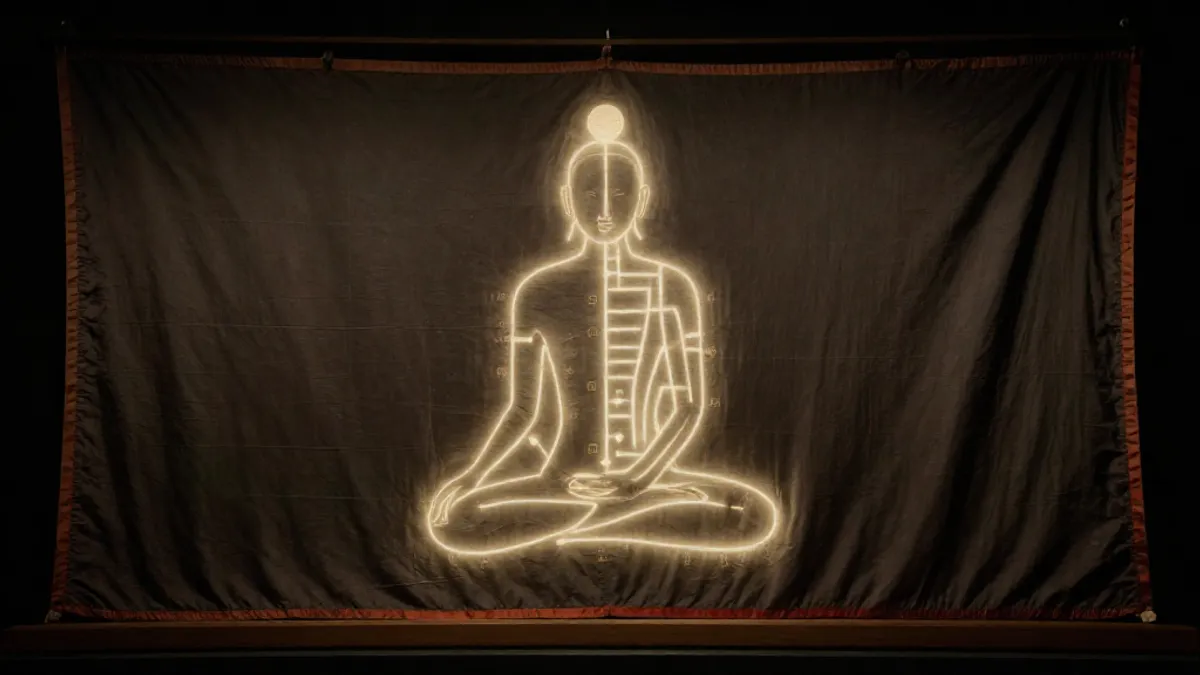
The dantian (丹田, "elixir field") system maps three vital centers along the body's central axis. These are not organs - you will not find them in an anatomy textbook. They are functional centers, places where attention naturally gathers and where the alchemical work takes place.
The lower dantian (下丹田, xia dantian) sits in the lower abdomen, roughly two inches below the navel and one-third of the way into the body. This is the furnace of the alchemical tradition, the seat of jing, the foundation. Most beginning practice focuses here. It is the center of gravity, both physical and energetic. When you feel grounded and stable in meditation, the lower dantian is doing its work.
The middle dantian (中丹田, zhong dantian) rests at the center of the chest, near the heart. This is the seat of qi and emotion, the place where feeling and energy interweave. It is also associated with the shanzhong (膻中) acupoint. When practitioners speak of "opening the heart," they mean something quite precise: allowing qi to flow freely through this center rather than constricting around grief, anger, or fear.
The upper dantian (上丹田, shang dantian) sits between and behind the eyebrows, in the region the tradition calls the niwan (泥丸, "mud pill"), sometimes correlated with the pineal gland. This is the seat of shen, the palace of awareness. Advanced practices involve gathering refined qi here, but beginners are usually cautioned against focusing on the upper dantian prematurely - it can produce headaches, agitation, and the kind of vivid but ultimately distracting visions that the tradition calls mojing (魔境, "demon realms"), meaning not actual demons but compelling hallucinations.
Beginning Where You Are
You do not need a lineage, a temple, or a master to begin. You need a quiet place, a willingness to sit, and twenty minutes.
A simple practice:
Sit comfortably. Spine upright but not rigid. Let the breath settle naturally - do not force it. Place your awareness gently on the lower abdomen, about two inches below the navel. This is the lower dantian (丹田).
Do not visualize. Do not count breaths. Simply rest your awareness there, as if you were listening to a very quiet sound.
When thoughts arise - and they will - do not fight them. Let them pass like clouds in a wide sky. Return to the quiet center.
That is the practice. It has been the practice for two thousand years.
What changes over time is not the technique but the quality of your sitting. In the first weeks, you are mostly just learning to stay. Staying with discomfort, staying with boredom, staying with the strange restlessness that arises when the mind has nothing to grasp. The Daoist term for this patient returning is shouyi (守一, "guarding the One") - keeping attention unified rather than fragmented.
The Breath as Bridge
In neidan, the breath occupies a unique position: it is the one physiological process that is both involuntary and voluntary, both body and mind. It is the bridge between the conscious and the unconscious, and so naturally it becomes the primary tool of inner work.
The simplest approach is natural breathing (自然呼吸, ziran huxi) - breathing as it wants to breathe, without any interference. This is harder than it sounds. Most people, when told to observe their breath, immediately begin to control it. True natural breathing means getting out of the way entirely, letting the body breathe itself. This alone can take months of patient practice to achieve.
Reverse breathing (逆呼吸, ni huxi) is the next stage for many practitioners. In natural breathing, the abdomen expands on the inhale and contracts on the exhale. In reverse breathing, this is inverted: the abdomen gently draws inward on the inhale and expands on the exhale. This sounds mechanical, but its purpose is energetic - reverse breathing naturally draws qi downward into the lower dantian on the inhale and circulates it outward through the body on the exhale. It should never be forced. When it arises naturally from sustained practice, it is a sign that the body's energy is beginning to reorganize itself.
The most advanced breath practice is embryonic breathing (胎息, taixi) - so called because it resembles the "breathing" of a fetus in the womb, which receives oxygen not through the lungs but through the umbilical connection. In taixi, the external breath becomes so fine and subtle that it nearly stops. The practitioner breathes through the dantian itself, or so it feels. The Taixi Jing (胎息經, "Classic of Embryonic Breathing") describes it thus:
胎從伏氣中結,氣從有胎中息。
The embryo forms within the hidden qi; the breath comes to rest within the embryo.
This is not breath-holding. It is a state in which the body's metabolic need for air diminishes because the internal energy has become self-sustaining. It cannot be willed into existence - it arises only when the foundation practices have been thoroughly established.
The Microcosmic Orbit
Once the dantian is established as a stable center of warmth and awareness, many traditions introduce the circulation practice known as the microcosmic orbit (小周天, xiao zhoutian, literally "small heavenly circuit").
The microcosmic orbit traces a loop through two of the body's central meridians. The Du mai (督脈, "governing vessel") runs up the spine from the perineum, over the crown of the head, and down to the upper palate. The Ren mai (任脈, "conception vessel") runs down the front of the body from the lower lip, through the throat and chest, and back to the perineum. The tongue, placed lightly on the upper palate, closes the circuit - a detail so small that many texts mention it almost in passing, yet without it the orbit cannot complete.
Learning the orbit typically unfolds in stages:
- Gathering - weeks or months of dantian focus, building enough qi to have something to circulate
- Sensing the pathway - the practitioner begins to notice warmth or tingling along the spine, especially at the tailbone (weilü, 尾閭), the mid-back (jiaji, 夾脊), and the base of the skull (yuzhen, 玉枕). These are the three gates (sanguan, 三關), traditionally considered the hardest points for qi to pass through
- Guiding without forcing - using gentle intention, not muscular effort, to encourage qi upward along the Du mai and downward along the Ren mai. The classic instruction is yi yi yin qi (以意引氣): "use intention to guide the qi"
- Spontaneous circulation - eventually the orbit runs on its own, without conscious direction. At this point the practitioner simply observes
The macrocosmic orbit (大周天, da zhoutian, "great heavenly circuit") extends this circulation through the arms and legs, through all the body's major meridians. It is a more advanced practice and, in most lineages, not something a practitioner pursues deliberately - it unfolds naturally when the small orbit is thoroughly established and the body's channels have opened sufficiently.
Sitting and Forgetting
While neidan developed its elaborate alchemical framework over centuries, its philosophical root reaches back to one of the most striking passages in the Zhuangzi.
In Chapter 6, "The Great Ancestral Teacher," Yan Hui - Confucius's favorite disciple - reports a breakthrough to his master:
墮肢體,黜聰明,離形去知,同於大通,此謂坐忘。
I let my limbs fall away, dismiss hearing and sight, leave my body and abandon knowledge, and become identical with the Great Thoroughfare. This is what I call sitting and forgetting.
- Zhuangzi, Chapter 6
Confucius, in the story, is humbled. He asks to become Yan Hui's follower.
Zuowang (坐忘, "sitting and forgetting") is not amnesia. It is the systematic release of everything that is not essential - sensory fixation, intellectual grasping, the habitual sense of being a separate self located behind the eyes. What remains, when all that is dropped, is not nothing. It is the Dao itself, experienced directly rather than thought about.
This passage from the Zhuangzi predates the formal neidan tradition by nearly a thousand years, yet it describes the endpoint that all neidan practice aims toward. The alchemical stages - refining jing, circulating qi, gathering shen - are the ladder. Zuowang is what happens when you no longer need the ladder.
The Quanzhen Legacy
No discussion of Daoist meditation is complete without the Quanzhen (全真, "Complete Perfection") school, which made sitting meditation the absolute center of Daoist cultivation.
Founded by Wang Chongyang (王重陽, 1113–1170) during the Jin dynasty, Quanzhen was radical in its time. Wang insisted on monastic celibacy, vegetarianism, and rigorous meditation practice - a program that looked, to many observers, more Buddhist than Daoist. But Wang's genius was synthetic. He drew from Chan Buddhism, Confucian ethics, and Daoist inner alchemy, insisting that the three teachings were ultimately one.
Wang Chongyang gathered seven primary disciples, known as the Seven Perfected (七真, Qizhen). Among them, Qiu Chuji (丘處機) became the most historically significant - it was he who traveled across Central Asia to meet Genghis Khan in 1222 and secured imperial protection for the Quanzhen order, ensuring its survival. But for meditation practitioners, the most important of the seven may be Ma Yu (馬鈺) and his wife Sun Bu'er (孫不二), who developed distinctive approaches to male and female cultivation respectively.
Sun Bu'er's poetry remains one of the clearest guides to women's neidan practice. Her verses are deceptively simple - short, musical, precise - yet they encode sophisticated instructions for working with the body's energy.
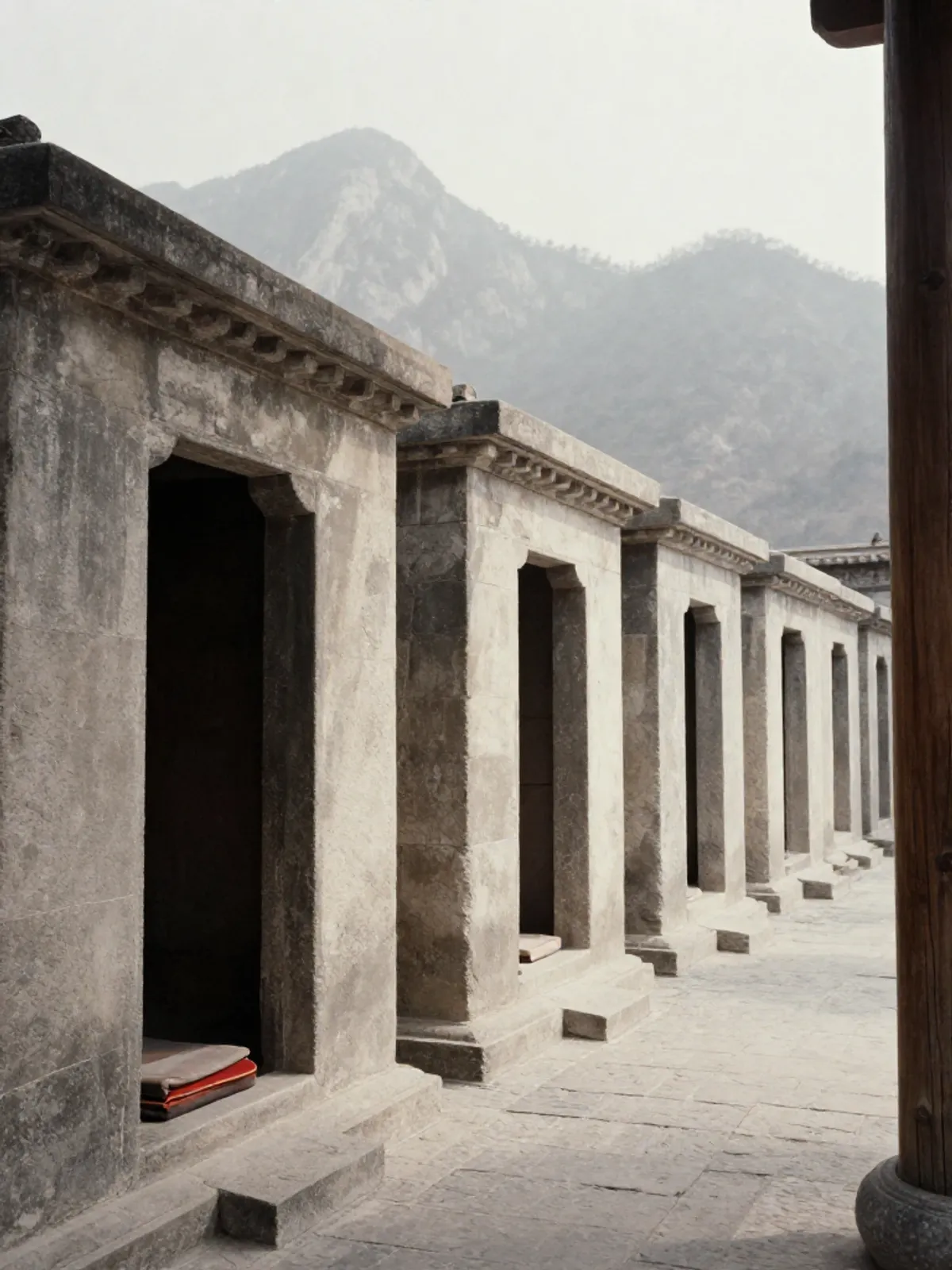
The Quanzhen emphasis on prolonged sitting practice, sometimes lasting entire days, produced a rich literature of practical advice about the obstacles that arise in meditation.
Common Obstacles and Their Remedies
Every meditator encounters the same difficulties. The tradition names them clearly.
Drowsiness (昏沉, hunchen) - the heavy, sinking feeling that pulls you toward sleep. It arises when qi descends too far, when the body is exhausted, or when the mind has nothing to grip and simply shuts down. Traditional remedies include sitting at a time when you are naturally alert (early morning is preferred), sitting with the eyes slightly open rather than fully closed, and briefly straightening the spine with a gentle inhalation when dullness descends.
Agitation (散亂, sanluan) - the restless, scattered mind that jumps from thought to thought like a monkey swinging between branches. The classic Daoist image is the "monkey mind" (xinyuan, 心猿). Agitation often intensifies in the first months of practice, not because practice is making it worse, but because you are finally noticing what was always there. The remedy is patience and the lower dantian - dropping attention below the navel cuts the fuel supply to mental agitation with surprising effectiveness.
Physical discomfort - pain in the knees, numbness in the legs, aching in the lower back. The tradition is pragmatic here: if your posture is causing genuine pain, adjust it. The lotus position is traditional but not essential. A chair is acceptable. A low bench is excellent. The spine's uprightness matters far more than the configuration of the legs. Some discomfort is simply the body releasing tension it has held for years - this passes. Sharp pain in the joints is a warning to change position.
Qi deviations (走火入魔, zouhuo rumo, literally "fire goes astray, demons enter") - this dramatic-sounding term refers to the various physical and psychological disturbances that can arise from overly forceful practice. Headaches from excessive focus on the upper dantian, chest tightness from reverse breathing done too aggressively, emotional instability from premature attempts to open the heart center. The universal remedy is to return to basics: natural breathing, gentle dantian focus, and time spent outdoors walking. Nearly all qi deviations resolve on their own once the practitioner stops forcing.
Stillness and Movement
One of the deepest misunderstandings about Daoist meditation is that it is purely static - that one simply sits and does nothing. In reality, stillness practice and movement practice have always been complementary halves of a single system.
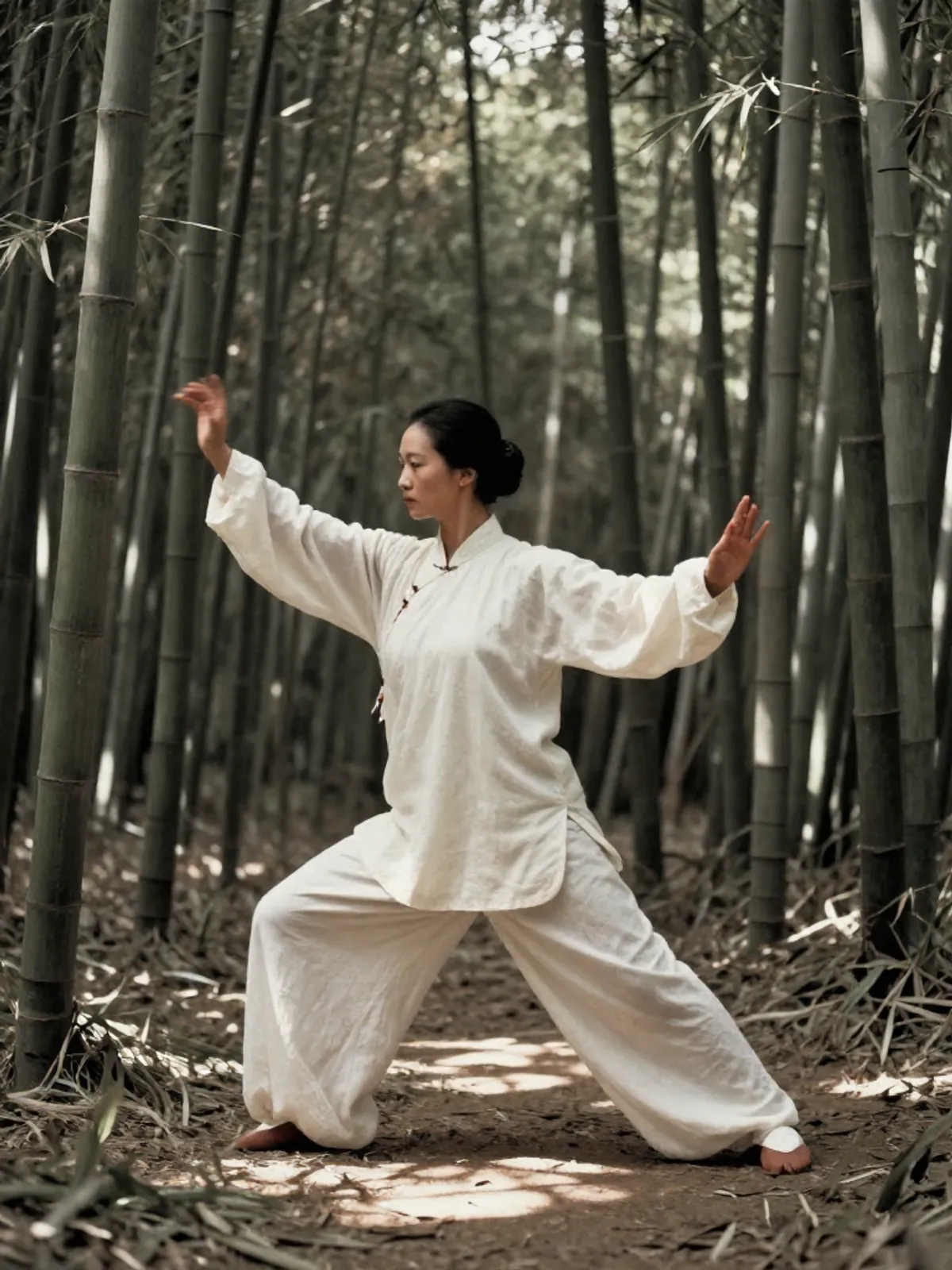
Qigong (氣功, "energy work") and taijiquan (太極拳) are not separate disciplines from neidan sitting practice. They are its extensions into the body in motion. The same dantian awareness that anchors sitting meditation anchors the slow, spiraling movements of taiji. The same breath principles apply. The same three treasures are cultivated.
The classic formulation is: stillness within movement, movement within stillness (動中有靜,靜中有動). In sitting practice, the body is still but the qi moves. In taiji, the body moves but the mind is still. The practitioner who only sits risks stagnation - qi pools and congeals rather than circulating freely. The practitioner who only moves risks superficiality - activity without the depth that only prolonged stillness can build.
Many traditional training schedules alternate between the two: sitting in the early morning when yang qi is rising, practicing taiji or qigong in the late afternoon when the body needs to move. The relationship between them is like breathing itself - inhale and exhale, gathering and releasing, yin and yang.
The Body Remembers
For women, neidan practice often begins with what the tradition calls "taming the dragon" (降龍) - not a martial metaphor, but a reference to calming the emotional and hormonal tides that modern life amplifies. The body is not an obstacle to practice. It is the instrument.
The Qing dynasty anthology Nüdan Hebian (女丹合編) teaches that women's cultivation has its own rhythms and gates. Menstrual regulation, breast qi circulation, womb breathing - these are not folk remedies. They are sophisticated energy practices with their own internal logic, and they deserve serious attention.
Among the most celebrated women practitioners in the tradition is He Xiangu (何仙姑), the only woman among the Eight Immortals (八仙, Baxian). According to legend, she attained immortality through a combination of ascetic diet and meditation practice in the mountains of Guangdong. While her hagiography is layered with myth, her presence in the pantheon of the Eight Immortals signals something important: the tradition has always recognized, at least in principle, that women's bodies are not deficient vessels requiring correction but distinct instruments with their own path to realization.
Sun Bu'er, mentioned earlier, takes this further. Her Nüdan Shisi Shou (女丹十四首, "Fourteen Verses on Women's Alchemy") lays out a complete practice path for women, beginning with the regulation of menstrual qi and culminating in the same return to emptiness that male practitioners pursue. Her work insists that women's practice is not a modification of men's practice - it is its own complete system.
The Long Sitting
There is no shortcut. The texts are unanimous on this point.
Wang Chongyang told his students that genuine transformation requires years of dedicated practice. The Xingming Guizhi (性命圭旨, "Balanced Instructions on Nature and Life"), one of the great Ming dynasty meditation manuals, maps out a progression that unfolds over a full decade of daily sitting. The Quanzhen monastics who built the tradition at White Cloud Temple (白雲觀, Baiyun Guan) in Beijing practiced in hundred-day intensive retreats.
But "long" does not mean "grim." The quality that sustains a meditation practice over years is not discipline in the military sense. It is something closer to curiosity - the willingness to keep returning to the cushion to see what happens next. The tradition calls this chang (常, "constancy"), the same word Laozi uses for the eternal, the unchanging. It suggests that steadiness of practice is itself a form of alignment with the Dao.
Twenty minutes a day, maintained for years, will take you further than a weekend retreat. The quiet accumulation of sitting - the body slowly learning to release, the breath slowly finding its own depth, the mind slowly remembering that it does not have to narrate everything - this is the real alchemy. It does not announce itself with visions or dramatic experiences. It arrives as a gradual settling, the way sediment clears from still water.
水靜則明燭鬚眉。
When water is still, it clearly reflects the eyebrows and eyelashes.
- Zhuangzi, Chapter 13