The Oracle Without Apparatus
In an earlier issue, we explored the I-Ching as a living system of inquiry - hexagrams cast with yarrow stalks or coins, each reading a mirror held up to the shape of the present moment. That method requires an apparatus: objects in hand, a ritual frame, a deliberate pause between question and answer.
But what if no apparatus were needed? What if the hexagram were already present - inscribed in the number of birds on a branch, the hour a stranger knocks, the direction a horse bolts? What if the entire visible world were itself the oracle, and the only instrument required were a trained and quiet mind?
This is the premise of meihua yishu (梅花易數, Plum Blossom Numerology), the divination method developed by the Song dynasty scholar Shao Yong. It is among the most elegant and most demanding practices in the Chinese esoteric tradition. It asks you to do something deceptively simple: look at the world and read it as a hexagram.
The sixty-four hexagrams are not confined to a book. They are the recurring structures of change itself. The meihua method trains you to perceive them directly - in the arrangement of objects, the timing of events, the quality of an encounter. Once you learn to see this way, the distinction between "consulting an oracle" and "paying attention" dissolves entirely.
The Man Who Became the Changes
Shao Yong (邵雍, 1011-1077), also known by his honorific Shao Kangjie (邵康節), was not born into the intellectual aristocracy of the Northern Song dynasty. He came from a modest family in what is now Hebei province and spent his early years in a period of intense, solitary study that later biographers described with a phrase bordering on hagiography: "In winter he did not use a stove; in summer he did not use a fan" (冬不爐,夏不扇). The image is of a man so absorbed in the patterns of the Yijing that bodily comfort ceased to register.
What Shao Yong sought was not merely intellectual understanding. He wanted to grasp the li (理, principle) that structured reality itself - the hidden mathematics of change. He studied under Li Zhicai (李之才), who transmitted a lineage of Yijing number theory descending from the Daoist master Chen Tuan (陳摶). This tradition treated the hexagrams not primarily as wisdom literature but as a combinatorial system, a set of relationships that could be mapped, calculated, and applied.
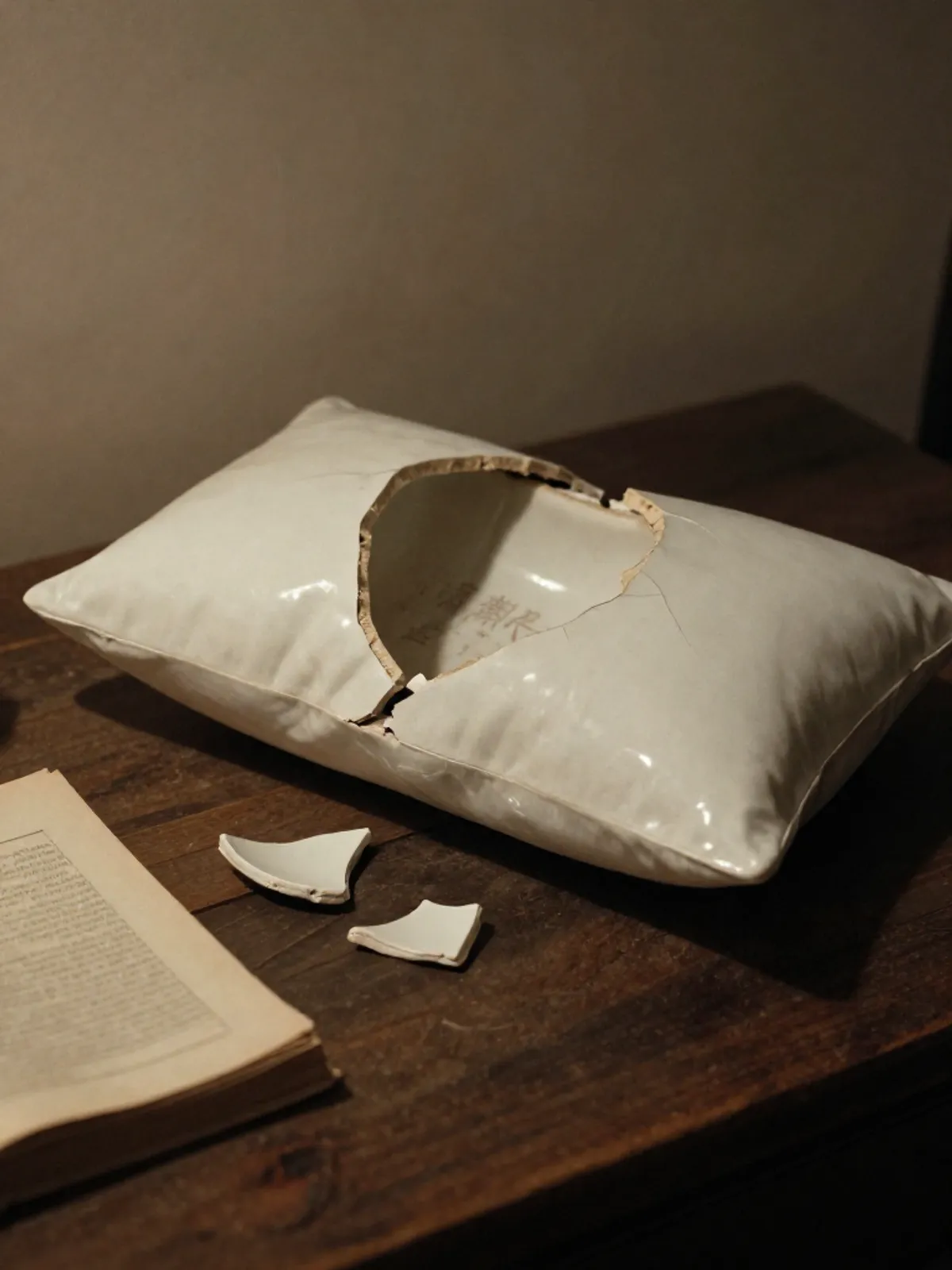
The story of Shao Yong's breakthrough has the quality of a Zen koan. One afternoon, resting in his study, a mouse scurried across the floor. Startled, he threw his ceramic pillow at it. The pillow shattered, and inside was a slip of paper bearing an inscription: "On such a year, such a month, such a day, at such an hour, this pillow will be made. On such a year, such a month, such a day, at such an hour, it will be broken by a certain scholar." The prediction was exact. Shao Yong traced the inscription to an old man in the village who had placed it inside the pillow years before and who, recognizing in Shao a worthy student, transmitted to him a hidden book of Yi calculation methods.
Whether this happened as told is less important than what the story teaches. The universe is already inscribed with its own future. The question is not whether the patterns exist, but whether one's perception is refined enough to read them.
Shao Yong eventually settled in Luoyang, where he built a modest dwelling he named An Le Wo (安樂窩, Nest of Peace and Joy). Despite his reclusive reputation, he became a magnet for the intellectual elite of the Northern Song. The great statesman Sima Guang (司馬光) was his neighbor and friend. The philosopher Cheng Hao (程顥) considered him a kindred spirit. Yet Shao Yong's approach to the Yijing differed sharply from the moral-philosophical reading favored by most Neo-Confucians. Where they sought ethical principles in the hexagram texts, he sought mathematical structures - the numerical relationships that governed the unfolding of events in time.
His magnum opus, the Huangji Jingshi (皇極經世, Supreme Principles Governing the World), laid out a vast chronological framework mapping all of human history through hexagram cycles. But it is the Meihua Yishu, a more practical and intimate text, that carries his method to practitioners. Whether Shao Yong himself wrote the Meihua Yishu as we have it is debated - later students may have compiled and expanded his teachings. What is not debated is the method's power. It changed the way an entire tradition understood the relationship between the observer and the oracle.
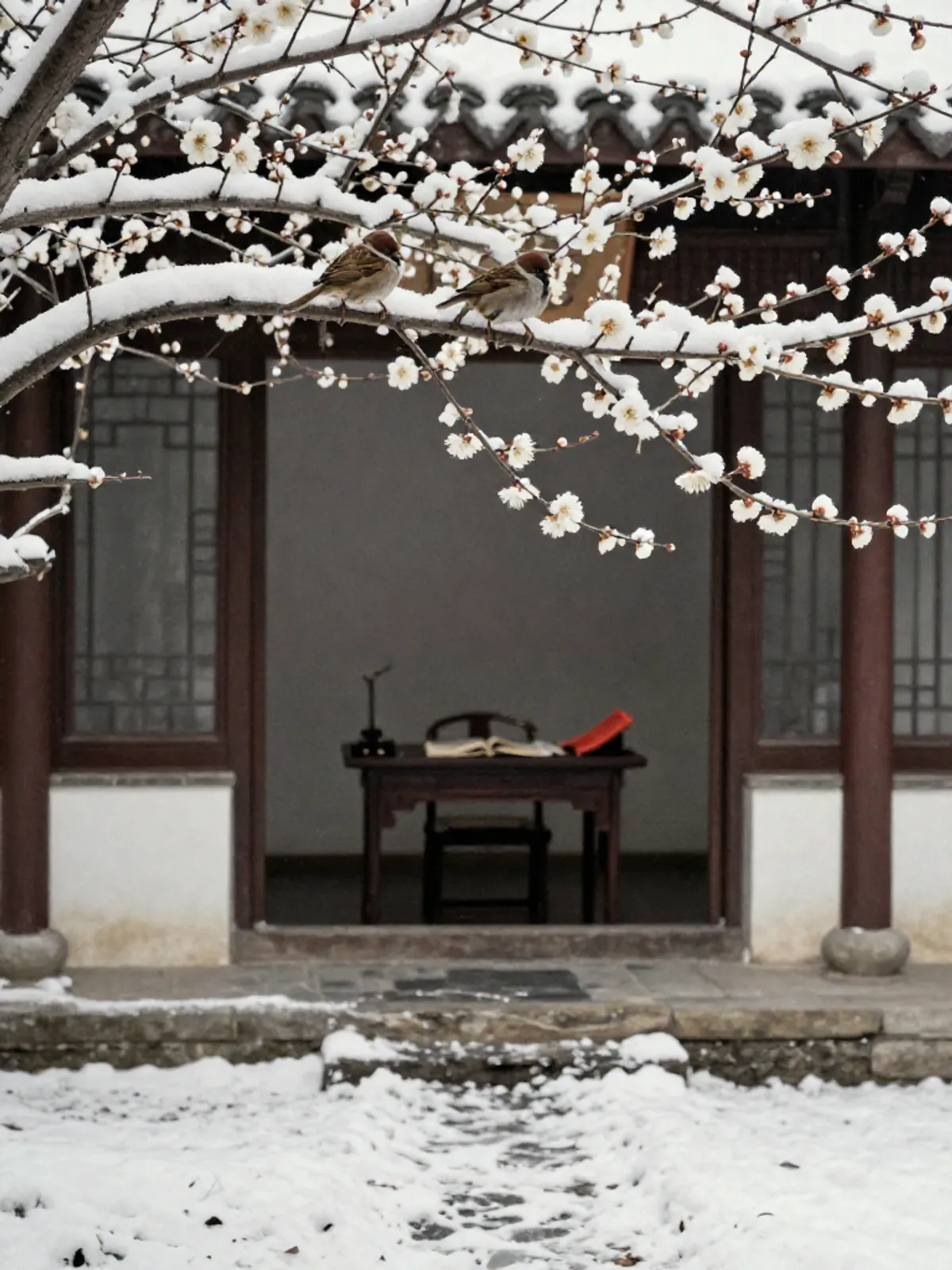
Two Sparrows and a Plum Branch
The incident that gave the method its name is the founding demonstration of meihua divination.
On the seventeenth day of the twelfth month of a chen (辰) year, during the shen (申) hour, Shao Yong was observing plum blossoms in his garden when he noticed two sparrows fighting over a branch. One fell. From this scene - unremarkable to anyone else - he derived a complete hexagram and a precise prediction.
Here is how the mathematics work.
The meihua system uses the Prior Heaven (xiantian, 先天) trigram numbers, a fixed assignment attributed to the legendary sage Fuxi:
- Qian (乾) = 1
- Dui (兌) = 2
- Li (離) = 3
- Zhen (震) = 4
- Xun (巽) = 5
- Kan (坎) = 6
- Gen (艮) = 7
- Kun (坤) = 8
To derive the upper trigram, Shao Yong summed the numbers of the year, month, and day: the chen year (5) + twelfth month (12) + seventeenth day (17) = 34. Divide by 8: 34 / 8 = 4 remainder 2. The remainder 2 corresponds to Dui (兌), the Lake. This becomes the upper trigram.
For the lower trigram, add the hour to the previous sum: 34 + shen hour (9) = 43. Divide by 8: 43 / 8 = 5 remainder 3. The remainder 3 corresponds to Li (離), Fire. This becomes the lower trigram.
The moving line is found by dividing the total by 6: 43 / 6 = 7 remainder 1. The moving line is in the first position, counted from the bottom.
The resulting hexagram is Ze Huo Ge (澤火革), Hexagram 49 - Revolution. Lake above, Fire below. The moving line falls in the lower trigram (Li), making Li the yong (用, Function) trigram and Dui the ti (體, Body) trigram. The mutual trigram (hugua, 互卦) - derived from the inner four lines - yields Tian Feng Gou (天風姤), further refining the interpretation.
From this structure, Shao Yong predicted that the next evening a young woman would come to pick the plum blossoms and, in doing so, would fall and injure her thigh. The reasoning: Dui (Lake) symbolizes a young woman. The mutual trigram Xun (巽) represents the thigh. The moving line transforms the hexagram, and the interaction of elements pointed toward injury.
The prediction was confirmed.
What matters here is not the prophecy but the method. An ordinary scene - blossoms, birds, a winter garden - became legible as a hexagram. The oracle did not require stalks or coins. It required only the capacity to perceive the numerical structure latent in the moment.
The Mathematics of Perception
The date-time method illustrated above is only the most basic of the meihua casting techniques. The Meihua Yishu describes ten methods for generating hexagrams from the world:
- Date and time (nianyueri shi, 年月日時) - the foundational method, using calendrical numbers.
- Object counting (shumu, 數目) - the number of objects in view: birds on a wire, tiles on a roof, steps to a door.
- Sounds (shengyin, 聲音) - the number of knocks, cries, chimes, or spoken words.
- Characters (zihua, 字畫) - the stroke count of written characters.
- Measurements (chicun, 尺寸) - lengths, heights, dimensions.
- Reading a person (renwu, 人物) - the querent's position, appearance, or bearing.
- Animals (qinshou, 禽獸) - species, number, direction of movement.
- Inanimate objects (jingjing, 靜景) - arrangement, shape, material.
- Shapes (xingzhuang, 形狀) - geometric forms, natural configurations.
- Colors (yanse, 顏色) - the dominant hues of a scene, mapped to five-phase correspondences.
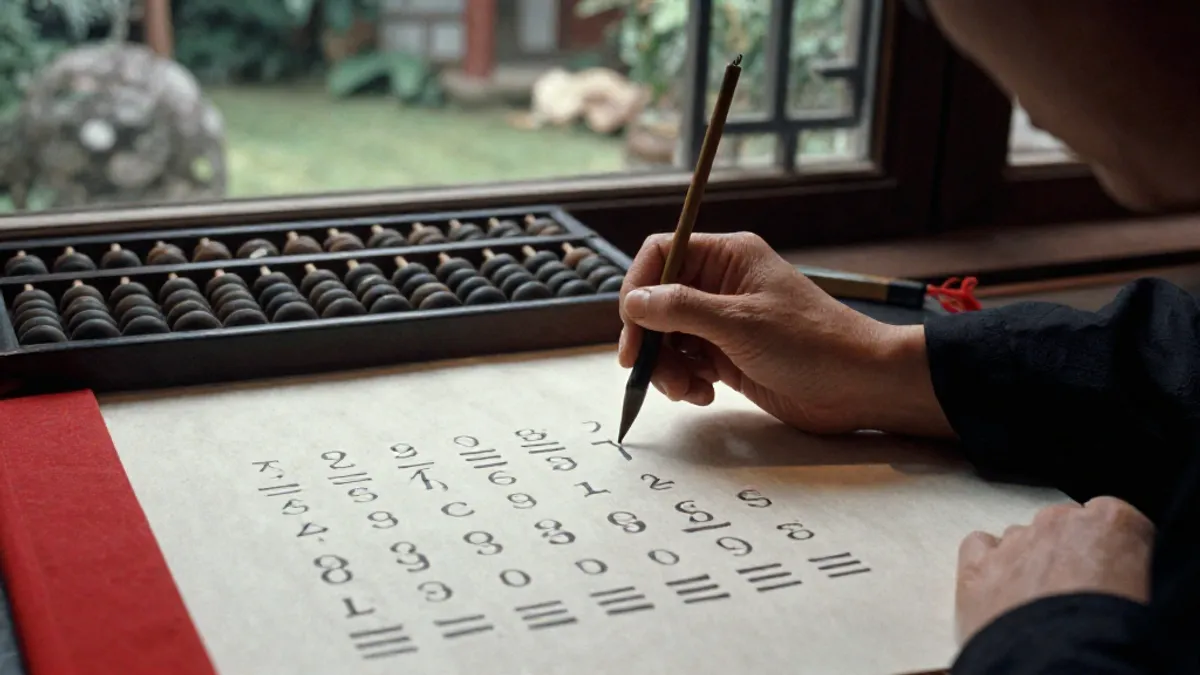
The core mathematical operation is always the same: sum the relevant numbers, divide by 8 for the trigram, divide the total by 6 for the moving line. If the remainder is 0, use 8 (Kun) for trigrams or 6 for the moving line. The elegance of the system lies in its universality. Any countable or classifiable phenomenon can generate a hexagram.
But beneath the arithmetic sits a more radical idea. The meihua system presupposes that the moment of observation is not arbitrary. The numbers you encounter are already the oracle's answer. The hexagram does not arise from randomness, as it does with coins or stalks. It arises from the structure of the moment itself. You are not generating a hexagram. You are discovering one.
This presupposition has a name in the tradition: bu dong bu zhan (不動不占), "Do not divine what does not move." The hexagram arises only when something happens - a sound, a movement, an unexpected encounter. Stillness does not speak. Only change generates a reading. The diviner waits, attentive, until the world offers a sign. Then - and only then - does the calculation begin.
The distinction between meihua and stalk-or-coin methods is therefore not merely procedural. It is ontological. With stalks or coins, you create a controlled act of randomness and ask the oracle to speak through it. With meihua, you attend to what is already occurring and recognize that the oracle has already spoken. The first method treats the hexagram as something to be produced. The second treats it as something to be perceived. This is a different relationship with the world entirely - one in which attentiveness replaces ritual, and the diviner's primary skill is not manipulation of objects but refinement of awareness.
Body and Function
Casting the hexagram is only half the work. The other half - and the more demanding half - is interpretation. Here the meihua system introduces a framework of extraordinary power: ti-yong (體用, Body-Function) theory.
The principle is stated with characteristic compression:
體卦為主,用卦為事。
The Body trigram is the subject; the Function trigram is the situation.
In any meihua hexagram, the trigram that does not contain the moving line is the ti (體, Body) - it represents the querent, the self, the stable ground. The trigram that does contain the moving line is the yong (用, Function) - it represents the situation, the external force, the matter being asked about.
The relationship between Body and Function is then analyzed through the five-phase (wuxing, 五行) cycle. Each trigram carries an elemental correspondence: Qian and Dui are Metal; Zhen and Xun are Wood; Kan is Water; Li is Fire; Gen and Kun are Earth. The five phases interact through generation (sheng, 生) and overcoming (ke, 克), and these interactions yield the core judgments of every reading:
- Function generates Body (yong sheng ti, 用生體): highly auspicious. Support arrives without effort. The situation nourishes the querent.
- Body overcomes Function (ti ke yong, 體克用): the goal is achievable, but requires effort. You have the upper hand, but must act.
- Function overcomes Body (yong ke ti, 用克體): inauspicious. External forces are stronger than your position. Caution is warranted.
- Body generates Function (ti sheng yong, 體生用): energy drain. Your resources flow outward toward the situation. Loss, expenditure, diminishment.
- Body and Function in harmony (ti yong bihe, 體用比和): everything proceeds smoothly. The text says simply: "All affairs go well" (百事順遂).
This framework transforms the meihua method from a curiosity into a universal analytical lens. Any situation can be mapped: the Body is always "you" (or your side, your interest, your position), the Function is always "what you face." The five-phase interaction between them tells you whether the energy flows in your favor, against you, or whether you are bleeding resources into a situation that cannot nourish you in return.
The mutual trigram (hugua, 互卦) and the transformed hexagram (biangua, 變卦) add further layers. The mutual trigram is derived from the inner four lines of the hexagram (lines 2-3-4 form one trigram, lines 3-4-5 form another), revealing the hidden dynamics at the center of the situation - what is not immediately visible but is actively shaping the outcome. The transformed hexagram shows the direction of development - where the situation is headed once the moving line completes its change. A reading that looks auspicious in the primary hexagram may darken when the transformed hexagram reveals a difficult destination. A grim primary hexagram may lighten when its transformation points toward resolution.
The five-phase relationships among all these trigrams - Body, Function, mutual, and transformed - create a web of interactions that the skilled reader navigates with increasing subtlety. A single hexagram reading in the meihua system is not a flat answer but a three-dimensional map of forces, timing, and trajectory.
"Numbers Must Be Tempered by Reason"
The Meihua Yishu contains many worked examples, but one stands above the rest as a teaching moment. It concerns not a dramatic prophecy but a humble household object.
One winter evening, a neighbor knocked at Shao Yong's door. The pattern of knocks came in two groups: first one knock, then five. Shao Yong's son, who was studying the method, attempted to derive the hexagram and predict what the neighbor wanted to borrow.
One knock yields the trigram Qian (乾, 1). Five knocks yield the trigram Xun (巽, 5). The resulting hexagram is Tian Feng Gou (天風姤), Heaven over Wind. Analyzing the trigram components - three Qian lines (Metal, associated with short, hard objects) and two Xun lines (Wood, associated with long, flexible objects) - the son reasoned that the neighbor wanted to borrow something with a short metal head and a long wooden handle. He guessed: "A hoe."
Shao Yong corrected him. The analysis of the hexagram was sound. The trigram-element reasoning was correct. But the conclusion was wrong, because it ignored context. He said:
推數又須明理。
In divination, you must also use reason.
At night, in winter, who borrows a hoe? No one is tilling a garden in the dark. The object must be something needed at night - something with a short metal head and a long wooden handle that one would require urgently on a cold evening. An axe, for splitting firewood.
This is the text's most important pedagogical moment, and it cuts against any temptation to treat meihua as a mechanical procedure. The numbers give you a structure. Reason gives you a meaning. Without context - time, season, circumstance, the ordinary logic of human life - the mathematical result is a skeleton without flesh. The diviner who trusts calculation alone is like a translator who knows grammar but has never heard the language spoken.
Tui shu you xu ming li. This sentence should be inscribed above the desk of every student of the method.
The teaching extends beyond divination into epistemology. Every model, every framework, every analytical system produces outputs that must be interpreted through lived understanding. Data without context is noise. The hexagram without reason is superstition. The meihua tradition insists on both - the rigor of the calculation and the wisdom to know what the calculation means in the particular, unrepeatable circumstances of this moment, this place, this hour.
The Peony and the Horses
Another celebrated example demonstrates the full reasoning chain.
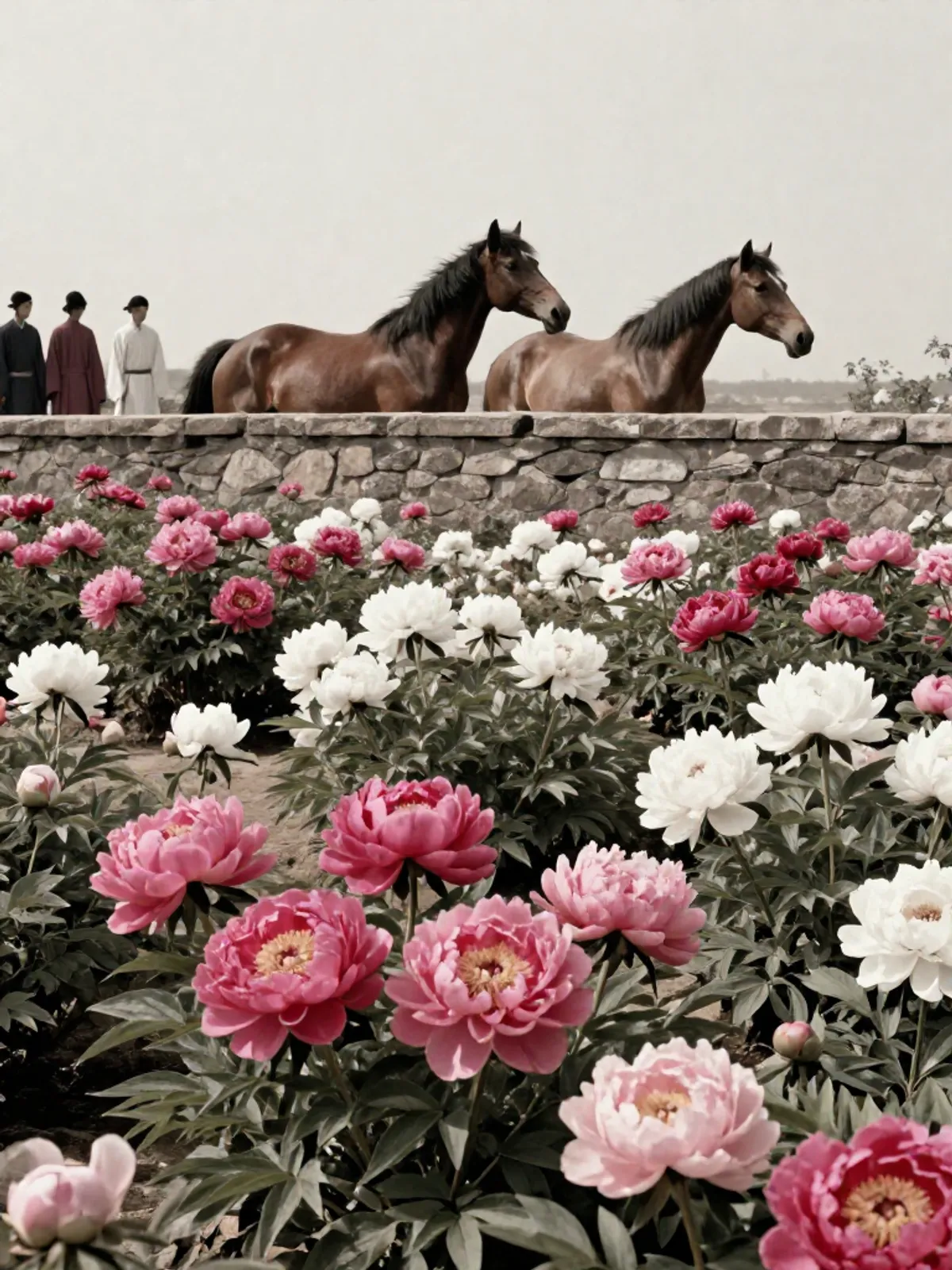
Shao Yong was visiting a friend's garden with several guests, admiring a magnificent display of peonies in full bloom. One guest, half playful and half serious, posed a question:
花盛如此,亦有數乎?
The flowers are so abundant - do even they have their number?
The question itself became the occasion for divination. Shao Yong cast the hexagram using the date and time, arriving at a reading that predicted: "Tomorrow at noon, these flowers will be trampled by horses."
The guests were incredulous. The garden was enclosed. The peonies were flourishing. No horses were in sight. Several of the guests smiled at what they took to be the old scholar's eccentricity.
The next day at noon, two of the regional governor's horses, being exercised in the nearby fields, broke free from their handlers. The animals fought, bolted, and stampeded directly through the garden gate into the peony beds. The flowers were destroyed exactly as predicted.
The technical details of the casting matter less here than the interpretive principle. The hexagram structure indicated Metal overcoming Wood (horses are associated with Qian/Metal in the xiantian system; peonies are Wood). The timing was fixed by the moving line's position. But the prediction required more than element theory. It required the imaginative leap from "Metal overcomes Wood" to the concrete image of horses trampling flowers - the willingness to let the abstraction find its specific, lived form.
This is the art of meihua reading. The mathematics give you a skeleton of relationships: this element overcomes that element, at this time, in this direction. The diviner's task is to clothe that skeleton in the particular flesh of the situation at hand. It is an act of disciplined imagination - neither pure logic nor pure intuition, but a conversation between the two.
The Diviner's Mind
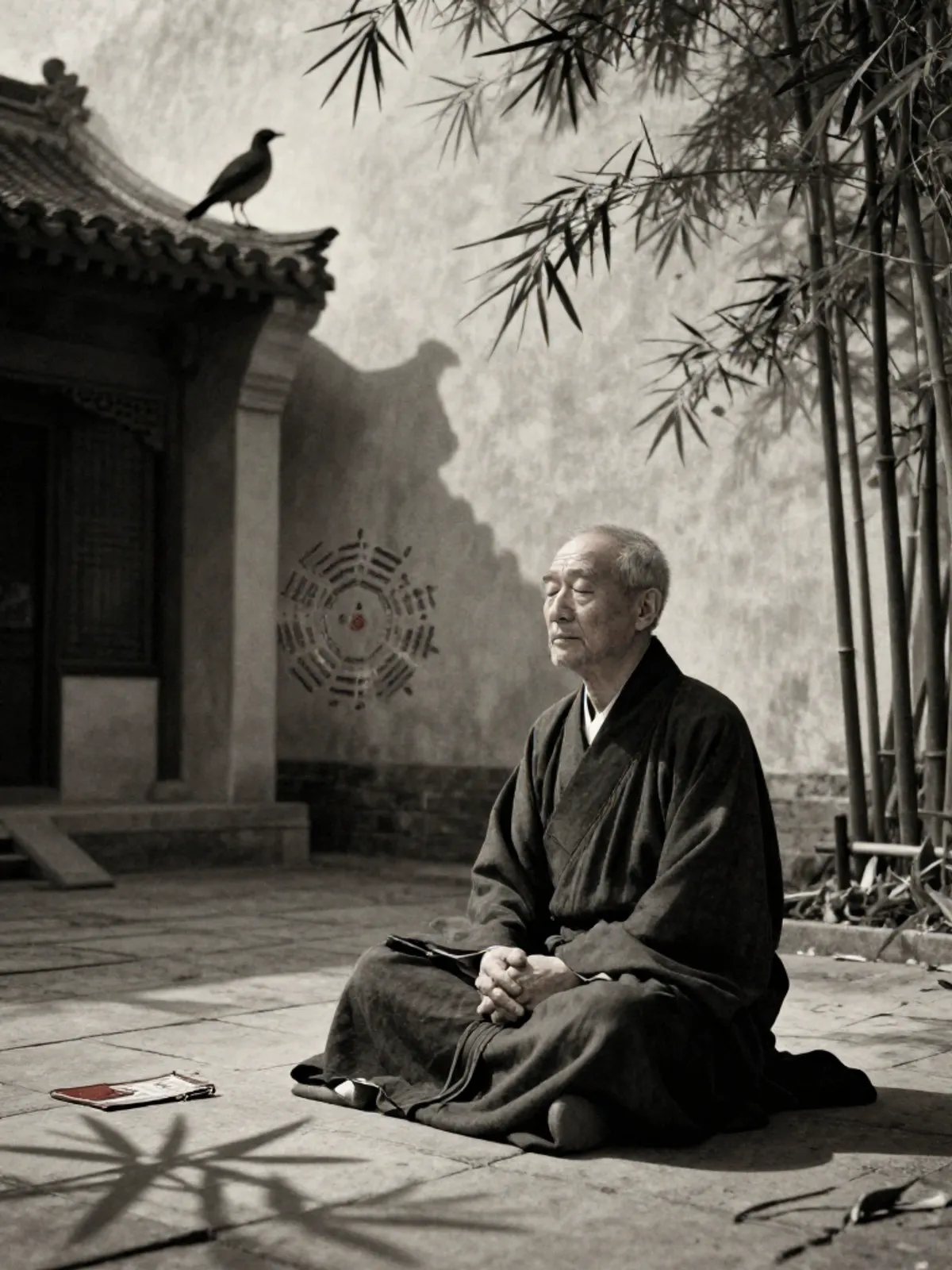
If meihua were merely a mathematical technique, it could be programmed into a machine. It cannot, because the system's deepest requirement is not computational but contemplative.
The Meihua Yishu is explicit about this. The text's most demanding passage concerns not trigrams or elements but the state of the diviner's own mind:
心清明而無一毫之累……性理具在而易存吾心,渾然是易也。
When one's mind is clear and bright, without a single thread of interference... then the innate principle of the Yi exists in one's heart, and one is entirely the Yi.
To be "entirely the Yi" is not a metaphor. It is a description of a perceptual state in which the practitioner no longer consults the Changes from outside but perceives the world through its logic directly. The hexagrams cease to be symbols applied to experience. They become the structure of experience itself.
The text goes further:
思慮未動,鬼神不知。
Before thought stirs, even ghosts and spirits cannot know.
This points to the moment before conceptual thought arises - the instant of pure perception, before the mind begins to categorize and interpret. In that instant, the practitioner sees the situation as it is, unclouded by desire, fear, or expectation. The hexagram that arises from this seeing is trustworthy precisely because it has not been contaminated by the diviner's wishes.
There is a parallel here with contemplative traditions across cultures - the Zen emphasis on mushin (無心, no-mind), the Daoist concept of wuwei (無為, non-action), the Christian mystic Meister Eckhart's Gelassenheit (releasement). In each case, the practitioner seeks a state of receptive clarity in which perception is not filtered through the ego's preferences. The meihua tradition makes the pragmatic claim that this state produces better divination. But the implication runs deeper: if accurate reading of the world requires a mind free of self-interest, then the practice of divination becomes inseparable from the practice of self-cultivation. You cannot see clearly while wanting something from what you see.
The Meihua Yishu also describes the Three Essentials (sanyao lingying, 三要靈應) that support accurate readings:
- The Ear (er, 耳): what is heard at the moment of divination - sounds, words, tones.
- The Eye (mu, 目): what is seen - colors, movements, arrangements.
- The Heart-Mind (xin, 心): the intuitive sense that arises without deliberation.
These three channels - auditory, visual, and intuitive - converge in the moment of casting. The diviner does not merely calculate a hexagram from one input. The diviner attends to the total field of the moment, integrating multiple streams of information into a single, coherent reading.
This elevates meihua from a technique of divination to a discipline of cultivation. The diviner's accuracy depends directly on the clarity of the diviner's mind. Emotional turbulence, obsessive desire for a particular outcome, intellectual arrogance - these do not merely "bias" the reading. They make genuine reading impossible. The practice becomes, inevitably, a practice of self-refinement.
True and Apparent Overcoming
The five-phase interactions that structure meihua interpretation are not as simple as they first appear. The tradition draws a crucial distinction between genuine overcoming and apparent overcoming - between element interactions that actually produce effects and those that exist in theory but lack the force to manifest.
The Meihua Yishu offers vivid illustrations. A sharp blade of forged steel (zhen jin, 真金) genuinely overcomes wood: it cuts, splits, reshapes. But a gold hairpin cannot fell a tree. A furnace fire genuinely overcomes metal: it smelts, melts, transforms. But a single lamp flame does not threaten an iron pot. Water overcomes fire - but a cup of water will not extinguish a burning building.
The principle is proportionality. Element interactions are not binary switches that are simply "on" or "off." They operate along a spectrum of intensity, and the diviner must assess whether the overcoming force in a given reading is proportionate to what it claims to overcome. A trigram of Metal in the Function position may theoretically overcome a trigram of Wood in the Body position - but if the Metal is weak (a yin trigram in a diminished seasonal position) and the Wood is strong (supported by the season and other elements in the hexagram), then the theoretical overcoming will not manifest. The tree stands. The hairpin bends.
This teaching guards against mechanical interpretation. It is not enough to know the cycle of generation and overcoming. You must also assess the relative strength of the forces involved - their seasonal vitality, their support from other trigrams in the hexagram, their correspondence to the actual objects and forces in the situation being read.
Season matters especially. Each element has its time of maximum strength: Wood in spring, Fire in summer, Metal in autumn, Water in winter, Earth at the transitions between seasons. A Wood trigram in spring is at full power; the same trigram in autumn, when Metal dominates, is weakened. The skilled diviner reads not only the trigram but its seasonal context - whether the force in question is waxing, at its peak, waning, or dormant. The same hexagram cast in March and in October may carry entirely different implications.
The five phases are a grammar, not a verdict. And like any grammar, their power lies not in the rules themselves but in the practitioner's ability to compose with them - to construct meaning from structure, to read the particular within the universal.
A Practice: Reading the World
If you wish to begin meihua practice, start with the date-time method. It is the most structured, the least dependent on intuitive perception, and the most forgiving of beginners.
Choose a moment when something catches your attention unbidden - a sudden sound, an unexpected encounter, a scene that arrests you for no obvious reason. Note the date and time according to the Chinese calendar (online converters will serve). Sum the year, month, and day numbers. Divide by 8 for the upper trigram. Add the hour number to the sum. Divide by 8 again for the lower trigram. Divide the total by 6 for the moving line. Identify the Body and Function trigrams. Assess their five-phase relationship.
Then sit with the hexagram. Read its traditional judgment and image. Consider how the Body-Function relationship maps to your question or situation. Let the mutual trigram reveal what is hidden. Let the transformed hexagram suggest where things are heading.
A concrete example for your first attempt. Suppose you are walking on the fifteenth day of the third month of a yin (寅) year, during the mao (卯) hour. You hear a dog bark three times, and the sound arrests your attention. Using the date-time method: yin year (3) + third month (3) + fifteenth day (15) = 21, divided by 8 = remainder 5, which is Xun (巽, Wind). Add mao hour (4): 21 + 4 = 25, divided by 8 = remainder 1, which is Qian (乾, Heaven). The moving line: 25 / 6 = remainder 1, first line. Your hexagram is Feng Tian Xiao Chu (風天小畜), Wind over Heaven - The Taming Power of the Small. The lower trigram Qian contains the moving line, so Qian is the Function and Xun is the Body. Now you reason: what does this configuration tell you about your situation?
Keep a journal. Record not just the hexagram and the calculation but the scene that prompted it - the image, the sound, the quality of the moment. Over time, your journal becomes a training record, a document of how your perception sharpens. Return to old entries after weeks or months. You will find that certain readings whose meaning was opaque at the time become luminously clear in retrospect - and this retrospective clarity is itself a teacher, revealing the gap between what you could see then and what you can see now.
As your practice matures, begin to notice trigrams in the world without calculating them. The eight trigrams are not abstractions. They are perceptual categories. Qian is the dome of the sky, the authority of a father, the hardness of metal. Kun is the flat field, the patience of the earth, the receptivity of a mother. Zhen is the sudden crack of thunder, the eldest son, the shock of the new. You will begin to see situations as combinations of trigrams - fire beneath the mountain, wind over the lake - before you reach for any numbers at all.
But observe one discipline absolutely. The meihua tradition warns against compulsive divination. Bu dong bu zhan - do not divine what does not move. Do not cast hexagrams for idle curiosity, for entertainment, or to confirm what you have already decided. The oracle speaks when the moment speaks. When nothing stirs, the correct practice is silence.
The World as Oracle
一物從來有一身,一身還有一乾坤。能知萬物備於我,肯把三才別立根。
One thing from its origin has one body; one body contains its own heaven and earth. If you can know that the myriad things are all complete within me, then you may establish the root of the Three Powers.
- Meihua Yishu
The meihua method begins as a technique and ends as a way of seeing. Its mathematics are not difficult - addition, division, remainders. Its interpretive framework - Body, Function, five-phase interaction - can be learned in an afternoon. What cannot be learned in an afternoon is the quality of attention it demands.
Shao Yong did not invent a cleverer way to cast hexagrams. He recognized that the hexagram is not something you construct. It is something already present in the structure of every moment, every encounter, every scene that unfolds before you. The sparrows on the plum branch were already a hexagram before he calculated a single number. His calculation merely made explicit what was already there.
This is the deepest teaching of the Meihua Yishu, and it circles back to the heart of the Yijing itself. The Changes are not in the book. The book merely records what the sages saw when they looked at the world with unclouded eyes. The hexagrams are the shapes of change, and change is all there is.
To practice meihua is to train yourself to see those shapes - first through numbers, then through reason, then through a perception so refined that the distinction between observer and oracle falls away. You do not read the world. You realize you have always been reading it, poorly. The practice simply corrects your vision.
But the final correction is this: the deepest pattern you will ever read is the one you carry. The trigrams of your own mind - its habitual movements, its characteristic blindnesses, its seasons of clarity and turbulence - are the most consequential hexagram you will ever cast. "The myriad things are all complete within me." The world is the oracle. And so, irreducibly, are you.