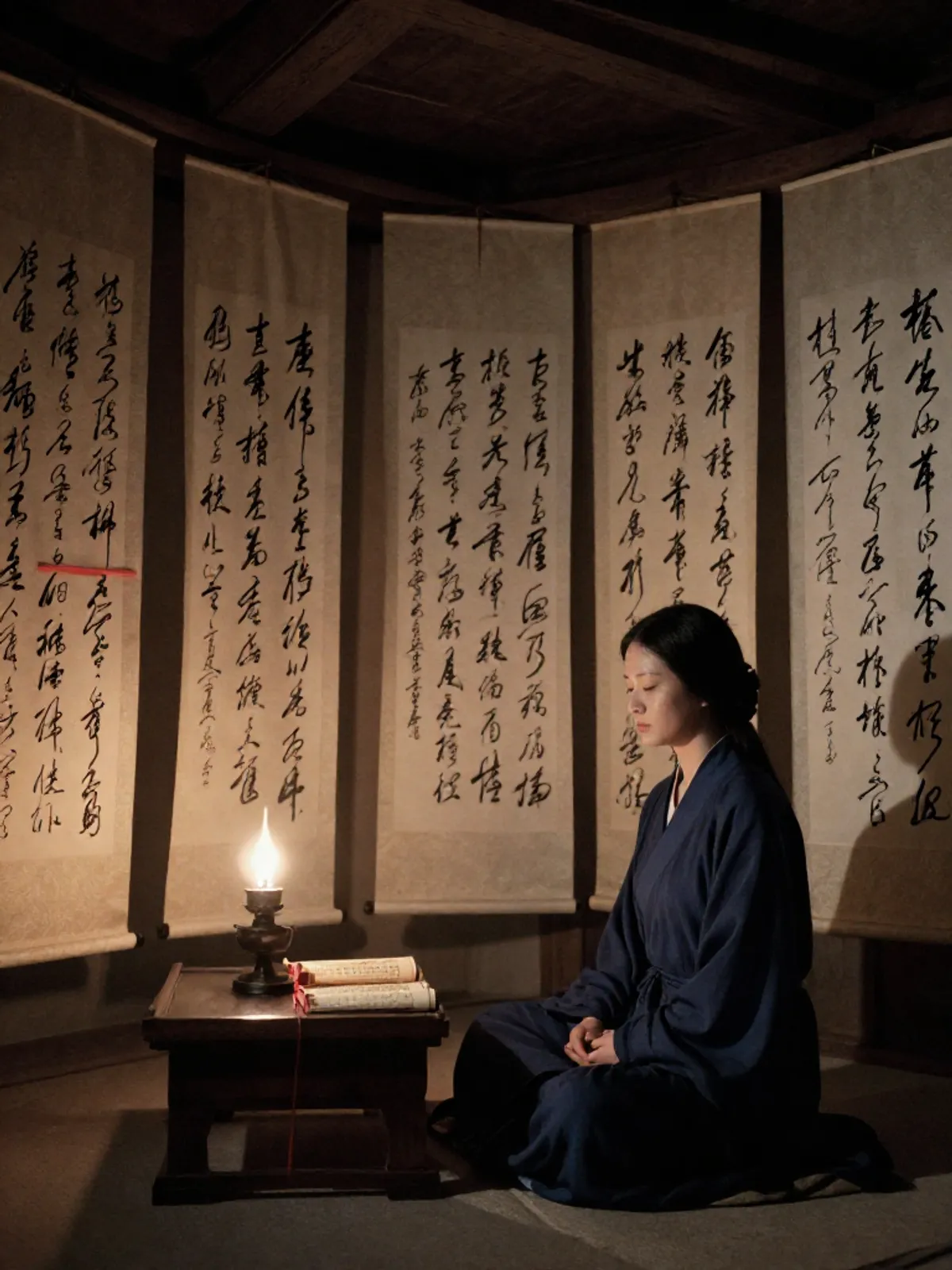
Not a Modification
There is a persistent misunderstanding about nüdan (女丹, women's alchemy): that it is men's practice with adjustments. A modified recipe. The same building, different door.
The texts themselves say otherwise.
In a previous issue, we explored the feminine as it appears in the Daodejing and the inner alchemical traditions — the xuanpin (玄牝, mysterious feminine), the cosmological priority of the receptive, and the figure of Sun Bu'er as the exemplary woman adept. That article ended at the threshold of the nüdan texts. Now we cross it.
What we find on the other side is not a supplement to male practice but an independent body of cultivation literature — one that begins from the female body, addresses the female body, and refuses to treat the female body as an inferior version of the male. The first-stage practices are different. The energetic anatomy is different. The relationship to blood, breath, and the womb is different. These are not modifications. They are a distinct tradition, articulated across centuries by women who practiced, realized, and transmitted what they knew.
To read the nüdan texts is to encounter a voice that has been there all along, waiting — not for permission to speak, but for ears willing to listen.
The misconception has deep roots. When Western scholars first encountered Chinese alchemical literature in the nineteenth and early twentieth centuries, they mapped it onto frameworks they already possessed — Western esotericism, Indian tantra, the universal-mystic template that smooths all traditions into one reassuring shape. Women's alchemy, in this reading, became a footnote: an adaptation, a concession, proof that the tradition was at least willing to include women if they followed the men's path with minor variations. The texts themselves were rarely consulted. The assumption was enough.
The Anthology of Many Voices
The Nüdan Hebian (女丹合編, "Collected Works on Women's Alchemy") is not a single text with a single author. It is an anthology compiled during the Qing dynasty (1644–1912) that gathers instructions, poems, commentaries, and oral transmissions from multiple lineages across several centuries. To read it as a monograph is to misread it. It is more like a chorus — different voices, different periods, unified by a common subject.
Some of its material is attributed to Sun Bu'er (孫不二, 1119–1182), the Quanzhen adept whose poems on women's cultivation circulated widely in later centuries. Other sections draw on teachings associated with He Xiangu (何仙姑), the sole woman among the Eight Immortals. Still others preserve the words of anonymous women practitioners — lineage holders whose names the textual tradition did not bother to record, even as it faithfully preserved their instructions.
The compilation itself is an act of recovery. Whoever assembled the Nüdan Hebian understood that these teachings were scattered, fragmentary, and at risk of being lost. Some existed as handwritten manuscripts passed between teacher and student. Others survived within larger Daoist encyclopedias where they occupied a marginal position — included but not emphasized, preserved but not prioritized. The anthology format is not a weakness but a deliberate strategy: gather everything, preserve the contradictions, let the reader discern the pattern.
The result is a text that reads like a conversation across centuries. One passage offers terse, four-character instructions that assume a practitioner already deep in the work. The next provides patient, almost maternal guidance for a beginner. Some sections carry the formal cadence of court literature. Others have the rough directness of oral teaching, transcribed by a student who wanted to capture the master's voice exactly. This heterogeneity is the text's strength. It preserves not a single system but an entire tradition — plural, debated, alive.
And the pattern is remarkably consistent. Across lineages and centuries, the nüdan texts agree on the fundamental sequence: first quiet the heart-mind, then work with the blood and breath, then nurture the spiritual embryo. The details vary — the specific breathing methods, the visualization practices, the dietary recommendations. The architecture does not.
The First Gate: Quieting the Heart-Mind
女子修煉,先須靜心。心不靜,則神不凝;神不凝,則氣不聚。
In women's cultivation, one must first quiet the heart-mind. If the heart-mind is not quiet, the spirit cannot congeal. If the spirit does not congeal, the qi cannot gather.
- Nüdan Hebian
Every nüdan text begins here. Jìng xīn (靜心, quieting the heart-mind) is the first gate, the non-negotiable foundation. Before any work with breath or blood or subtle energy, the practitioner must learn to sit with the turbulence of her own mind and let it settle.
This instruction appears in male alchemical texts too. But the nüdan literature frames it with a particular urgency that reveals its social context. A woman in traditional China — managing a household, serving in-laws, raising children, navigating the dense web of familial obligation — had few occasions for solitude. The inner quiet required for alchemical work was not a given. It had to be carved out, often in stolen moments: before the household woke, after the children slept, during brief windows when duty loosened its grip.
The texts do not complain about this. They simply acknowledge it and instruct accordingly. The first practice is not elaborate. Sit. Close the eyes. Let the ten thousand concerns fall away, one by one, like leaves settling to the bottom of a still pond. Do not chase the thoughts. Do not fight them. Simply withdraw attention from them, the way you withdraw your hand from a flame — not with effort, but with the body's own intelligence.
Xin (心) in classical Chinese means both heart and mind. It is the organ of feeling-and-thinking, inseparable. To quiet the xin is not merely to stop thinking. It is to let the entire emotional-cognitive field come to rest. The nüdan texts understand that for many women, the emotional dimension is the harder one — not because women are more emotional, but because the conditions of their lives gave them more to grieve, more to worry over, more to hold.
The instruction is compassionate but uncompromising: none of the later stages are possible without this one. The red dragon cannot be slain by an agitated mind. The breast qi cannot be directed by a scattered spirit. Everything begins in stillness.
Slaying the Red Dragon
The most distinctive — and most frequently misunderstood — practice in nüdan is zhǎn chì lóng (斬赤龍, "slaying the red dragon"): the cessation of menstruation through meditative practice.
This is not suppression. The distinction matters enormously.
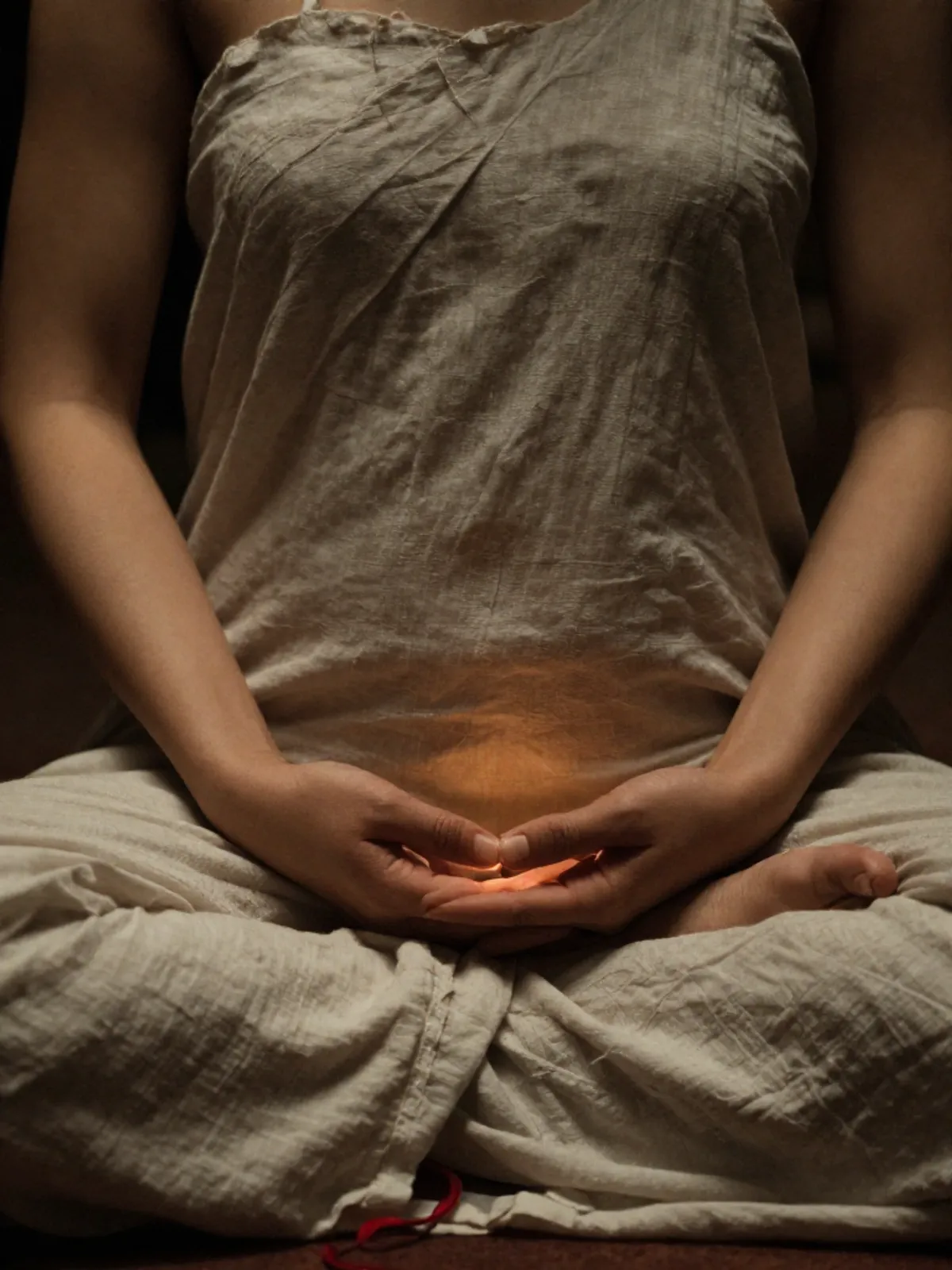
Suppression is the imposition of will on the body — a forcing, a denial. What the nüdan texts describe is closer to transformation: the reproductive qi that normally expresses itself as the menstrual cycle is gradually redirected, through sustained meditative work, toward the formation of the shèngtāi (聖胎, the holy embryo or spiritual body). The blood does not simply stop. The energy that produced it finds a different channel.
女子之經血,乃生人之本。若能逆用其機,則生仙之本。
A woman's menstrual blood is the root of creating a human being. If one can reverse its mechanism, it becomes the root of creating an immortal.
- Attributed to Sun Bu'er
The language of "slaying" is dramatic, and it is worth understanding why the tradition chose it. The red dragon is not the body. It is the unconscious, automatic expenditure of creative energy in biological reproduction. To "slay" it is to interrupt that automaticity — not to reject the body's capacity for creation, but to claim it for a different kind of creation.
The parallel to the male practice of liàn jīng huà qì (煉精化氣, refining essence into qi) is instructive. Male practitioners redirect sexual energy. Female practitioners redirect menstrual and reproductive energy. The underlying principle is the same: the body's most potent creative force is the raw material of spiritual transformation. But the somatic pathways are entirely different, and the nüdan texts are explicit about this. A woman cannot practice the male method and expect results. The body will not cooperate with instructions that do not belong to it.
Some commentators have attempted to allegorize the red dragon — to treat it as purely symbolic, a metaphor for desire or attachment. The texts resist this reading. They speak of blood, of cycles, of specific physical changes that accompany the practice. The red dragon is literal before it is symbolic. That is what makes its transformation meaningful: the most material, most undeniably physical dimension of feminine experience becomes the doorway to the most refined spiritual attainment.
The texts describe the process as gradual. First the cycle lightens. Then the intervals lengthen. Eventually, if the practice is sustained and the foundation of jìng xīn is solid, menstruation ceases entirely. The woman's complexion brightens. Her energy stabilizes. The texts say she begins to look younger — not as vanity, but as a sign that the body's resources are no longer being spent outward and downward but are being gathered and refined.
This is delicate ground, and the tradition walks it with more care than its detractors acknowledge. The womb is honored precisely because it is powerful. "The womb that creates a child can create a Buddha" — this is not a rejection of motherhood but a recognition that the same capacity underlies both.
The Breast Qi Circulation
Here the nüdan tradition departs most radically from male alchemy.
Liàn rǔ (煉乳, "refining the breast qi") is a practice with no male equivalent. The male alchemical body does not have this center, this pathway, this concern. The breast region in women's alchemy is understood as a secondary energy center — not one of the three dantian, but a site of particular significance for women's cultivation.
乳房為女子氣血之所聚,不可不煉。
The breasts are where a woman's qi and blood gather. They cannot be neglected in practice.
- Nüdan Hebian
The practice involves directing awareness and breath through the breast center. Not visualization exactly — the texts are careful to distinguish between imagined sensation and the felt, somatic movement of qi. The practitioner brings gentle attention to the chest, allows the breath to open the area, and lets the gathered energy descend along the Ren mai (任脈, conception vessel) toward the lower dantian (丹田).
The purpose is twofold. First, the breast center in women tends to accumulate stagnant qi — grief, unexpressed emotion, the physical residue of nursing and hormonal cycles. Clearing this stagnation is both therapeutic and preparatory. Second, the energy gathered in the breasts is understood as a refined form of qi that, when properly circulated, contributes to the formation of the holy embryo.
The nüdan texts treat the breast center the way they treat all aspects of the female body: as a specific site of practice, neither shameful nor incidental. The body is the alchemical vessel. Every part of it is relevant. To ignore the breast center because it makes the male commentarial tradition uncomfortable is to practice an incomplete alchemy.
The instruction is always gentle. Attention, not force. Awareness, not will. The breath does the work. The mind simply accompanies it.
What is remarkable about liàn rǔ is how plainly the texts discuss it. There is no embarrassment, no euphemism, no apologetic framing. The breasts are part of the body. The body is the vessel of practice. To omit this center from women's alchemy would be like omitting the lower dantian from men's — a fundamental incompleteness that would undermine everything built upon it. The nüdan tradition's willingness to address the female body in its specificity is not radical in the modern sense. It is simply honest.
Sun Bu'er's Fourteen Verses
The Sūn Bù'èr Nüdān Shísì Shǒu (孫不二女丹十四首, "Sun Bu'er's Fourteen Verses on Women's Alchemy") is the most widely circulated text in the nüdan tradition. These fourteen poems trace the complete arc of women's cultivation, from the first settling of the heart-mind to the final dissolution into the Dao.
They are poems — compressed, allusive, layered. They encode practice instructions in verse, as was common in the Chinese alchemical tradition, where precision and beauty were not considered opposites. To read them is to encounter a master teacher who assumed her students were intelligent, committed, and already sitting.
The first verse establishes the foundation:
坤德柔順利貞吉,靜養靈根氣自回。
The virtue of Kun is yielding, gentle, beneficial, and true. In stillness, nurture the spiritual root — the qi returns of itself.
- Sun Bu'er, Verse 1
Kūn (坤) is the hexagram of pure yin in the Yijing — earth, the receptive, the feminine principle in its cosmological dimension. Sun Bu'er opens her sequence by grounding women's practice in the deepest structure of the Yijing's cosmology. This is not a derivative practice borrowing from male traditions. It begins from the yin principle itself, from the earth that receives and transforms.
The phrase qì zì huí (氣自回, "the qi returns of itself") is crucial. The practitioner does not force the qi to move. She creates the conditions — stillness, softness, patience — and the qi reorganizes on its own. This is wu wei (無為) applied to the body's own intelligence.
The seventh verse addresses the pivotal moment of transformation:
功夫到此方為妙,身外有身未足奇。
When practice reaches this point, it becomes truly wondrous. That there is a body beyond the body is not yet the marvel.
- Sun Bu'er, Verse 7
"A body beyond the body" — this is the shèngtāi, the holy embryo, described not as a metaphor but as an experiential reality. Sun Bu'er's tone is characteristically precise and unsentimental. The formation of the spiritual body is "not yet the marvel." There is further to go.
The later verses trace the practitioner's ascent through increasingly refined states: the circulation of light, the crystallization of the spiritual embryo, the opening of the tiānmén (天門, heavenly gate) at the crown of the head. Each verse builds on the last with a precision that reveals deep practice experience. These are not speculations. They are reports from someone who went the distance and came back to describe the terrain.
The final verses describe the dissolution of even this attainment, the release of the spiritual body into the formless Dao. The practitioner who has formed the holy embryo must then release it — must let go of even this extraordinary achievement and merge with the undifferentiated source. Sun Bu'er insists throughout that women's practice is complete in itself — a full path from beginning to ultimate realization. Her fourteen verses are not a supplement to a male curriculum. They are the curriculum, and they end where all authentic Daoist practice ends: in the return to the root, the dissolution of the practitioner into the Dao that was never separate from her.
He Xiangu and the Mountain
He Xiangu (何仙姑) occupies a singular place in the Daoist imagination. She is the only woman among the Bā Xiān (八仙, Eight Immortals), and her story, though wrapped in hagiographic legend, preserves a distinct model of women's cultivation.
The traditional accounts say she lived during the Tang dynasty, in the mountains of Guangdong. She was given a peach by a supernatural being — or she ground mica into powder and consumed it — or she vowed never to marry and retreated into the wilderness to practice. The details vary because the story was told and retold across centuries, each version emphasizing a different aspect of the teaching.
What remains constant is the pattern: renunciation, austerity, mountain solitude, and eventual immortality. He Xiangu achieved realization not through the elaborate alchemical sequences of the later nüdan literature but through what an earlier age understood as the fundamentals — ascetic diet, meditative absorption, and the slow refinement of the body's energies through years of uninterrupted practice in nature.
Her presence among the Eight Immortals is significant. It is not tokenism. The Eight Immortals represent the totality of human types — old and young, rich and poor, male and female, scholar and fool. Zhongli Quan is the ancient general, Lu Dongbin the scholar-swordsman, Lan Caihe the gender-fluid eccentric, Tie Guai Li the crippled beggar. Each embodies a different face of the Dao's expression in human form. He Xiangu's inclusion means the tradition recognized that feminine cultivation was not merely possible but necessary for the completeness of the immortal ideal. Without her, the Eight would be seven, and the pattern would be broken.
In popular religion, He Xiangu is often depicted holding a lotus flower — the symbol of purity arising from mud, of spiritual beauty emerging from the raw material of embodied existence. It is an apt image for the nüdan tradition as a whole: the body's most ordinary processes, properly understood and cultivated, become the means of extraordinary transformation.
The Nüdan Hebian preserves teachings attributed to He Xiangu that emphasize simplicity above all. Quiet the mind. Refine the breath. Let the body become transparent to the spirit. Her instructions lack the systematic elaboration of Sun Bu'er's verses, but they carry a different authority — the authority of someone who walked away from everything and sat in a cave until the Dao opened.
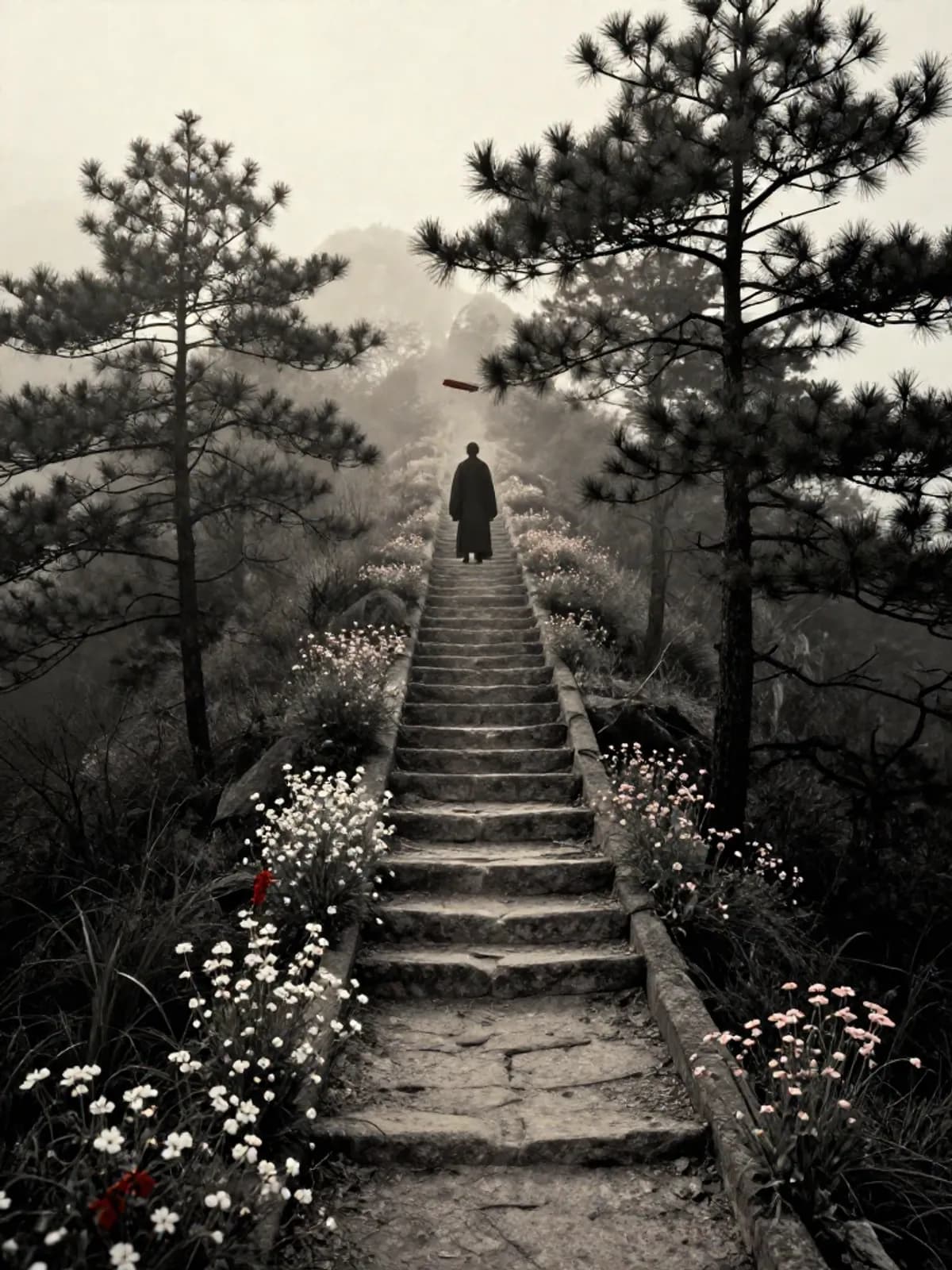
Where Sun Bu'er represents the householder's path — the woman who found cultivation within the structures of marriage, family, and organized religion — He Xiangu represents the renunciant's path. Both are legitimate. Both produce realization. The nüdan tradition is capacious enough to hold them both, and the Nüdan Hebian's inclusion of both models is itself a teaching: there is no single correct form for a woman's spiritual life. The mountain hermit and the urban practitioner, the celibate ascetic and the mother who meditates after the children sleep — the Dao does not prefer one over the other. It receives them all, as the valley receives all streams.
Womb Breathing, Twice Born
Tāixī (胎息, embryonic breathing) appears throughout the Daoist meditation literature, in both male and female traditions. The Taixi Jing (胎息經) describes a state in which the external breath becomes so subtle it nearly ceases, and the practitioner breathes through the dantian itself, as a fetus breathes through the umbilical cord.
But the nüdan texts describe tāixī with a resonance unavailable to the male tradition. For women, the language of embryonic breathing is not purely metaphorical. The womb is not an imagined furnace. It is the organ that has, or could have, actually held a developing life. When a woman practitioner cultivates tāixī, she is not borrowing a metaphor from biology. She is returning to a capacity that her body already knows.
胎息者,如嬰兒在母腹中,不以口鼻呼吸。女子修此,尤為親切。
Embryonic breathing is like an infant in the mother's womb, not breathing through mouth or nose. When women cultivate this, it is especially intimate.
- Nüdan Hebian
The word qīnqiè (親切, intimate, close, familiar) is telling. The text does not say women are better at tāixī. It says the practice is closer to them — that their bodies recognize it more readily, that the somatic memory of the womb gives them a direct relationship to what male practitioners must approach through analogy.
This double resonance — the alchemical embryo and the biological one, the spiritual womb and the physical one — is characteristic of nüdan at its most profound. The body is not transcended. It is deepened. The same capacity that creates life creates realization. Nothing is wasted. Nothing is rejected. The lowest becomes the highest through a shift not of substance but of direction.
The male alchemical tradition must construct a "womb" through visualization and energetic practice — the lower dantian becomes a metaphorical womb in which the spiritual embryo gestates. For women, the nüdan texts suggest, this construction is less arduous because the body already possesses the template. The practice is not to build something new but to recognize and redirect what is already present. This is not an argument for women's superiority in practice — the texts are careful to avoid such claims — but it is an acknowledgment that the female body offers a particular intimacy with the alchemical metaphor that the male body must work harder to achieve.
A Practice from the Texts
What follows is drawn from the nüdan literature and adapted for contemporary practitioners. It is not a substitute for lineage transmission, but it is a genuine beginning.
Preparation. Choose a quiet time — early morning or late evening. Sit comfortably on a cushion or chair. Spine upright, not rigid. Hands resting in the lap, palms up, one cradling the other. Close the eyes.
Settling. For the first several minutes, do nothing. Let the body arrive. Let the breath find its own rhythm without interference. Notice the weight of the body, the temperature of the air, the sounds in the room. Do not push anything away. Let the ten thousand things settle.
Lower dantian. When the mind has quieted — even partially — bring awareness gently to the lower abdomen, about two inches below the navel and slightly inward. Do not visualize anything. Simply rest attention there, as if listening to a sound almost too faint to hear. Let the breath naturally deepen toward this center. Do not force it. The breath knows where to go when you stop directing it.
Breast center. After some time — five minutes, ten, there is no prescribed duration — allow awareness to include the center of the chest. Not the heart, exactly, but the open space behind the sternum. Let the breath move gently between these two centers: the lower abdomen and the chest. Do not create a circuit. Do not visualize channels. Simply hold both centers in awareness and let the breath do what it will.
You may notice warmth, tingling, a sense of expansion. You may notice nothing. Both are fine. The practice is the attention itself, not the sensations it produces.
Closing. After twenty to thirty minutes, let go of the focus on any particular center. Rest in open awareness for a few breaths. Place both palms over the lower abdomen. Sit quietly for another moment before opening the eyes.
This practice is gentle. It asks nothing of the body that the body does not already know how to give. Its power lies not in technique but in consistency — in the willingness to return, day after day, to the quiet center that the nüdan texts insist is every woman's birthright.
A note on discomfort: you may encounter emotions during this practice — grief, tenderness, a sadness without a name. The nüdan texts anticipate this. The breast center and the lower abdomen are repositories of emotional experience, and when attention rests there with patience, what has been stored begins to move. The instruction is always the same: do not flee from it, do not pursue it, do not make a story of it. Let it arise, let it pass, let the breath continue. This is not bypassing emotion. It is allowing the body to complete what it has been holding incomplete.
Why Translation Matters
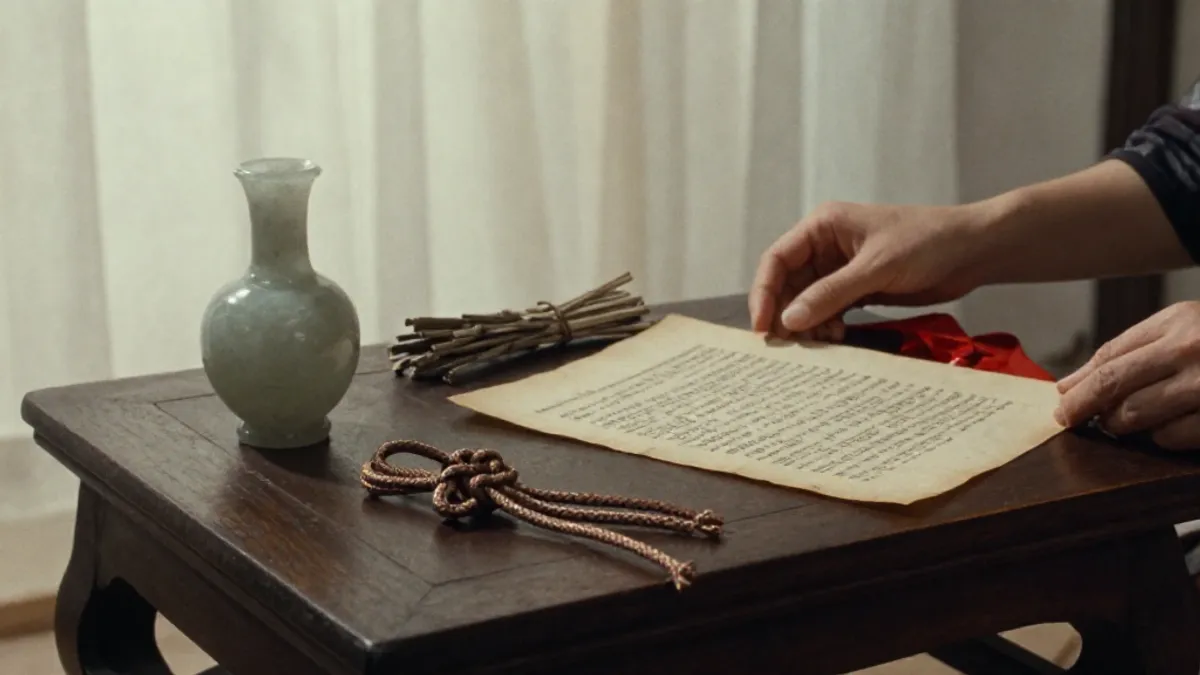
Classical Chinese is among the most compressed literary languages ever devised. A single character can carry a verb, a noun, and a philosophical concept simultaneously. The alchemical texts exploit this compression ruthlessly. A four-character phrase that takes three seconds to read may encode an instruction that requires three years of practice to understand.
Translation, then, is not merely a matter of finding English equivalents. It is a matter of unpacking — of making explicit what the original deliberately left implicit, because the original assumed a reader who was already practicing, already sitting, already working with a teacher who could fill in the gaps.
The nüdan texts present additional challenges. Many of them circulated as oral teachings before being written down, and the written versions retain the marks of oral transmission: ellipsis, repetition, the assumption of a shared physical practice that the text annotates rather than explains. To translate a passage about liàn rǔ without understanding the somatic reality it describes is to produce words without meaning — technically accurate, experientially empty.
There is also the problem of commentarial overlay. Many nüdan texts survive only within larger compilations edited by men, and the male editors sometimes added glosses that subtly reframe women's practice as a preparatory stage for "real" (meaning male) alchemy. Reading through these layers requires both philological skill and practice experience — the ability to distinguish the original voice from the editorial frame.
These texts deserve to be read on their own terms. Not simplified into self-help. Not exoticized into esoteric curiosity. Not absorbed into a male alchemical framework that treats them as an appendix. They are primary sources for a tradition of women's spiritual practice that spans centuries, and they speak with an authority that does not require anyone else's validation.
The work of translation is also, inevitably, a work of interpretation. Every translator makes choices — which ambiguity to resolve and which to preserve, when to render literally and when to gloss, how much context to supply for a reader who does not share the original audience's assumed knowledge. Good translation of the nüdan texts requires not only linguistic competence but embodied understanding. The translator who has never sat in meditation, who has no felt sense of what it means for qi to gather in the lower abdomen, will produce a text that is technically correct and spiritually inert. The words will be right. The transmission will be missing.
The Body as Text
The feminine in the Dao is not an abstraction. It is not a chapter in a philosophy textbook, not a symbol to be decoded, not a principle to be admired from a safe intellectual distance. It is a body sitting in the dark before dawn, breathing. It is the felt sense of qi gathering in the lower abdomen. It is the patient, unglamorous work of returning, day after day, to the quiet that the nüdan masters said was the foundation of everything.
The tradition of women's alchemy is in recovery. Texts are being translated — in China, in Taiwan, in Western universities where scholars with both philological training and practice experience are doing the slow, careful work of rendering these compressed classical instructions into languages that can carry them. Lineages are being reconstructed. Practitioners — women and men alike — are beginning to take these teachings seriously, not as historical artifacts but as living instructions that have something to say to a body sitting quietly in a room in the twenty-first century.
歸根曰靜,靜曰復命。
Returning to the root is called stillness. Stillness is called returning to life.
- Laozi, Daodejing, Chapter 16
The root has not moved. The valley spirit has not died. The mysterious feminine is still there — in the texts, in the body, in the breath that continues whether or not anyone is watching. The nüdan tradition asks only this: that you sit down, grow quiet, and listen to what your body has always known.