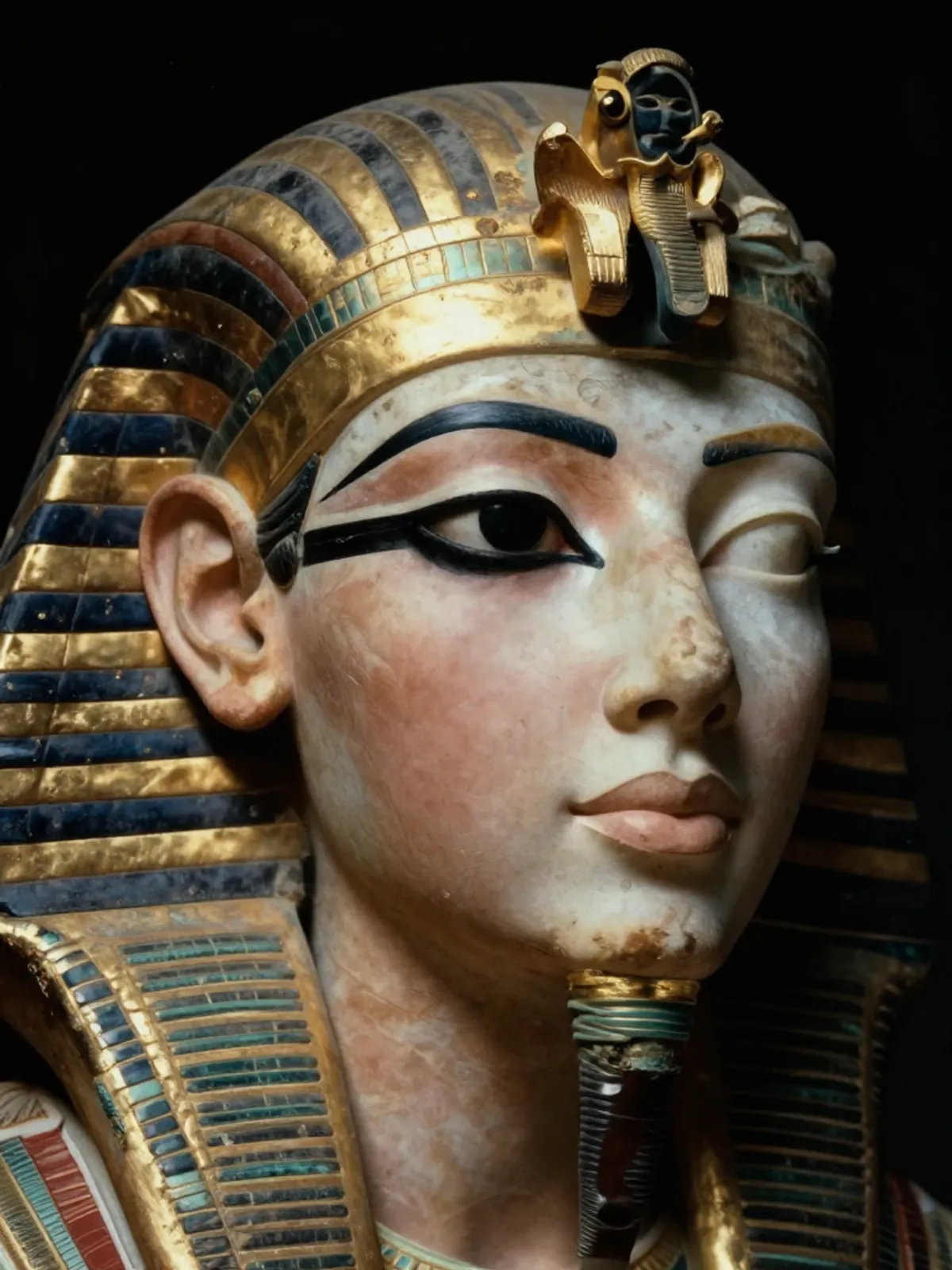
The Chain of Names
On certain conspiracy maps - the kind drawn in red string and permanent marker - you will find a lineage that looks something like this:
Cybele --- Inanna --- Ishtar --- Isis --- Aphrodite --- Venus --- Diana --- Semiramis --- Columbia --- Libertas --- Statue of Liberty
The implication is always the same: a single goddess, worshipped continuously under different masks for six thousand years, her cult maintained by secret priesthoods that became secret societies that became the architects of the modern world. The chain of names is presented as evidence of a hidden continuity - proof that someone, somewhere, never stopped lighting the old fires.
It is a seductive story. It is also wrong in the way that makes it almost impossible to correct, because it is built on something true.
These goddesses are related. Their iconographies do rhyme. Attributes did migrate from one to the next across centuries and civilizations. But the mechanism is not conspiracy. It is something far more common and far more interesting: it is the way human beings have always carried their gods with them when they travel.
Consider a parallel that AEON readers will recognize immediately. In Indian Buddhism, Avalokitesvara (अवलोकितेश्वर) is male - a bodhisattva of compassion depicted with a mustache and bare chest. When this figure crossed the Himalayas and the South China Sea into Chinese Buddhism, Avalokitesvara became Guanyin (觀音) - female, robed in white, holding a willow branch and a vase of pure water. No conspiracy was required. The transformation happened because Chinese culture already had a space shaped like a compassionate mother goddess, and the incoming deity flowed into it like water into a valley.
The goddess migrations of the ancient Mediterranean followed the same logic. Not a single cult in hiding, but a recurring pattern: human beings, encountering the divine feminine in a foreign form, recognizing something they already knew.
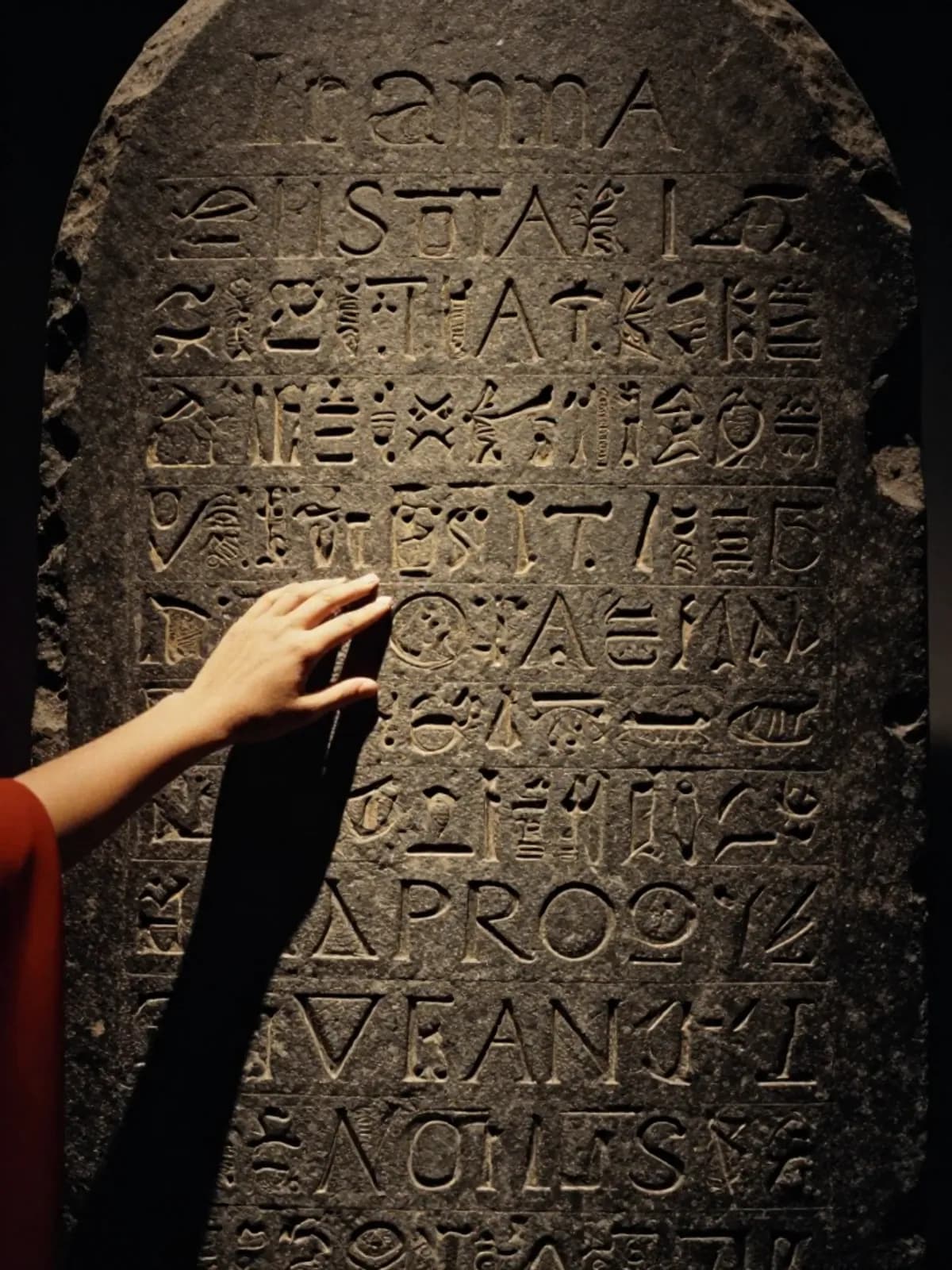
Inanna: The First
She is the oldest named goddess whose worship we can trace in the archaeological record. The Sumerians of southern Mesopotamia were venerating Inanna (𒀭𒈹) at the temple of Eanna in Uruk by at least 4000 BCE - a full millennium before the first pyramids rose in Egypt.
Inanna is not a fertility goddess. Or rather, she is not merely a fertility goddess, and to call her one is to flatten something fierce and strange into something pastoral and manageable. She is the goddess of sexual desire, of political power, of war, of the morning and evening star. She is, in the Sumerian theological imagination, the divine force that makes things happen - the spark of agency itself.
Her most famous myth, The Descent of Inanna, is one of the oldest narratives in human literature. In it, Inanna decides to visit the underworld - the domain of her sister Ereshkigal. At each of the seven gates, she is stripped of one garment, one piece of divine regalia, until she arrives naked and powerless before the throne of death. She is killed. She is hung on a hook. And then, through cunning and sacrifice, she is brought back.
From the Great Above she opened her ear to the Great Below. From the Great Above the goddess opened her ear to the Great Below. From the Great Above Inanna opened her ear to the Great Below.
The threefold repetition is characteristic of Sumerian literary style, and it tells us something important: Inanna's descent is voluntary. She opens her ear - she chooses to listen to the call of the underworld. This is not a kidnapping. It is an initiation.
Before her descent, Inanna acquires the me (𒈨) - the divine powers or civilizational arts - by getting the god Enki drunk and stealing them. The me include kingship, truth, the descent into the underworld, the ascent from the underworld, the art of lovemaking, the art of warfare, the craft of the carpenter, the craft of the smith. They are, in essence, everything that makes civilization possible. And Inanna takes them all.
She is not a goddess who waits to be given power. She is a goddess who takes it, who descends into death and returns, who contains contradictions - sacred prostitute and queen of heaven, mourning wife and triumphant warrior - without resolving them.
The Sumerian theologian-poets composed hymns to Inanna that are among the earliest literary works attributable to a named author. Enheduanna, high priestess of the moon god Nanna at Ur and daughter of Sargon of Akkad, wrote the Exaltation of Inanna (nin me sar-ra) around 2300 BCE. She is the first author in human history whose name we know, and she wrote about a goddess:
Lady of all the divine powers, resplendent light, righteous woman clothed in radiance, beloved of heaven and earth.
That the first named author in recorded history was a woman writing hymns to a goddess is a fact worth sitting with. It tells us something about who was doing the intellectual and spiritual work of civilization at its inception - and about what happened later, when that work was gradually claimed by others.
Ishtar: The Translation
In the twenty-fourth century BCE, Sargon of Akkad conquered Sumer and established the first known empire. The Akkadian language was Semitic, not Sumerian. And in the great work of cultural synthesis that followed conquest, Inanna became Ishtar (𒀭𒌋𒁯).
The name itself migrated through Semitic languages: Eshtar in Akkadian, Attar in South Arabian, Ashtart (Astarte) in Phoenician and Ugaritic. The linguistic chain is well-documented and uncontroversial. What is more interesting is what changed in the translation.
Ishtar retains Inanna's association with the planet Venus, with sexual desire, and with the underworld descent. But she acquires a harder martial edge. In the Epic of Gilgamesh - the Akkadian redaction of older Sumerian stories - Ishtar propositions the hero Gilgamesh and is rejected. She responds by demanding that her father Anu release the Bull of Heaven to destroy Uruk. When Gilgamesh kills the bull, Ishtar leads the temple women in mourning over its severed haunch.
This is not a humiliated goddess. This is a goddess whose rage has cosmic consequences. The Gilgamesh poet may intend us to side with the hero, but Ishtar's power is never in question - only the wisdom of crossing her.
The Ishtar Gate of Babylon, built by Nebuchadnezzar II around 575 BCE, was faced with glazed blue brick and decorated with rows of mushussu (dragon-serpents) and aurochs. It was one of the most magnificent structures in the ancient world - its ruins, now in Berlin's Pergamon Museum, still radiate a cobalt intensity that no photograph quite captures. That a city would name its grandest gate for this goddess tells us where she stood in the Mesopotamian imagination: at the threshold between the human world and everything beyond it.
The Akkadian Descent of Ishtar (Ishtar ina ersetim la tari) is shorter and starker than its Sumerian predecessor. Where Inanna's descent is rich with dialogue and narrative complexity, Ishtar's reads almost like a ritual script - as if the myth had been condensed for liturgical performance. The stripping at the seven gates remains, but the emphasis shifts: Ishtar's absence from the upper world causes all sexual desire to cease. Bulls will not mount cows. Men and women turn away from each other. Without the goddess of desire, the world does not merely grieve - it stops reproducing. The gods must intervene not out of love for Ishtar but out of sheer biological necessity.
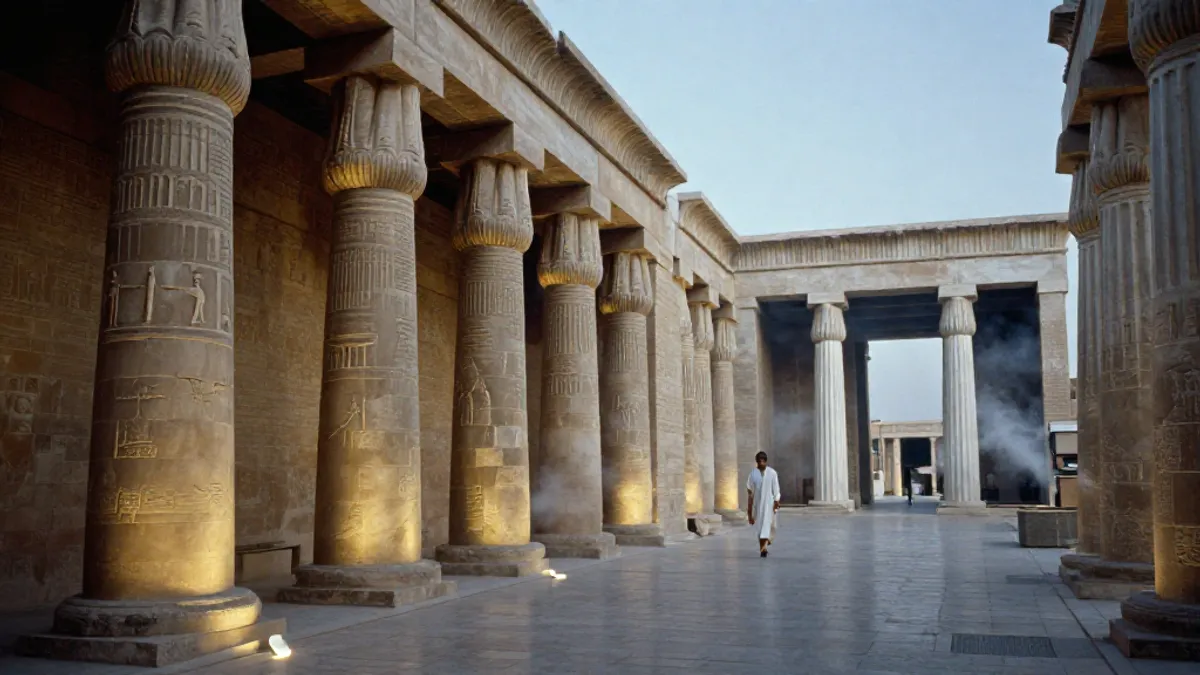
Isis: The Universal
The transition from Ishtar to Isis is not a simple linear descent. Egyptian religion developed independently over millennia, and Isis (Aset, 𓊨𓏏𓆇) has deep indigenous roots in the Nile Valley. But as the Mediterranean world became increasingly interconnected through trade, warfare, and Hellenistic empire, Isis became the goddess who absorbed all other goddesses.
By the Ptolemaic period (305--30 BCE), Isis had taken on attributes of Hathor (the cow-horned solar disk), Mut (the vulture crown), Renenutet (the serpent), and Demeter (the grain). Her worship spread from Alexandria to Rome, from Londinium to the Danube frontier. Temples to Isis have been found in archaeological sites across three continents.
The Isis mysteries - initiation rites that promised the devotee a personal encounter with the goddess - spread along Roman trade routes with remarkable speed. By the first century BCE, there were Isis temples in Pompeii, in Athens, in Carthage, in the legionary camps along the Rhine. The Roman Senate repeatedly tried to suppress the cult, ordering her temples destroyed in 59, 53, and 48 BCE. Each time, the temples were rebuilt. You cannot legislate a goddess out of existence when she meets a genuine need.
What made the Isis cult so portable? In part, it was theology. The myth of Isis - her search for the dismembered body of her husband Osiris, her reassembly of his scattered limbs, her conception of the child Horus through magical means - offered initiates a narrative of loss, devotion, and miraculous restoration that spoke to something universal in human experience.
In part, it was iconography. The image of Isis nursing the infant Horus - the mother enthroned with the divine child at her breast - became one of the most widely reproduced images in the ancient world. When early Christian artists needed a visual vocabulary for the Madonna and Child, this image was ready to hand. The resemblance between Isis-Horus and Mary-Jesus is not coincidental. It is not a conspiracy. It is an iconographic inheritance, openly adopted and openly adapted.
Apuleius, writing in the second century CE, offers in The Golden Ass (also called Metamorphoses) what may be the most moving devotional text in pagan literature. His protagonist Lucius, transformed into a donkey by misadventure with magic, prays to Isis on a moonlit beach and is answered:
I am Nature, the universal Mother, mistress of all the elements, primordial child of time, sovereign of all things spiritual, queen of the dead, queen also of the immortals, the single manifestation of all gods and goddesses that are.
Isis speaks here as the one behind the many - the single divine feminine reality that all cultures have glimpsed under different names. Apuleius is not a conspiracy theorist. He is a theologian, and a sophisticated one. He is describing syncretism as a devotional practice: the recognition that the goddess you worship at home and the goddess they worship abroad are faces of the same mystery.
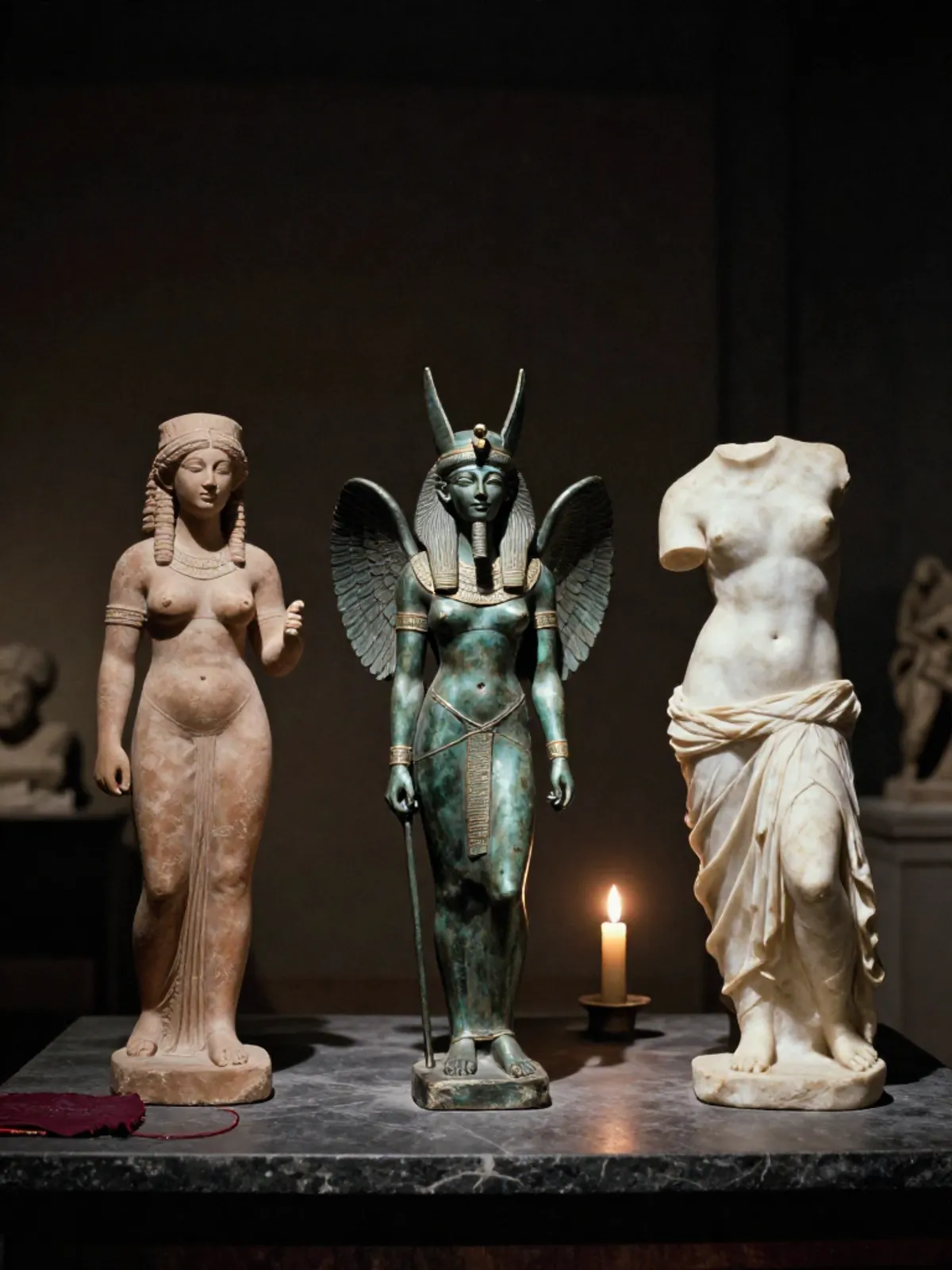
Aphrodite and Venus: The Philosophical Goddess
The Greek goddess Aphrodite arrived in the Hellenic world already bearing traces of her Near Eastern ancestry. Her cult center at Paphos on Cyprus was, in antiquity, understood to be of Phoenician origin. The Phoenician Astarte - herself a descendant of Ishtar - contributed iconographic elements: the dove, the morning star, the association with the sea.
Hesiod tells us in the Theogony that Aphrodite was born from the sea foam that gathered around the severed genitals of Ouranos after Kronos castrated his father and cast them into the ocean. This is not a pretty birth story. It is a story about beauty and desire emerging from an act of primal violence - from the separation of sky and earth. The goddess of attraction is born from the first great act of cosmic division.
But to call Aphrodite merely a "love goddess" is to misunderstand the Greek conception. Aphrodite is the power that draws things together. She is the force of attraction operating at every level of reality - from the desire between lovers to the cohesion of atoms, from the magnetic pull between allies in war to the binding of citizen to polis. Empedocles called this cosmic principle Philotes (Love), and set it against Neikos (Strife) as one of the two fundamental forces driving the universe.
When Rome adopted Aphrodite as Venus, the philosophical dimension deepened. Lucretius opens his De Rerum Natura - a materialist philosophical poem that denies the gods any role in governing the universe - with an invocation to Venus:
Aeneadum genetrix, hominum divumque voluptas, alma Venus...
Mother of Aeneas and his race, delight of men and gods, nurturing Venus...
This is extraordinary. A poet who explicitly denies divine providence begins his work by praising Venus as the generative force of all nature. She is not, for Lucretius, a person on a throne. She is the principle of generation itself - the reason anything exists rather than nothing. Even a materialist needs a name for the force that makes the world go.
The philosophical Venus is perhaps the most honest translation of the original Inanna. Stripped of cult and ritual, what remains is the core intuition: there is a force in the universe that creates, that draws together, that generates life from the meeting of opposites. The ancients called it a goddess. The philosophers called it a principle. The name changes. The recognition persists.
Columbia and Libertas: The Enlightenment Translation
Something peculiar happens to the goddess tradition during the European Enlightenment. The divine feminine does not disappear - she is translated once more, this time from theology into political allegory.
The goddess Libertas was already present in Roman religion as a minor deity, personifying the state of freedom (as opposed to slavery). She had a temple on the Aventine Hill. Freed slaves would sometimes have their heads ritually shaved at her shrine. She was depicted on coins wearing the pileus - the soft cap given to emancipated slaves.
When the architects of the French and American revolutions needed a visual language for their new republics, they reached for the classical vocabulary they had been educated in. Libertas became Liberty. Columbia - a feminized form of Columbus - became the poetic name for the American continent and eventually a national personification, depicted as a robed woman with a starred diadem.
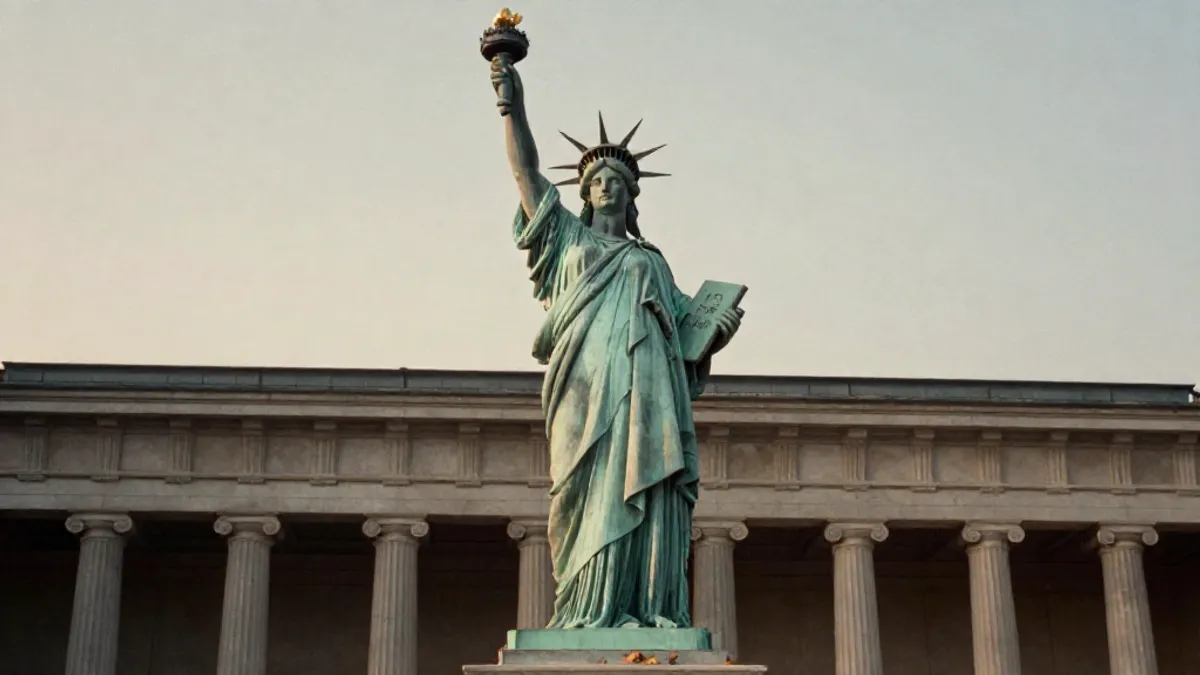
The Statue of Liberty, dedicated in 1886, is the final avatar in the chain. Frederic Auguste Bartholdi's design draws on the iconography of Libertas (the crown of rays, the tablet of law) and of Isis (the monumental scale, the torch-as-lighthouse echoing the Pharos of Alexandria, which stood in a city sacred to Isis). Whether Bartholdi intended these resonances or simply absorbed them through the visual tradition is an open question and, in a sense, an irrelevant one. The iconography carries its history whether or not the artist is conscious of it.
What is preserved in this final translation? The association of the feminine with freedom, with welcoming, with the threshold between the known world and the unknown. The torch. The crown. The monumental scale that forces you to look up.
What is lost? Everything numinous. Liberty is not a goddess you pray to. She is an idea you admire. The difference is the distance between a living religion and a national monument - between a temple and a museum. No one leaves offerings at the feet of the Statue of Liberty. No one expects her to answer prayers. She has been, in the language of theology, demythologized - stripped of her divinity and left standing as pure allegory, a goddess-shaped container with the goddess removed.
The Shekhinah: The Feminine Divine in Exile
There is another lineage of the feminine divine that runs parallel to the Mediterranean chain, and it offers a different and perhaps deeper key to understanding these migrations.
In Kabbalah, the Shekhinah (שכינה) is the feminine aspect of God - the divine presence that dwells in the world. In the Zohar, the great thirteenth-century text of Jewish mysticism, the Shekhinah is associated with Malkuth (מלכות), the tenth and lowest Sephirah on the Tree of Life. Malkuth is the kingdom - the material world, the earth, the place where the divine meets the human.
The Zohar teaches that the Shekhinah is in exile. When the Temple was destroyed and Israel scattered, the feminine face of God went into exile with her people. She wanders. She suffers. She is separated from Tiphereth (תפארת), the masculine divine aspect, her bridegroom. The reunification of the Shekhinah with the Holy One, blessed be He, is the inner meaning of all prayer, all ritual, all righteous action. Every mitzvah is a small repair of this cosmic fracture.
When Israel went into exile, the Shekhinah went with them. When they went into exile in Egypt, the Shekhinah went with them. When they went into exile in Babylon, the Shekhinah went with them.
- Babylonian Talmud, Megillah 29a
Consider this image alongside the goddess migrations traced above. The feminine divine, always crossing borders. Always in exile. Always finding new forms, new names, new temples - because the old ones have been destroyed or outgrown. Inanna becomes Ishtar not because of a secret society but because Sumer fell and Akkad rose and the goddess needed a new language to be spoken in. Isis becomes universal not because of a conspiracy but because the Hellenistic world cracked open every local cult and forced the gods to travel.
The sixteenth-century Kabbalist Isaac Luria developed this image further. In the Lurianic system, the exile of the Shekhinah is not merely a historical event caused by the destruction of the Temple - it is a cosmic condition, part of the primordial catastrophe of shevirat ha-kelim (שבירת הכלים), the shattering of the vessels. The divine light was too intense for the containers meant to hold it, and they broke, scattering sparks of holiness throughout the material world. The Shekhinah descends to gather these sparks. She is the divine presence doing the work of repair (tikkun, תיקון) at the lowest and most broken level of reality.
The Kabbalistic image of the Shekhinah in exile offers a theological framework for understanding syncretism itself. The feminine divine is the aspect of God that goes into exile - that accompanies the scattered, the displaced, the searching. She is, by her nature, the one who crosses every border.
Conspiracy vs. Continuity
Now return to the conspiracy map with its red strings connecting Inanna to the Statue of Liberty. What does it get right, and what does it get wrong?
It gets the connections right. These goddesses are genuinely related, through documented historical processes of cultural contact, conquest, trade, and theological reflection. The iconographic similarities are real. The chain of transmission can be traced in texts, in archaeological strata, in the comparative linguistics of divine names.
What it gets wrong is the mechanism. The conspiracy version requires a continuous institution - a secret priesthood maintaining the cult across six millennia, through the fall of Sumer, the rise and fall of Babylon, the conquests of Alexander, the expansion and collapse of Rome, the European Middle Ages, the Enlightenment, and the founding of the American republic. This is not how religious transmission works. There is no need for a hidden hand. The visible, well-documented processes of syncretism, cultural diffusion, and iconographic inheritance explain every link in the chain.
And here is the deeper error: the conspiracy version assumes that syncretism is suspicious - that if two traditions share a symbol, someone must be secretly coordinating them. But syncretism is not suspicious. It is normal. It is what happens every time one civilization encounters another. When Alexander's soldiers reached Egypt and saw Isis, they did not see a conspiracy. They saw something that reminded them of Aphrodite. They saw a mother with a divine child, a queen of heaven, a mistress of the sea. And they said: We know her. She has a different name here, but we know her.
That recognition - spontaneous, uncoordinated, arising from the genuine structural similarities between human experiences of the sacred - is the real story. It is not less interesting than a conspiracy. It is more interesting, because it tells us something about the architecture of the human encounter with the divine. Across cultures separated by thousands of miles and thousands of years, human beings have independently arrived at a remarkably similar set of images for the feminine face of the sacred: the mother, the lover, the queen, the guide through death, the star that appears at dusk and dawn.
The conspiracy theorist sees this convergence and concludes: someone planned it. The scholar of religion sees it and asks the more productive question: why do these images keep recurring? What is it about human beings, about the structure of consciousness or the shape of embodied life, that generates these particular forms again and again?
The Mysterious Feminine Returns
In the Daodejing, Laozi writes:
玄牝之門,是謂天地根。
The gateway of the mysterious feminine is the root of heaven and earth.
In the Chinese tradition, the feminine divine takes forms that are both parallel to and independent of the Mediterranean lineage. Xiwangmu (西王母), the Queen Mother of the West, presides over a paradise garden on the Kunlun Mountains, dispensing the peaches of immortality. Her worship predates Daoism itself, reaching back to Shang dynasty oracle bones. Guanyin (觀音), as we have seen, crossed the border from India to China and changed gender in the crossing - the bodhisattva of compassion becoming the mother of mercy.
These are not the same goddess as Inanna. The Chinese feminine divine has its own roots, its own logic, its own theological architecture. But the pattern is recognizable: a feminine power associated with compassion, with the threshold between life and death, with the generative source of reality itself. The same pattern, arising independently. Not because of secret transmission, but because of shared humanity.
There is a passage in the Daodejing, Chapter 25, that might serve as the epitaph for every goddess in this lineage:
有物混成,先天地生。寂兮寥兮,獨立而不改,周行而不殆,可以為天下母。
There was something formless and complete, born before heaven and earth. Silent and void, it stands alone and does not change, moves in cycles and does not falter. It may be regarded as the mother of all under heaven.
Laozi does not name this mother. He says her true name is unknown. He calls her the Dao only for convenience. Perhaps the Sumerians, too, used "Inanna" only for convenience - a name pressed onto something that exceeds all names, a sound to hold a silence too large for silence.
The goddess who crossed every border is not a single entity with a continuous history. She is a recurring recognition - a shape that the human encounter with the sacred tends to produce, again and again, wherever human beings gather to name the mystery that gives them life.
She is always arriving. She is always in exile. She has been here all along.
Next in the series: the dying god who rose again - from Osiris and Tammuz to Dionysus and Christ, the masculine counterpart to the goddess migration, and what the pattern of death and resurrection reveals about the deepest structures of human hope.