The Pattern That Won't Die
Horus. Dionysus. Bacchus. Jesus. Arranged in a row on a conspiracy map, connected by lines, labeled as masks of one eternal deity. It is a claim with a strange genealogy of its own - traceable not to any ancient source but to the Enlightenment polemics of the eighteenth century, revived by Victorian anthropology, and given new life in the age of internet documentaries and cork-board infographics.
In 1890, James George Frazer published the first edition of The Golden Bough, a work that would swell across subsequent editions into twelve volumes and reshape how the Western world understood religion. His central thesis was bold, elegant, and irresistible: beneath the surface of every mythology lies a single story. A god dies. The land withers. The god returns. The land is renewed. Vegetation king, scapegoat, sacred marriage - Frazer claimed to find the same ritual logic from the banks of the Nile to the forests of Scandinavia.
The idea proved enormously influential. It entered literary criticism through T.S. Eliot and Jessie Weston. It entered popular culture as a kind of master key - the reassuring notion that all religions are, at bottom, saying the same thing.
It also turns out to be largely wrong, at least as a universal theory. Over the past century, scholars of religion have systematically dismantled Frazer's grand category, showing that his "dying and rising gods" often don't rise, that the connections he drew were superficial, and that the pattern says more about modern Western assumptions than about ancient religious experience.
And yet something real persists here. Across the ancient Mediterranean and Near East, multiple traditions independently developed narratives in which a divine or semi-divine figure descends into death, and something - not always the same thing - comes back. These traditions sometimes influenced each other directly. They sometimes arose from shared agricultural anxieties about the death and return of fertile land. To dismiss the pattern entirely is as misleading as to universalize it.
What follows is not a catalog of "the same god." It is an attempt to look at several distinct traditions - Egyptian, Mesopotamian, Greek - with enough care to see both what they share and where they diverge. The truth, as usual, lives in the difficult middle.
Osiris: The Green God
The oldest and most fully documented case is Egyptian. Osiris (Wsir) - king, civilizer, giver of agriculture - is murdered by his brother Set (or Seth), who dismembers his body and scatters the pieces across Egypt. The goddess Isis (Aset), his wife, gathers the fragments and reassembles them. Through her magic and the aid of Anubis, Osiris is restored - but not to living kingship. He descends to the Duat, the underworld, where he reigns as lord of the dead.
This is a crucial distinction that Frazer's framework tends to blur. Osiris does not rise. He does not walk again among the living. His domain is below, among the justified dead. The Pyramid Texts, carved inside Old Kingdom tombs from roughly 2400 BCE onward, make the theology explicit: the dead pharaoh becomes Osiris, while the living pharaoh is Horus, the son who avenges and succeeds his father.
He lives, this King Osiris, he is not dead. He has risen, he has not perished.
- Pyramid Text Utterance 213
What looks like resurrection language is actually enthronement language. The pharaoh "rises" into his new sovereignty over the dead - a promotion, not a return.
Over the centuries, this privilege was democratized. By the Middle Kingdom, ordinary Egyptians could aspire to become maa-kheru - "true of voice," justified before the tribunal of the dead. By the Late Period, virtually every deceased person was identified with Osiris. The afterlife, once a royal monopoly, became available to all.
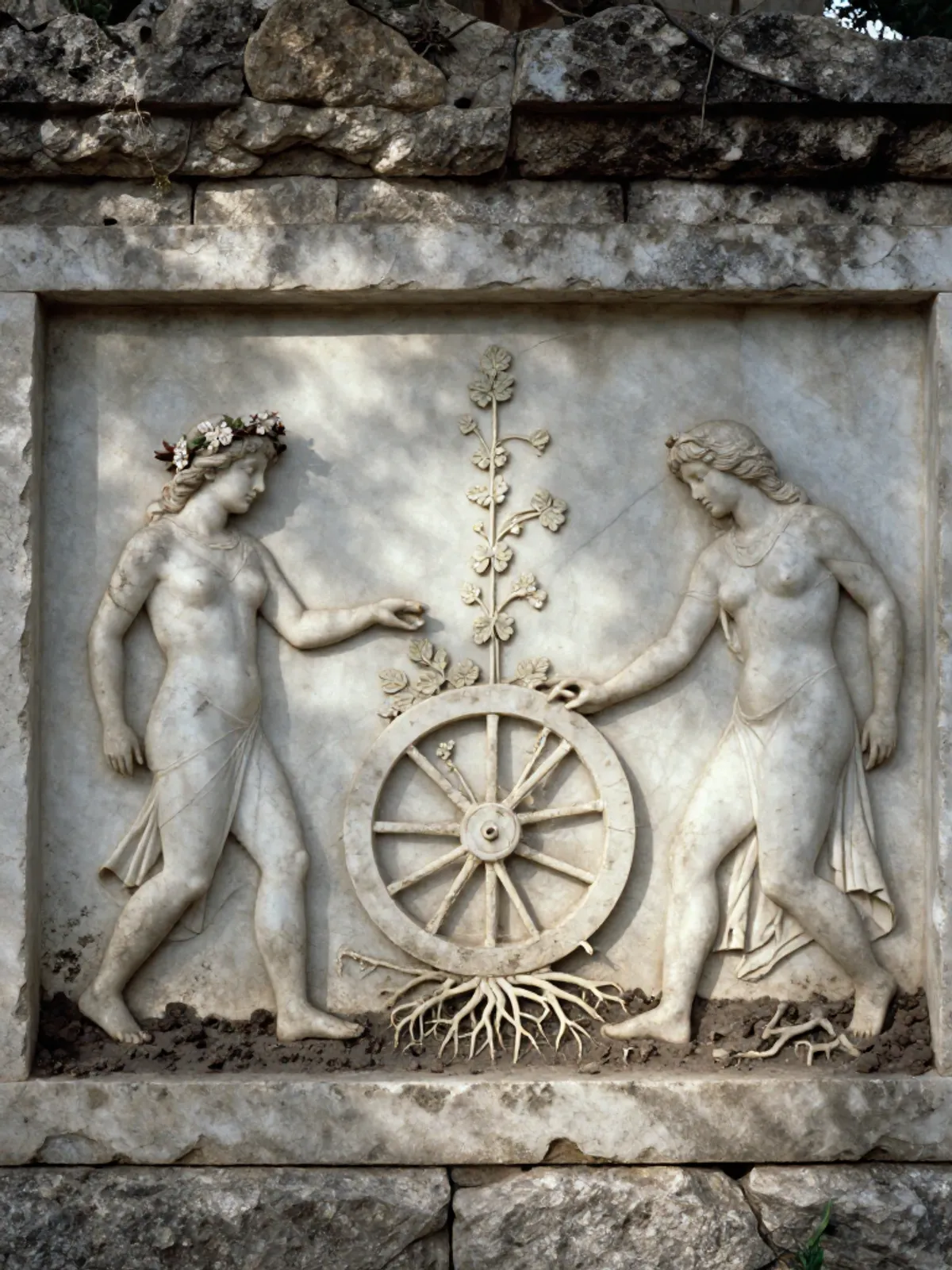
The agricultural dimension is unmistakable. Osiris was depicted with green or black skin - the colors of vegetation and of the fertile Nile silt deposited by the annual flood. Grain mummies, small linen-wrapped figures packed with seeds and moistened until they sprouted, were placed in tombs. The annual Khoiak festival reenacted the god's death and restoration through elaborate rituals: earth was packed into Osiris-shaped molds, planted with barley, and watered for days until the grain sprouted from the god's body. The god's body was the field. His death was the dry season. His restoration was the flood that made Egypt live again.
The Book of the Dead - more accurately, the Pert em Heru (Coming Forth by Day) - provided spells for navigating the underworld, but the destination was not a return to the living. It was a permanent dwelling in the Sekhet Aaru, the Field of Reeds, where the blessed dead farmed eternal crops under an eternal sun. Even in paradise, the Egyptian imagination remained agricultural.
Tammuz and Adonis: The Mourned Shepherd
Older even than the Osiris cult in its earliest roots is the Mesopotamian tradition of Dumuzi (Sumerian) or Tammuz (Akkadian) - the shepherd-king and consort of the goddess Inanna (later Ishtar). In the Sumerian poem Inanna's Descent to the Netherworld, the goddess travels to the realm of the dead and is permitted to return only by providing a substitute. She chooses Dumuzi. He flees, is captured by demons, and taken below.
His sister Geshtinanna eventually agrees to share his sentence: each will spend half the year in the underworld. This is seasonal mythology in its most transparent form - the alternation of abundance and scarcity, the dying of the pastoral landscape and its return.
The mourning for Tammuz became one of the great ritual events of the ancient Near East. The prophet Ezekiel, writing from Babylonian exile in the sixth century BCE, describes seeing women at the north gate of the Jerusalem Temple "weeping for Tammuz" (Ezekiel 8:14) - a practice he regards as abomination, but one that testifies to the cult's reach.
The Greek Adonis is a direct descendant of this tradition. The name itself derives from the Semitic Adon - "lord" - a title of Tammuz. The myth was transmitted through Phoenician intermediaries: Adonis, the beautiful youth beloved by Aphrodite, is gored by a boar and dies. Anemones spring from his blood. In Athens and Alexandria, the Adonia festival involved women planting quick-sprouting "gardens of Adonis" - seeds forced in shallow pots that germinated rapidly and died just as fast, embodying the beauty and brevity of the god's life.
These are not conspiracies or secret connections. They are well-documented instances of cultural transmission across the ancient Mediterranean - the normal way religious ideas travel, carried by merchants, migrants, and the slow pressure of empire.
What the Tammuz-Adonis line demonstrates is that mythic patterns do travel, but they change as they move. Dumuzi the Mesopotamian shepherd, dragged to the underworld by demons, is not identical to Adonis the beautiful Greek youth, mourned by aristocratic Athenian women tending their miniature rooftop gardens. The emotional register shifts; the ritual context transforms; the theology adapts to new cosmological frameworks. Transmission is real. Identity is not.
Dionysus: The Twice-Born
Dionysus is the most complex figure in this constellation, and the one most resistant to tidy categorization.
In the standard myth, he is born from the union of Zeus and the mortal woman Semele. When Semele is destroyed by the sight of Zeus in his full divine splendor, the unborn Dionysus is sewn into Zeus's thigh and born a second time - hence his epithet dithyrambos, an epithet of uncertain etymology sometimes glossed as "he of the double door" - the twice-born.
But the Orphic tradition tells a darker story. In this version, the infant Dionysus (sometimes called Zagreus) is lured away by the Titans with toys and a mirror. They tear him apart and devour him - all except his heart, which Athena preserves. From this heart, Dionysus is reconstituted. Zeus destroys the Titans with a thunderbolt, and from their ashes - mixed with the divine substance they consumed - humanity is born. We are, in this theology, part Titan and part god. The spiritual life consists of liberating the Dionysian fragment within us from its Titanic prison.
The body is a tomb.
- Orphic formula (soma sema)
This is not vegetation mythology. This is something stranger and more radical - a theology of divine dismemberment and cosmic reconstitution. Dionysus is the god who is torn apart and made whole, and his worshippers sought to participate in that dissolution and remaking.
Wine is his blood. The act of pressing grapes - crushing, fermenting, transforming - mirrors the god's own passion. The sparagmos (ritual tearing) and omophagia (eating of raw flesh) described in connection with Dionysian worship, whether literal or symbolic, enact the Titan myth at the level of the body.
Euripides understood this. The Bacchae, written around 405 BCE, is the most searching theological text to survive from ancient Greece. In it, Dionysus arrives in Thebes - his own birthplace - and is refused recognition by King Pentheus. The young king sees only disorder, effeminacy, foreign corruption. He arrests the god. He tries to bind him. And so Dionysus does what Dionysus always does to those who refuse him: he drives Pentheus's own mother, Agave, into a frenzy in which she tears her son apart with her bare hands, believing him to be a lion.
The god is not gentle. He is the force that dissolves boundaries - between human and animal, male and female, self and other, civilization and wilderness. To deny him is to be destroyed by the very energies you refused to integrate. To accept him is to risk everything comfortable about your sense of self. There is no safe version of Dionysus.
By the Ptolemaic period, the identification of Dionysus with Osiris was explicit. Greek settlers in Egypt recognized their ecstatic god in the dying-and-restored Egyptian king. Herodotus had already made the connection in the fifth century BCE. The identification was not arbitrary - both gods were associated with agriculture, with death, with the underworld, with the promise that what is destroyed can be remade. But the modes were different. Osiris is solemn, regal, enthroned in the halls of the dead. Dionysus is wild, transgressive, dancing in the mountains.
What the Scholars Say
In 1987, the historian of religion Jonathan Z. Smith published an essay titled "Dying and Rising Gods" in Mircea Eliade's Encyclopedia of Religion that effectively demolished Frazer's category from within. Smith examined each supposed case and found the same problems again and again.
Osiris does not rise - he descends to rule the dead. Tammuz's "return" is seasonal and partial. Adonis has no cult of resurrection; his festivals mourn his death. Attis, the Phrygian god whose self-castration and death were central to the cult of Cybele, has a resurrection narrative only in late Roman sources, likely influenced by Christianity rather than the reverse. Persephone returns from the underworld, but she was never a dying god - she was an abducted goddess.
The category of "dying and rising gods," once a major topic of scholarly investigation, must now be understood to have been largely a misnomer based on imaginative reconstructions and patchy evidence.
- Jonathan Z. Smith
Smith's critique is devastating and largely persuasive. The "dying and rising god" as a universal religious category does not survive careful scrutiny. Too many of the cases are forced into conformity with a pattern derived, ultimately, from the Christian narrative of crucifixion and resurrection - and then projected backward onto traditions that do not, on their own terms, tell the same story.
More recent scholars - Tryggve Mettinger in The Riddle of Resurrection (2001), for instance - have pushed back partially against Smith, arguing that a few cases (Osiris, Baal, Melqart) do involve genuine death-and-return motifs that predate Christianity. The debate continues. But even Mettinger does not return to Frazer's grand synthesis. The maximalist position - all these gods are one god - remains untenable.
But fairness requires acknowledging what the critique does not disprove. The traditions did exist. They did involve divine figures who died or descended. Some of them did influence each other through documented historical channels. The phenomenological resonance - the recurrence of death-and-return as a religious motif - is real, even if the genealogical connections are weaker and more tangled than Frazer imagined.
The task is not to choose between "it's all the same myth" and "there are no meaningful connections." The task is to hold complexity.
The Mystery Traditions: Experience Over Doctrine
Whatever their theological differences, several of these traditions converged on a remarkable practice: the initiation of ordinary people into an experience of death and return.
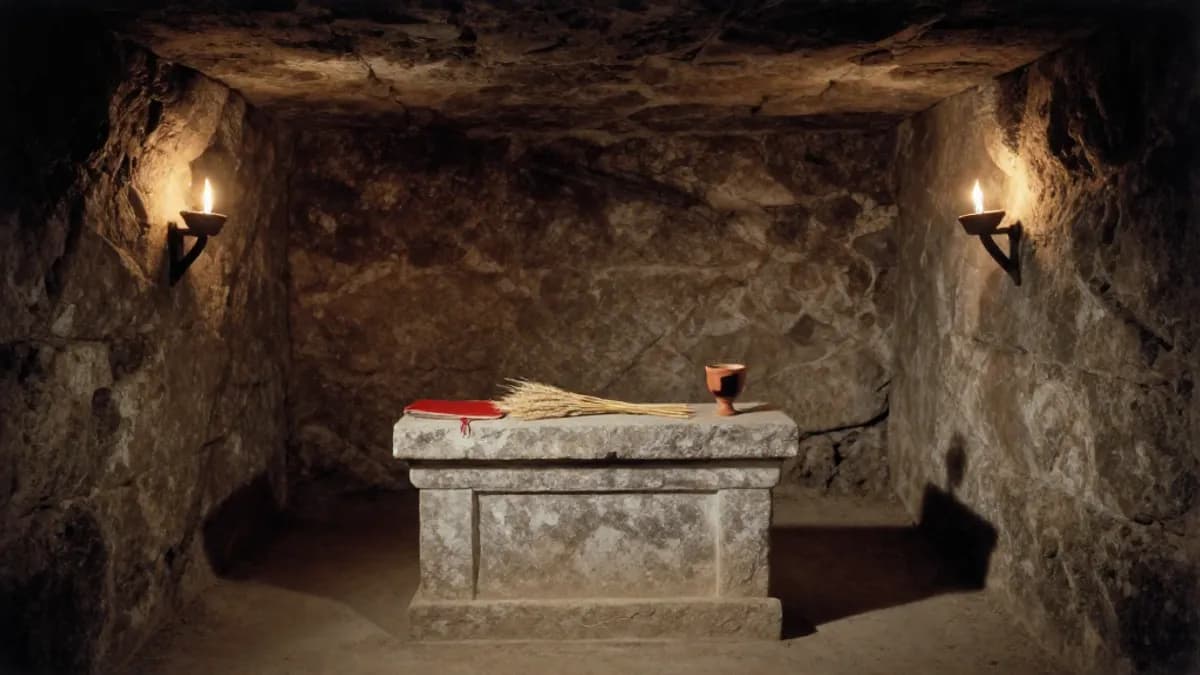
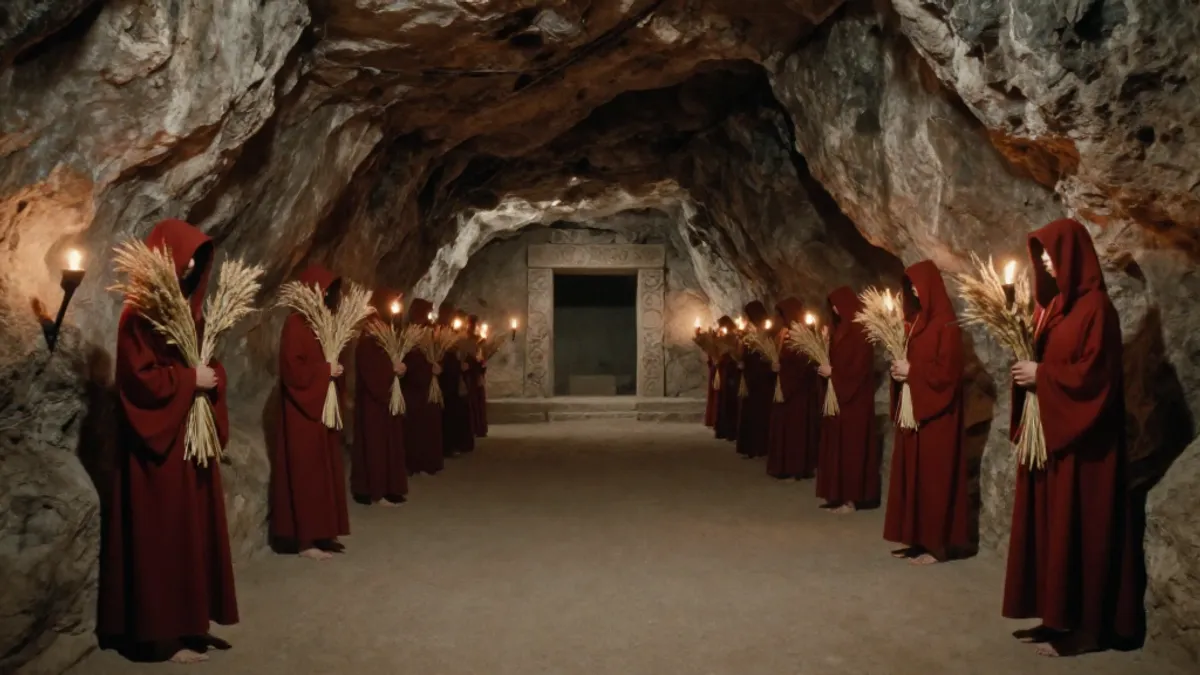
The Eleusinian Mysteries, celebrated near Athens for nearly two thousand years, centered on the myth of Demeter and Persephone - the mother who loses her daughter to the underworld and wins her back, partially, seasonally. Initiates fasted, processed, drank the kykeon (a barley drink of uncertain composition), and witnessed something in the Telesterion, the great hall of initiation, that they were forbidden to reveal.
I have fasted. I have drunk the kykeon. I have taken from the chest. Having done my task, I placed in the basket, and from the basket into the chest.
- Eleusinian synthema (ritual formula)
What we know is that initiates emerged transformed. Cicero wrote that the mysteries taught people "how to live in joy, and how to die with better hope." Pindar and Sophocles agreed: those who had seen the rites at Eleusis were blessed among the dead.
The Dionysian mysteries offered something parallel but wilder - not the quiet revelation of Eleusis but the ecstatic dissolution of the thiasoi, the roving bands of worshippers on the mountain. The initiate died to ordinary selfhood and was reborn in the collective frenzy of the god. Gold tablets found in graves across southern Italy and Crete - the so-called Orphic gold leaves, dating from the fifth century BCE onward - bear instructions for the dead soul's journey through the underworld:
I am a child of Earth and starry Heaven, but my race is of Heaven alone.
- Orphic gold tablet, Petelia
The initiate who carried this tablet to the grave had already rehearsed the journey in life. Death was not a surprise; it was a return to a road already traveled.
The pattern is not unique to the Mediterranean. In the Chinese tradition of internal alchemy (neidan), the adept undergoes a symbolic death. The process called lianshen huanxu (煉神還虛) - "refining spirit and returning to emptiness" - describes the dissolution of the constructed self and its reconstitution at a higher level of subtlety. The Daoist does not worship a dying god, but the inner landscape of the practice is strikingly familiar: something must die for something greater to be born.
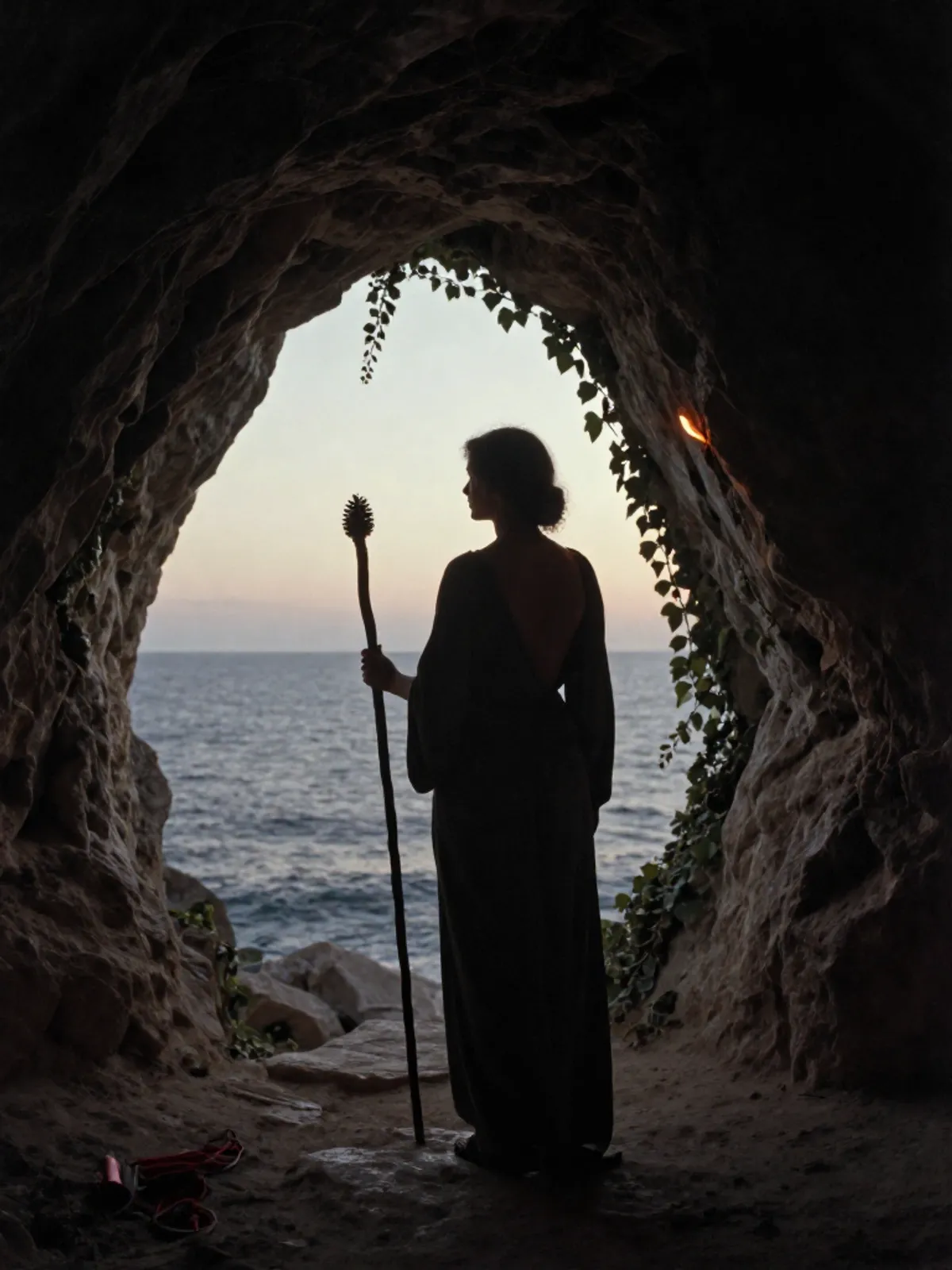
What these traditions share is not a myth but a structure of experience. The initiate descends - through fasting, through darkness, through the deliberate undoing of everyday identity - and returns changed. The katabasis, the descent, is the universal element. Not because all cultures tell the same story, but because the psyche, confronted with transformation, reaches for the same metaphor: you must go down before you can come back up.
The alchemical tradition, both Western and Chinese, formalized this into explicit stages. The nigredo - the blackening, the putrefaction - was the necessary first phase of the Great Work. "Except a grain of wheat fall into the ground and die, it abideth alone," wrote John (12:24), in a verse that alchemists quoted endlessly. The dying god is, from this perspective, not a mythological curiosity but a description of how transformation actually works: in the psyche, in the laboratory, in the field.
Why Conspiracy Maps Love This Pattern
The conspiratorial version of this material - the deity row that runs Horus, Dionysus, Bacchus, Jesus and labels them "the same god under different names" - is a flattening so severe it constitutes a different kind of error than Frazer's.
Frazer, for all his faults, was a serious scholar working with the tools available to him. He read primary sources. He distinguished between traditions even as he argued for underlying unity. The conspiracy version strips away all nuance and presents a simple claim: the elites have always known it's all one religion, and they've been hiding this from you.
This is seductive precisely because it contains a grain of truth. These traditions did influence each other. Hellenistic intellectuals did identify Dionysus with Osiris. Early Christians did notice - and were troubled by - the parallels between Christ's death and resurrection and the myths of pagan gods. Justin Martyr, writing in the second century, explained the similarities as the devil's work: Satan had planted counterfeit versions of the Christ story in pagan cultures in advance, to confuse future believers.
But flattening the traditions into identity erases precisely what makes each one significant. Osiris enthroned in the halls of Amenti, judging the dead with the feather of Ma'at, is not Dionysus raging through the mountains with his maenads. Dionysus torn apart by Titans and reconstituted from his own heart is not Christ crucified under Pontius Pilate and raised on the third day. The differences in theology, in ritual practice, in what the divine death means for worshippers - these are not incidental. They are the substance.
To say "it's all the same" is to understand none of it. And understanding - real understanding, the kind that requires patience and humility and the willingness to let each tradition speak in its own voice - is precisely what the conspiratorial mindset cannot tolerate. It needs the shortcut. It needs the key that opens every lock. But the locks are different, and that is not a flaw in the universe. It is the richness of it.
What Remains
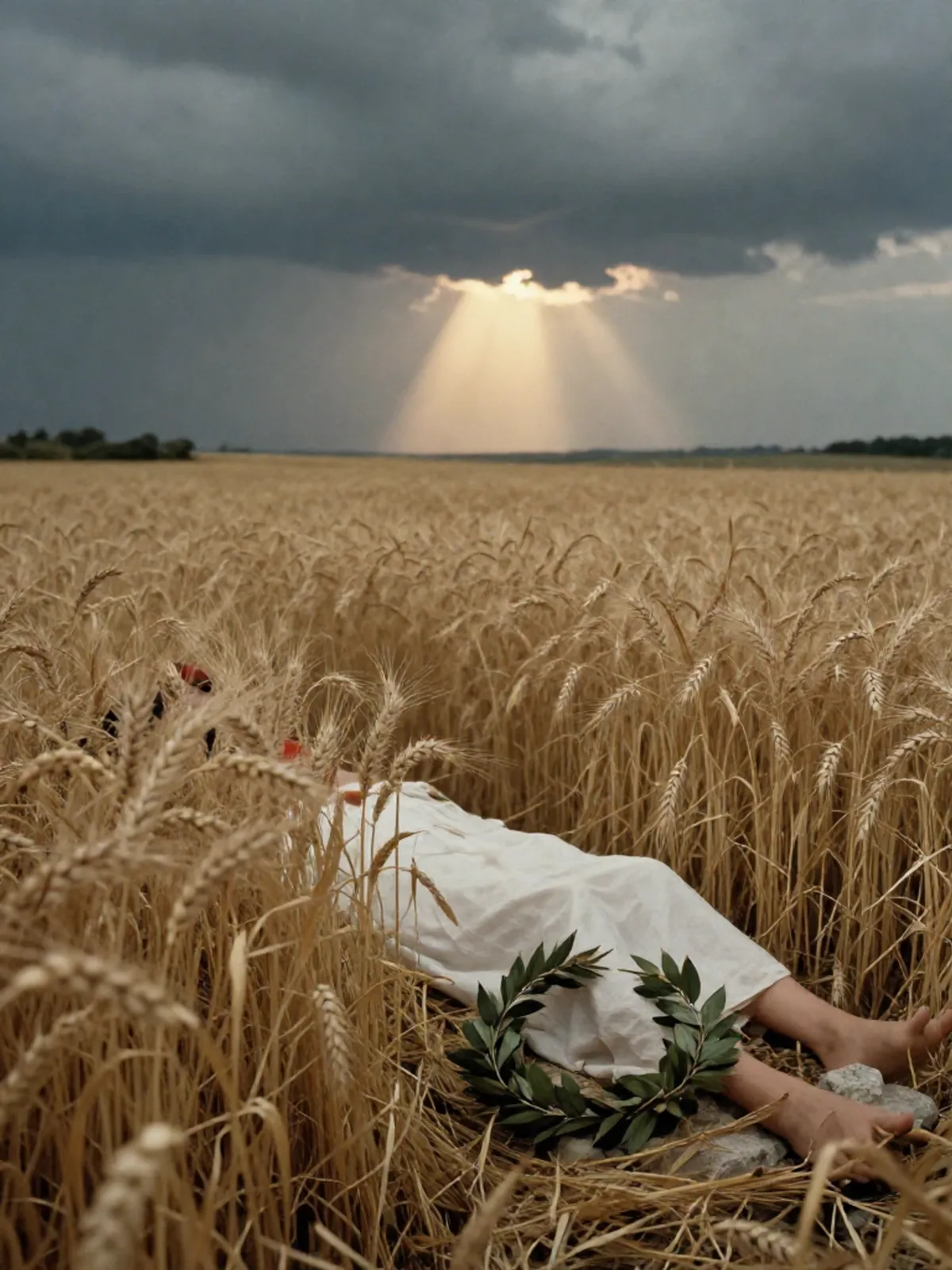
The dying god is not a single figure with many masks. He is a question that many cultures have asked independently, in conversation with each other, and in response to the undeniable facts of agricultural and human life: that things die, that the world goes dark, that winter comes.
The answers differ. For the Egyptians, the answer was cosmic order - the dead king maintaining ma'at from below. For the Greeks, the answer was ecstatic experience - the dissolution of the bounded self. For the mystery traditions, the answer was initiatory transformation - the journey down and back that makes you new.
The pattern endures not because there is a secret conspiracy preserving ancient knowledge, but because death and renewal are fundamental to both the natural world and the inner life. The grain falls into the earth. The vine is cut back to the root. The river floods and recedes. Every tradition that grapples seriously with transformation must eventually confront the question: what must die so that something new can live?
The conspiracy map answers this question too quickly, and therefore too cheaply. It offers the thrill of secret knowledge - they're all the same god - without the labor of actually understanding any of them. The ancient traditions, by contrast, demanded years of preparation, rigorous discipline, and the willingness to be genuinely undone. They had the wisdom to sit with the question longer, because they knew that the dying is the hard part, and there are no shortcuts through it.
In the final article of this series, we turn to the Tree of Life - Kabbalistic and conspiratorial - and ask what happens when a sacred symbol is uprooted from its tradition and replanted in the soil of paranoia.