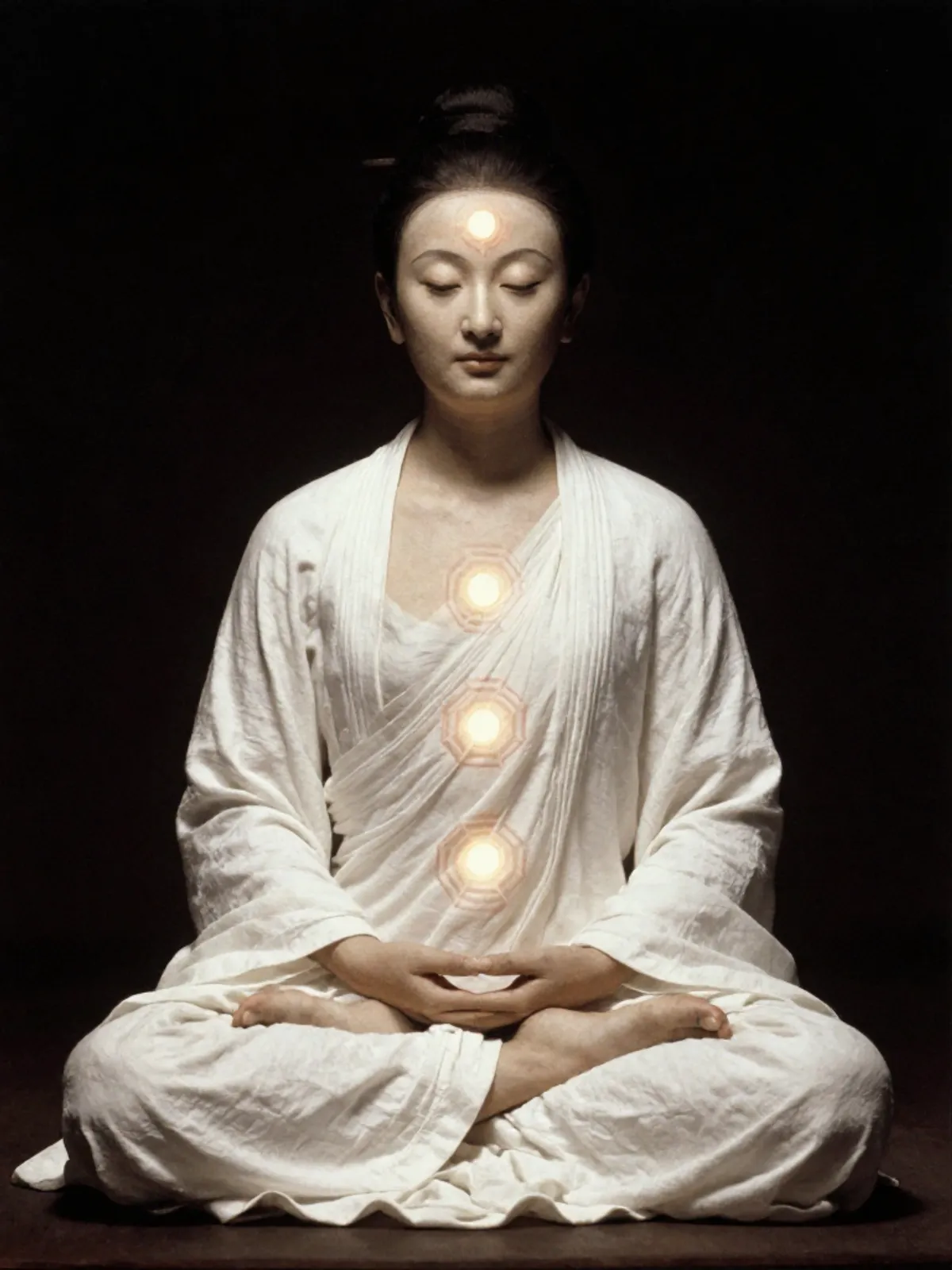
Where the Map Meets the Territory
If you have sat in meditation and felt the three dantian as living centers — warmth pooling below the navel, breath opening the chest, stillness gathering behind the eyes — then you already know the landscape. And if you have studied the eight trigrams and felt how each one carries a quality of movement or rest, of rising or yielding, then you already know the grammar.
What the neidan masters discovered, over a thousand years of sitting with both systems, is that the landscape and the grammar are the same thing.
The body is not merely described by hexagrams. It is a hexagram — a six-line figure in constant transformation, its upper and lower trigrams interacting, its lines shifting between yin and yang with every breath, every surge of heat, every settling of the mind into quiet. The alchemists who mapped trigrams onto the dantian were not reaching for metaphor. They were recording what they observed.
人身一小天地也。
The human body is a small heaven and earth.
- Xingming Guizhi (性命圭旨)
This is the territory we enter now: the place where the I-Ching becomes a practice for the body, and the body becomes a living text.
The Body as a Six-Line Figure
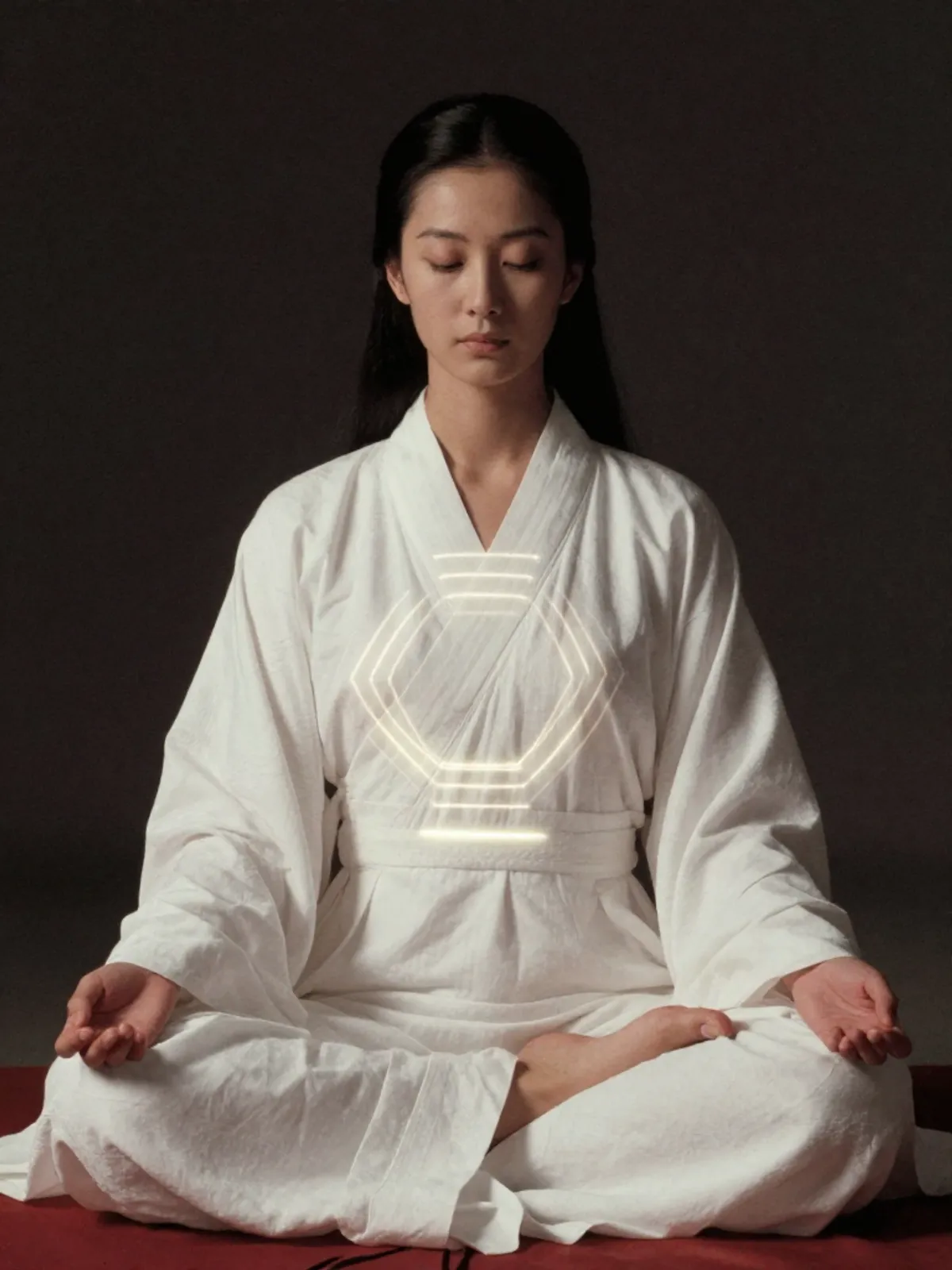
A hexagram is built from six lines — three below forming the inner trigram, three above forming the outer. In the neidan body-mapping tradition, this structure is not arbitrary. It corresponds to the body's own architecture.
The three lower lines correspond to the lower dantian and everything it governs: jing (精, essence), the kidneys, the reproductive vitality, the dense and rooted energy that pools in the belly and lower back. This is the body's foundation, the furnace where the alchemical work begins. In trigram terms, the lower position belongs most naturally to Kan (坎 ☵, Water) — the trigram of depth, danger, and hidden yang.
The three upper lines correspond to the upper dantian and the domain of shen (神, spirit): the heart-mind, the eyes, awareness itself. This is the body's clarity, the palace where refined energy gathers as luminous knowing. Its natural trigram is Li (離 ☲, Fire) — brightness, illumination, the clinging flame.
Between them — the middle lines, the middle dantian — is where the work happens. This is the meeting point, the crucible. It is here that the lower and upper trigrams interact, that water and fire negotiate, that essence and spirit find their exchange.
The whole body, then, is a hexagram. Not a fixed one. The lines change. Some days the lower trigram feels dense and stable, all yang, full of jing. Other days it feels depleted, broken, yielding. The upper trigram shifts with the quality of attention — sharp and clear when shen is gathered, scattered and dim when the mind is exhausted. To sit in meditation is to sit inside a hexagram whose lines are always in motion.
Eight Trigrams, Eight Gates
The eight trigrams do not map to the body as labels affixed from outside. They map as qualities of energy that practitioners recognized through sustained interior observation. Each trigram names a felt reality.
Qian (乾 ☰, Heaven) — the crown of the head, the baihui (百會) point. Pure yang. The place where energy reaches its most refined and immaterial expression. When shen gathers at the crown in advanced practice, the sensation is one of open spaciousness, as if the top of the skull has dissolved into sky. Qian's quality is initiating, strong, ceaselessly creative.
Kun (坤 ☷, Earth) — the abdomen, the belly, the pelvic floor. Pure yin. The body's ground, its capacity to hold and receive. Without Kun, there is no container for the alchemical work. The belly's softness is not weakness. It is the earth's ability to support everything that grows from it.
Kan (坎 ☵, Water) — the kidneys, the lower back, the mingmen (命門, "gate of life") point between the kidneys. Kan is yin outside, yang inside — two broken lines surrounding a single unbroken one. This is the trigram's deepest teaching: within the body's most hidden, dark, watery region lives a spark of pure yang. The warmth you feel in the lower back during deep meditation is that hidden fire. The entire alchemical tradition pivots on this point.
Li (離 ☲, Fire) — the heart, the eyes, the faculty of awareness. Li is yang outside, yin inside — two unbroken lines holding a single broken one. The heart's brightness contains, at its center, a space of receptive emptiness. When the eyes are soft and unfocused in meditation, when awareness is present but not grasping, you are experiencing Li's structure: illumination surrounding stillness.
Zhen (震 ☳, Thunder) — the feet, the liver, the sudden surge of movement rising from below. Zhen is a single yang line erupting beneath two yin lines. It is the first stirring, the impulse that breaks through dormancy. In the body, you feel it as the upward rush of energy from the soles of the feet, the liver's assertive rising qi, the moment in meditation when something suddenly shifts after long stillness.
Gen (艮 ☶, Mountain) — the hands, the upper back, the quality of stopping. Gen is yang above two yin lines: a solid cap over yielding space. The mountain does not move. In the body, Gen manifests as the capacity to be still — not suppressed but genuinely at rest. The hands in meditation, resting on the knees or folded in the lap, embody Gen. The upper back, held upright without rigidity, is the mountain's quiet authority.
Xun (巽 ☴, Wind) — the thighs, the breath, the quality of gentle penetration. Xun is yin beneath two yang lines. Wind enters everywhere. It does not force. In the body, this is the breath itself — the most subtle and pervasive of all energetic movements. The thighs, in seated practice, channel energy downward with a quality of yielding persistence. Xun teaches that the most powerful influence is often the softest.
Dui (兌 ☱, Lake) — the mouth, the lungs, openness. Dui is yin above two yang lines: an open surface over solid depth. The lake receives and reflects. In the body, the mouth and lungs are the organs of exchange — taking in air, releasing sound. The slightly parted lips in meditation, the soft palate lifted, the tongue touching the upper palate to close the circuit of the microcosmic orbit — all of this is Dui's territory.
These correspondences were not invented by a single author. They accumulated across centuries of practice, refined by generations of meditators who sat long enough to notice where each quality of energy naturally gathers. They are experiential maps, not theoretical ones.
The Central Mystery: Kan and Li
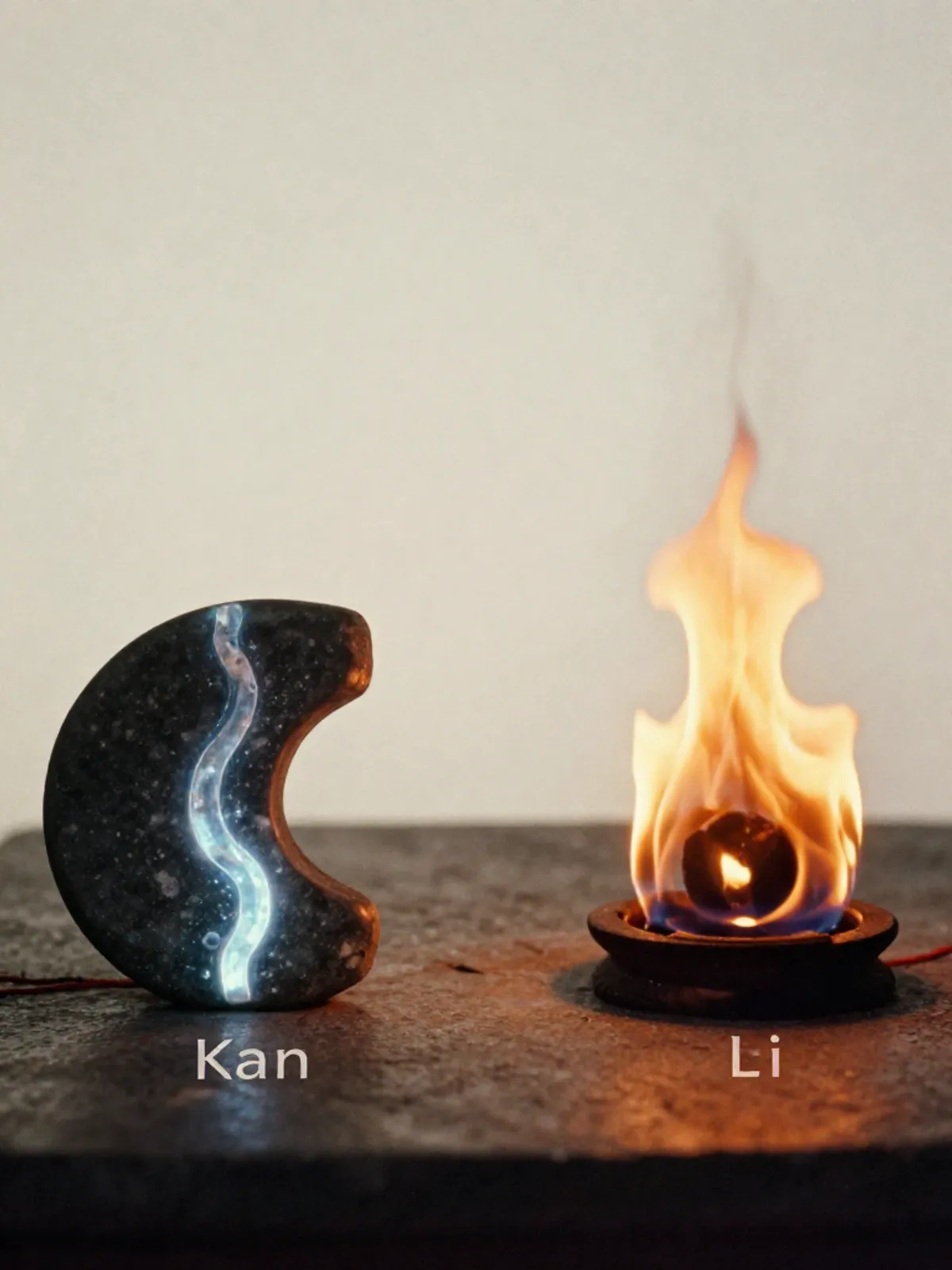
Of all the trigram relationships, one dominates the neidan tradition so completely that the entire art could be summarized in its terms. This is the relationship between Kan (☵, Water) and Li (☲, Fire).
Look at their structures. Kan: yin, yang, yin. A single solid line enclosed by two broken ones. Li: yang, yin, yang. A single broken line enclosed by two solid ones. Each contains what the other lacks. Each hides the other's essential quality within itself.
The neidan masters saw this with absolute precision. The kidneys — Kan's domain — are outwardly cool and still, belonging to the Water element. But within them burns a hidden yang, a warmth that sustains life itself. This is zhenyang (真陽), "true yang" — the spark of original vitality concealed within the body's deepest yin.
The heart — Li's domain — is outwardly bright and active, belonging to the Fire element. But within it rests a hidden yin, a space of receptive quiet. This is zhenyin (真陰), "true yin" — the seed of stillness concealed within the mind's ceaseless illumination.
The alchemical work is to bring these two into relationship. The phrase that encodes this entire operation is four characters long:
取坎填離
Qǔ kǎn tián lí — Extract from Kan, fill Li.
What this means: draw the hidden yang out of the kidneys and deliver it upward to the heart. Allow the heart's hidden yin to descend into the kidneys. When this exchange is complete, Kan — which was yin-yang-yin — loses its yang and becomes pure yin: Kun (☷). Li — which was yang-yin-yang — loses its yin and becomes pure yang: Qian (☰). The practitioner's body, which had been a field of mixed, post-natal trigrams, returns to the primordial state: pure Heaven above, pure Earth below, the undivided wholeness that existed before birth.
What does this feel like in practice? Warmth rises from the lower back and kidneys — not forced, but released, as if a spring that was being held down is allowed to surface. Coolness settles in the chest and behind the eyes — not suppression but relief, as if a fire that was burning too hot finds its proper measure. The heart quiets. The belly warms. Something clicks into place.
The tradition insists this is not visualization. You cannot fabricate the exchange through imagination. It arises from sustained practice — from enough hours of sitting that the body's own intelligence begins to reorganize itself. The meditator's role is not to engineer the process but to create the conditions in which it can occur.
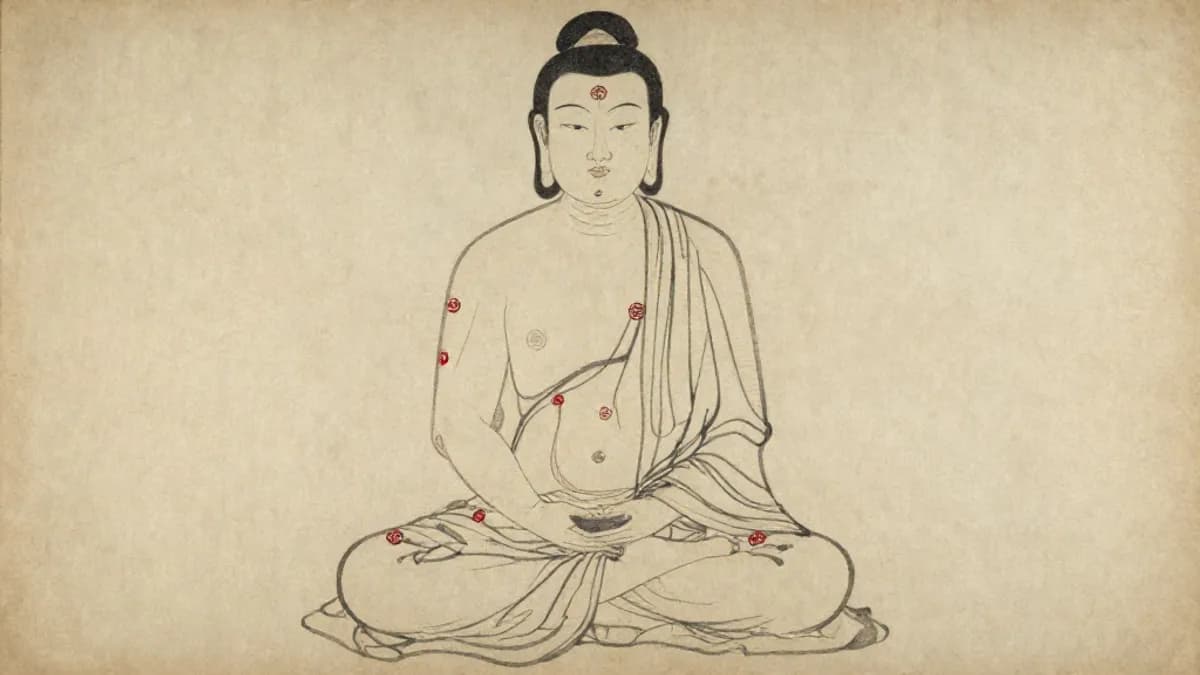
The Pre-Natal and Post-Natal Body
Behind the Kan-Li exchange lies a cosmological story that the neidan tradition tells about every human life.
Before birth — in the state the tradition calls xiāntiān (先天, "pre-natal" or "pre-celestial") — the body is whole. The upper trigram is Qian (☰), pure yang. The lower trigram is Kun (☷), pure yin. Heaven and earth are in their original positions. There is no separation between essence and spirit, no gap between vitality and awareness. The fetus floats in this undivided state, breathing through the umbilical connection, its energy circulating in a seamless loop.
At birth — the moment of entry into the hòutiān (後天, "post-natal" or "post-celestial") world — something happens. The traditions describe it as an exchange: Qian gives one yang line to Kun, and Kun gives one yin line to Qian. Qian, losing a yang, becomes Li (☲). Kun, losing a yin, becomes Kan (☵). The original wholeness fractures into the split condition of ordinary life: the heart burns with desire and restlessness (Li's excess fire), the kidneys grow cold and depleted (Kan's excess water), and the distance between them widens with every year of unconscious living.
This is not a story about physical embryology. It is a description of how consciousness fragments — how the original unity of awareness and vitality separates into a thinking mind that floats above and a physical body that labors below, the two increasingly estranged.
The entire neidan project is the reversal of this fragmentation. Extract the yang from Kan, return it to Li. Let Kan become Kun again. Let Li become Qian again. Restore the pre-natal body within the post-natal one. The alchemical texts describe this with a phrase of stark simplicity: fǎn xiāntiān (返先天), "return to the pre-natal."
It is the entire tradition compressed into a single hexagram operation.
The King of the Alchemical Classics
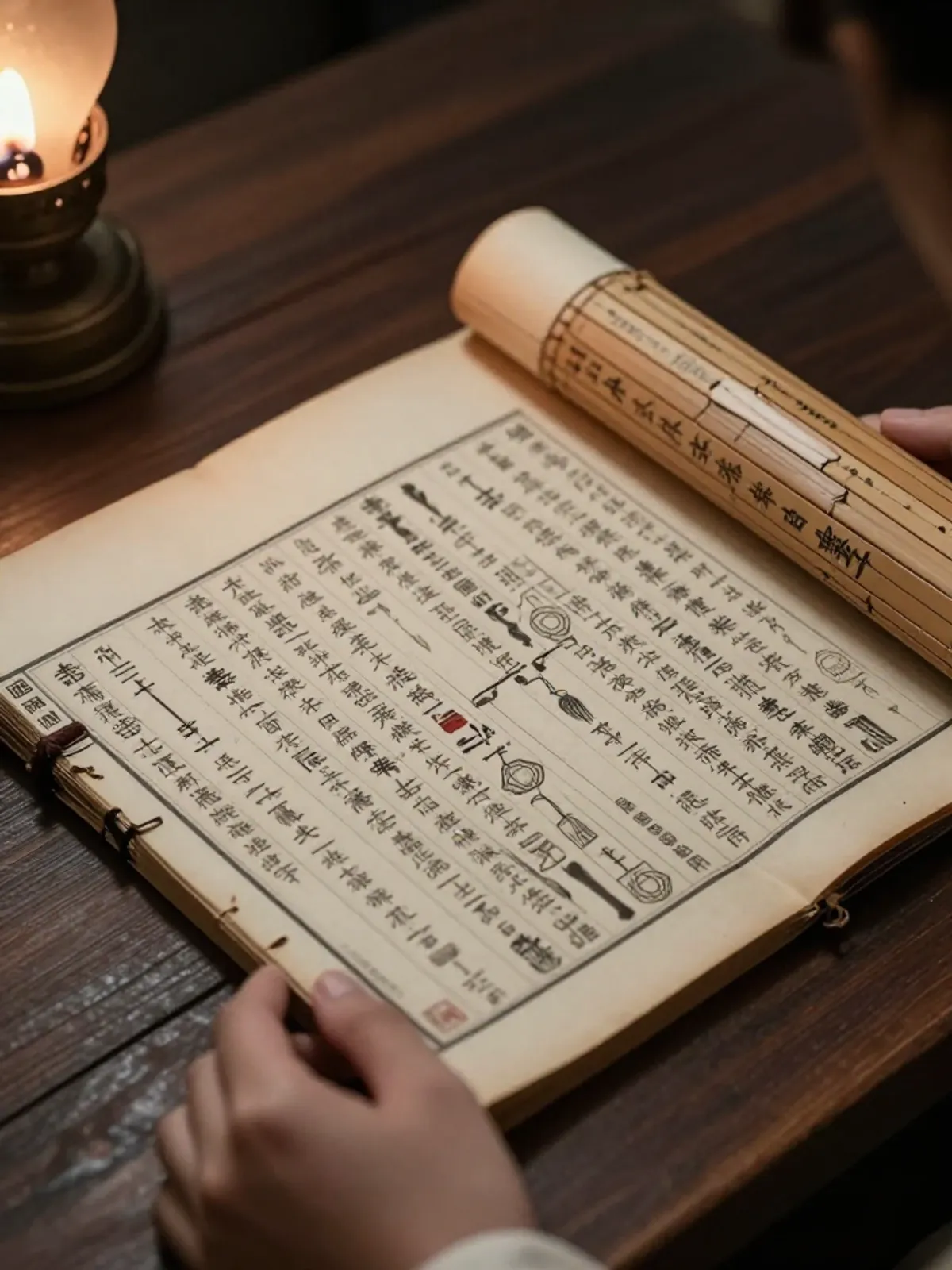
The text that first systematized the hexagram-body mapping is the Zhouyi Cantong Qi (周易參同契), "The Seal of the Unity of the Three." Attributed to Wei Boyang (魏伯陽) of the Eastern Han dynasty (2nd century CE), it is the oldest known alchemical text in the Chinese tradition and arguably in the world.
The "three" that are unified are the I-Ching, Daoist practice, and alchemical technique. Wei Boyang's genius was to recognize that the hexagram system — originally a divination tool — could serve as a precise symbolic language for describing transformations of energy within the body. The sixty-four hexagrams became a vocabulary for stages of meditation. The changing lines became markers for shifts in internal state. The trigram relationships became maps of the body's energetic architecture.
乾坤者,易之門戶,眾卦之父母。
Qian and Kun are the gateway of the Changes, the father and mother of all hexagrams.
- Wei Boyang, Zhouyi Cantong Qi
The Cantong Qi is notoriously difficult to read. Its language is deliberately obscure — partly to protect esoteric teachings from the uninitiated, partly because the phenomena it describes resist straightforward expression. For centuries it was read as a manual for laboratory alchemy: instructions for compounding mineral elixirs in a furnace. But by the Song dynasty, commentators had recognized that its deeper layer described internal processes. The furnace was the lower dantian. The ingredients were jing, qi, and shen. The fire was meditative attention.
Later generations called it the "King of the Alchemical Classics" (萬古丹經王). Every major neidan text that followed — from the Wuzhen Pian to the Quanzhen manuals — worked within the framework the Cantong Qi established. Its hexagram-body mapping became the shared language of Chinese inner alchemy.
The Twelve Sovereign Hexagrams
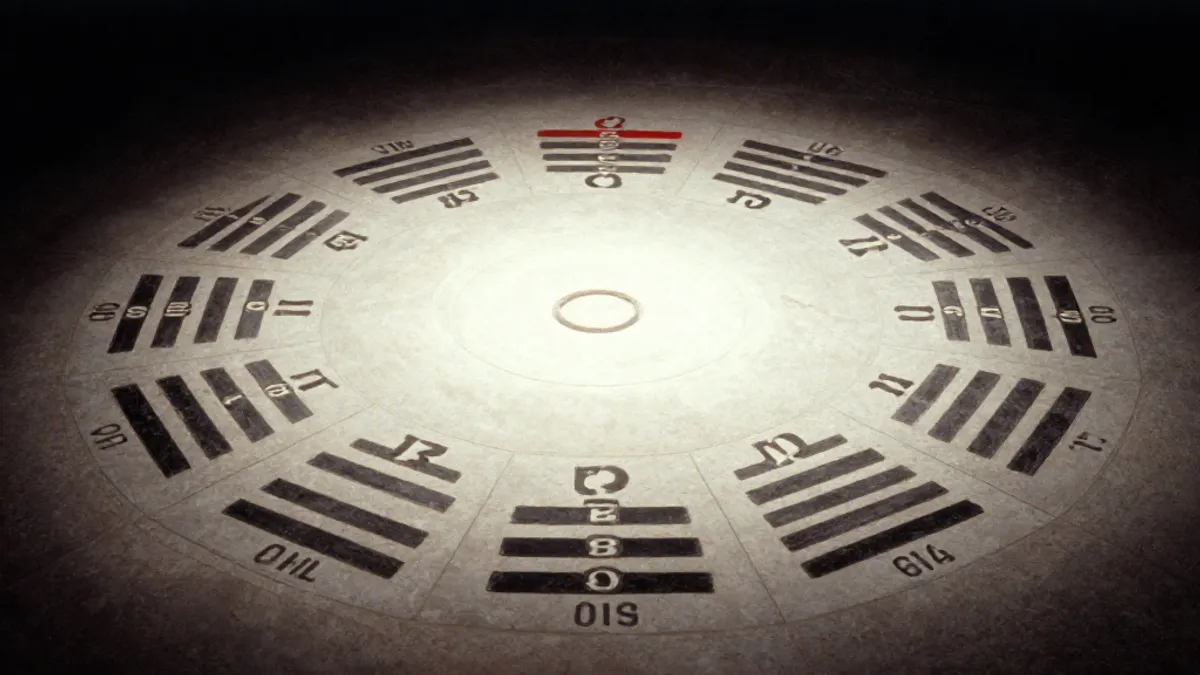
Among the most elegant structures in the hexagram-body system is the cycle of the twelve sovereign hexagrams — shí'èr pìguà (十二辟卦), also called the twelve tidal hexagrams, or the twelve xiāo xī guà (消息卦, "waxing and waning hexagrams").
These twelve hexagrams trace the annual rhythm of yang and yin through the twelve months. Each hexagram has six lines, and the cycle shows yang growing from zero lines to six, then yin growing from zero to six, in a perfect wave:
- Fu 復 (11th month, winter solstice) — one yang at the bottom, five yin above. The return. The first stirring of light in deepest darkness.
- Lin 臨 (12th month) — two yang rising, four yin above. Approach. Yang gains strength.
- Tai 泰 (1st month, spring) — three yang below, three yin above. Peace. Heaven and earth in perfect harmony, the balance point.
- Dazhuang 大壯 (2nd month) — four yang, two yin. Great power. Yang dominates.
- Guai 夬 (3rd month) — five yang, one yin. Breakthrough. Nearly pure yang, the last yin about to be resolved.
- Qian 乾 (4th month, summer solstice) — six yang. Pure heaven. The apex.
- Gou 姤 (5th month) — one yin enters at the bottom, five yang above. Encounter. The first shadow in full light.
- Dun 遯 (6th month) — two yin, four yang. Retreat. Yang begins to withdraw.
- Pi 否 (7th month, autumn) — three yin below, three yang above. Stagnation. Heaven and earth do not communicate. The anti-Tai.
- Guan 觀 (8th month) — four yin, two yang. Contemplation. Yin deepens.
- Bo 剝 (9th month) — five yin, one yang. Splitting apart. The last yang about to be consumed.
- Kun 坤 (10th month, winter) — six yin. Pure earth. The nadir.
Read this list slowly and feel the tide. One yang appears in the depths of winter and grows, line by line, until it fills the entire hexagram at the summer peak. Then one yin appears and grows, consuming the yang line by line, until pure yin holds the winter dark. Then the cycle turns again. Fu — return — the yang stirs once more.
The neidan practitioners mapped this annual tide onto the body. Yang rising up the spine along the Du Mai (督脈, governing vessel) follows the ascending arc from Fu to Qian. Yin descending down the front along the Ren Mai (任脈, conception vessel) follows the descending arc from Gou to Kun. The microcosmic orbit — that circulation of energy up the back and down the front — is, in hexagram terms, one complete passage through the twelve sovereign hexagrams.
At the tailbone: Fu. One yang returns. The first warmth stirring at the base of the spine.
At the heart center: Tai. Three yang, three yin. Balance. Heaven and earth in communion.
At the crown: Qian. Pure yang. The apex of the ascending current.
At the throat, descending: Gou. The first yin enters. The energy begins its downward return.
At the belly: Pi. Three yin, three yang. The descent's midpoint.
At the lower dantian: Kun. Pure yin. Rest. Gathering. Preparing for the next cycle.
This is not a diagram imposed on the body. It is a description of what sustained meditators actually feel: the tidal pulse of energy rising and falling, waxing and waning, in rhythms that mirror the year, the day, the breath.
The Firing Schedule
The timing of meditative attention — when to apply effort, when to release, when to do nothing at all — is what the tradition calls the huǒhòu (火候), the "firing schedule." The term comes from external alchemy, where it referred to the precise control of the furnace flame during mineral refinement. In neidan, the furnace is the body and the flame is intention.
The firing schedule is mapped to the hexagram phases.
Wǔhuǒ (武火, "martial fire") — strong, focused attention applied during the ascending phase, when yang is building. This corresponds to the rising arc of the twelve sovereign hexagrams, from Fu through Tai toward Qian. When qi is gathering at the lower dantian and beginning its ascent up the spine, the practitioner applies firm intention, actively guiding the energy upward through the three gates. This is effortful, concentrated, purposeful.
Wénhuǒ (文火, "civil fire") — gentle, soft attention applied during the descending phase. This corresponds to the waning arc from Gou through Pi toward Kun. As energy descends the front of the body, the practitioner relaxes intention, allowing the qi to settle downward under its own weight. The attention is present but not directive, like watching rain fall rather than pushing it.
Wúwéi huǒ (無為火, "non-action fire") — the cessation of intentional control entirely. This is the most advanced stage, corresponding to the moments when the practitioner stops managing the process and lets it run itself. The Cantong Qi insists that this is not laziness or negligence. It is the recognition that the body's alchemical intelligence, once properly activated, is wiser than the conscious mind. The meditator becomes an observer of a process that no longer needs a driver.
The firing schedule is not a recipe. It is a responsiveness — a capacity to read the body's signals and match the quality of attention to what the energy is doing in each moment. Too much martial fire during the descending phase causes headaches and agitation. Too much civil fire during the ascending phase lets the energy dissipate before it reaches the gates. The practitioner learns the timing the way a musician learns tempo: not from a metronome but from listening.
火候全憑呼吸量。
The firing schedule depends entirely on the measure of the breath.
- Alchemical proverb
Zhang Boduan and Awakening to Reality
The hexagram-body mapping reached its most sophisticated literary expression in the Wuzhen Pian (悟真篇, "Awakening to Reality"), composed by Zhang Boduan (張伯端, 984–1082) during the Northern Song dynasty.
Zhang Boduan was a government official who, after a series of personal catastrophes, abandoned his career and devoted himself to alchemical practice. His Wuzhen Pian is a collection of poems — eighty-one verses in regulated verse form, sixteen in other meters — that encode the complete neidan process in hexagram imagery of extraordinary density and beauty.
Where the Cantong Qi is prose and obscurity, the Wuzhen Pian is verse and compression. Zhang Boduan wrote as a poet who happened to be an alchemist, and his lines carry a music that the technical treatises lack.
先把乾坤為鼎器,次將烏兔藥來烹。 既驅二物歸黃道,爭得金丹不解生。
First take Qian and Kun as your cauldron and vessel, Then cook the Crow and Hare as your medicine. Once you drive these two along the Yellow Path, How could the golden elixir fail to come to life?
- Zhang Boduan, Wuzhen Pian
The "Crow" is the sun — Li, fire, the heart. The "Hare" is the moon — Kan, water, the kidneys. The "Yellow Path" (huángdào, 黃道) is the middle course, the central channel where Kan and Li meet and exchange their hidden essences. The "cauldron" is the body itself, configured as Qian above and Kun below — or rather, as the body that will be Qian and Kun once the alchemical work of restoring the pre-natal state is complete.
Every image in the verse is simultaneously cosmological, alchemical, and somatic. The poem describes the structure of the universe, the process of making an elixir, and the felt experience of sitting in meditation while energy rises and settles along the spine. This triple register is the Wuzhen Pian's signature achievement, and it is why the text has been continuously studied for nearly a thousand years.
Zhang Boduan also insisted, with an urgency unusual in alchemical literature, that the practice should not be delayed:
一粒金丹吞入腹,始知我命不由天。
One grain of the golden elixir swallowed into the belly — Only then do you know that your fate is not in heaven's hands.
The hexagram body is not a concept to be admired from a distance. It is a practice to be entered.
Three Dantian, Three Positions
The three-dantian system and the hexagram structure align with an elegance that suggests neither was designed in isolation from the other.
The lower dantian — seat of jing, located in the lower abdomen — corresponds to the lower trigram position: lines one, two, and three. In the post-natal body, its resident trigram is Kan (☵): outwardly still, inwardly warm, the kidneys cradling their hidden yang. The lower dantian is the foundation of the hexagram, the ground from which all lines are counted. When this center is strong and full, the entire hexagram has stability.
The upper dantian — seat of shen, located between and behind the eyes — corresponds to the upper trigram position: lines four, five, and six. Its resident trigram is Li (☲): outwardly bright, inwardly receptive, the heart-mind illuminating and clinging. The upper dantian is the hexagram's culmination, the place where energy reaches its most refined expression. When shen is gathered and clear, the upper trigram shines.
The middle dantian — seat of qi, located at the heart center — is the place where the two trigrams meet. It is the junction, the hinge, the point at which the lower trigram's energy becomes the upper trigram's awareness. In hexagram mechanics, the boundary between lines three and four — the boundary between the inner and outer trigrams — is the most dynamic zone. It is where the hexagram's meaning crystallizes, where the relationship between lower and upper conditions becomes legible.
The middle dantian, then, is not simply a third center alongside the other two. It is the relationship between them. It is the space where Kan and Li encounter each other, where the yang rising from below meets the yin descending from above, where the alchemical exchange takes place. In practice, the chest center often becomes the site of the most intense sensations during deep meditation: heat, pressure, expansion, emotional release. These are not problems. They are signs that the trigrams are interacting.
A Practice: Reading Your Own Hexagram
Set aside the maps and the theory for a moment. Sit.
Find your posture — spine upright, hands resting, breath natural. Close your eyes or soften your gaze. Let the body settle for several minutes before you begin any inquiry.
Now, without trying to change anything, notice the lower body. The belly, the lower back, the kidneys, the pelvic floor. What quality of energy is there? Is it warm or cool? Dense or diffuse? Stirring or still? You do not need to name a trigram. Just notice the quality of the lower three lines.
Then, with the same gentle attention, notice the upper body. The chest, the throat, the space behind the eyes, the crown of the head. What is happening there? Is it bright or dim? Spacious or contracted? Busy or quiet? Notice the quality of the upper three lines.
Now notice the relationship between them. Is there a connection — a current, a warmth, a thread of awareness linking below and above? Or does it feel like two separate regions, each doing its own thing? The quality of this connection — or its absence — is the hexagram's central meaning in this moment.
You do not need to identify which of the sixty-four hexagrams you are sitting in. That kind of precision comes, if it comes at all, after years of practice and study. What matters now is simpler and more direct: you are learning to read the body in the body's own language. You are noticing that energy has qualities — that it rises and falls, gathers and disperses, warms and cools — and that these qualities correspond to something real, something the ancient tradition mapped with extraordinary care.
Sit with this for ten minutes. Then let it go.
The Body's Own Language
The hexagram is not a symbol applied to the body from outside. It is the body's own language for describing what it is doing.
When the alchemists mapped Kan to the kidneys and Li to the heart, they were not constructing an analogy. They were reporting a correspondence so intimate that the distinction between map and territory dissolves. The kidneys are Kan — outwardly still, inwardly warm, holding a hidden fire that sustains life. The heart is Li — outwardly radiant, inwardly receptive, its brightness depending on something it cannot generate for itself.
This is what sets the hexagram body maps apart from other systems of subtle anatomy. They are not simply a grid overlaid on the body for convenience. They are a description of the body as a dynamic process — a process of constant change, of lines shifting, of trigrams interacting, of energy waxing and waning in tidal rhythms that mirror the year, the day, the breath, and the span of a life.
The practitioner who sits long enough begins to feel this directly. Not as an idea, but as an event in the body. The yang stirs at the base of the spine. The yin settles in the chest. The tidal hexagrams turn through their cycle, not because the meditator is visualizing them, but because the body has always been doing this — rising and falling, gathering and releasing, changing line by line.
六爻之動,三極之道也。
The movement of the six lines embodies the Dao of the three ultimates.
- Xici Zhuan (繫辭傳)
The three ultimates: heaven, earth, and the human between them. The six lines: two for each realm. The body, sitting in stillness, containing all three — root and crown and the living space between, arranged as a hexagram that never stops changing, and never needs to.